
News / Ball Python Breeding Season Planning | THE RACK
Ball Python Breeding Season Planning | THE RACK
A breeding season without a plan is a season full of surprises. And in this industry, surprises cost money. The breeders who run profitable programs year after year are not winging it. They are mapping projects, selecting pairings with intention, and setting production goals before the first lock.
Why Breeding Season Planning Changes Everything
Most breeders start their season the same way: look at what animals are available, pair up what makes sense, and hope for good odds. It works when you have five or ten animals. It falls apart when you are running a real program.
Planning your breeding season means deciding before the season starts what you want to produce, who you are producing it for, and how many clutches your facility can realistically handle. It is the difference between running a business and running a hobby.
A solid season plan answers three questions:
- What does the market want? Producing animals nobody is buying is the fastest way to eat into your margins. Look at what is selling on MorphMarket, pay attention to expo demand, and build projects around proven sellers.
- What does your collection support? Your holdbacks, your purchased breeders, and your available genetics determine what is possible. Know your inventory before you commit to projects.
- What can your facility handle? Incubator space, tub availability, feeding capacity, and your own time are all finite. Overproduction leads to stressed animals and stressed breeders.
The Business Case
Breeders who plan their season around market demand and facility capacity produce fewer animals they cannot sell and spend less time managing overflow.
Step 1: Define Your Projects
A project is not a single pairing. A project is a goal with a genetic outcome. If your goal is to produce visual Piebalds, the project includes every pairing contributing to Pied production this season, including het x het locks, holdback decisions from last year, and backup males if your primary breeder is not performing.
Start by listing every project you want to run. For each one, write down:
- The target morph or combo
- Which animals are involved
- Expected odds per clutch
- Number of clutches needed to hit your production target
- Market demand for the offspring
This is where Project Planner in THE RACK becomes essential. You can map every project, assign animals to pairings, and see your entire season laid out before a single introduction happens. No spreadsheet juggling. No trying to remember which female was supposed to go with which male.
Want to map your entire season before the first lock?
Plan Every Project in One Dashboard
THE RACK's Project Planner lets you assign pairings, set production goals, and track every project from introduction to hatchlings.
See THE RACKStep 2: Build Your Pairing Schedule
Once projects are defined, the next step is timing. Not every female is ready at the same time. Not every male can service multiple females back to back without recovery time. A pairing schedule accounts for:
- Female readiness: Weight, age, and cycling status. A female who is not at breeding weight is not a candidate, no matter how good the pairing looks on paper.
- Male rotation: If you are using one male across multiple females, space introductions out. A male locked up with three females in the same week is not performing at his best for any of them.
- Seasonal timing: Some breeders use a cooling period to trigger reproductive behavior. Others breed without it. Either way, your introduction schedule should work backward from your target hatch dates. If you cool, your first pairings follow the warm-up. If you do not cool, your pairing window is driven by female readiness and the season you want your hatchlings to land in.
The breeding pipeline in THE RACK tracks every pairing from introduction through ovulation, pre-lay shed, lay date, and hatching. You can see which females are on schedule, which are behind, and which males need rotation.
Avoiding Overcommitment
One of the biggest mistakes in season planning is committing more pairings than your facility can support. Every clutch needs incubator space for 55 to 60 days. Every hatchling needs a tub, a first meal attempt, and monitoring. If you are running 20 pairings and 15 of them produce, you need space for 60 to 90 hatchlings. Do you have it?
Build your pairing count around your post-hatch capacity, not your pre-season ambition.
A breeding season is a business quarter. Plan it like one.
Step 3: Set Production Goals
Production goals are not about hatching as many animals as possible. They are about hatching the right animals in the right quantities. Ask yourself:
- How many animals can I sell in a season? Look at last year. How many did you sell? How long did they sit? If animals from last season are still available, you produced too many or priced too high.
- What is my holdback plan? Every clutch produces potential holdbacks. Decide before the season which outcomes you will keep and which go straight to your sales pipeline.
- What is my break-even per clutch? Factor in the cost of feeders, electricity, substrate, and your time. If a clutch of normals costs you more to produce and raise than you will sell them for, the pairing does not belong in your plan.
Matching Production to Market Demand
The ball python market shifts every year. What sold fast two seasons ago might sit on MorphMarket for months now. Before locking in your projects, spend time looking at current listings, recent sales data, and expo trends.
High-demand combos with limited supply are where the margin lives. Producing ten visual Pinstripes when there are already hundreds listed is a different business decision than producing three Clown Piebalds from a proven pair.
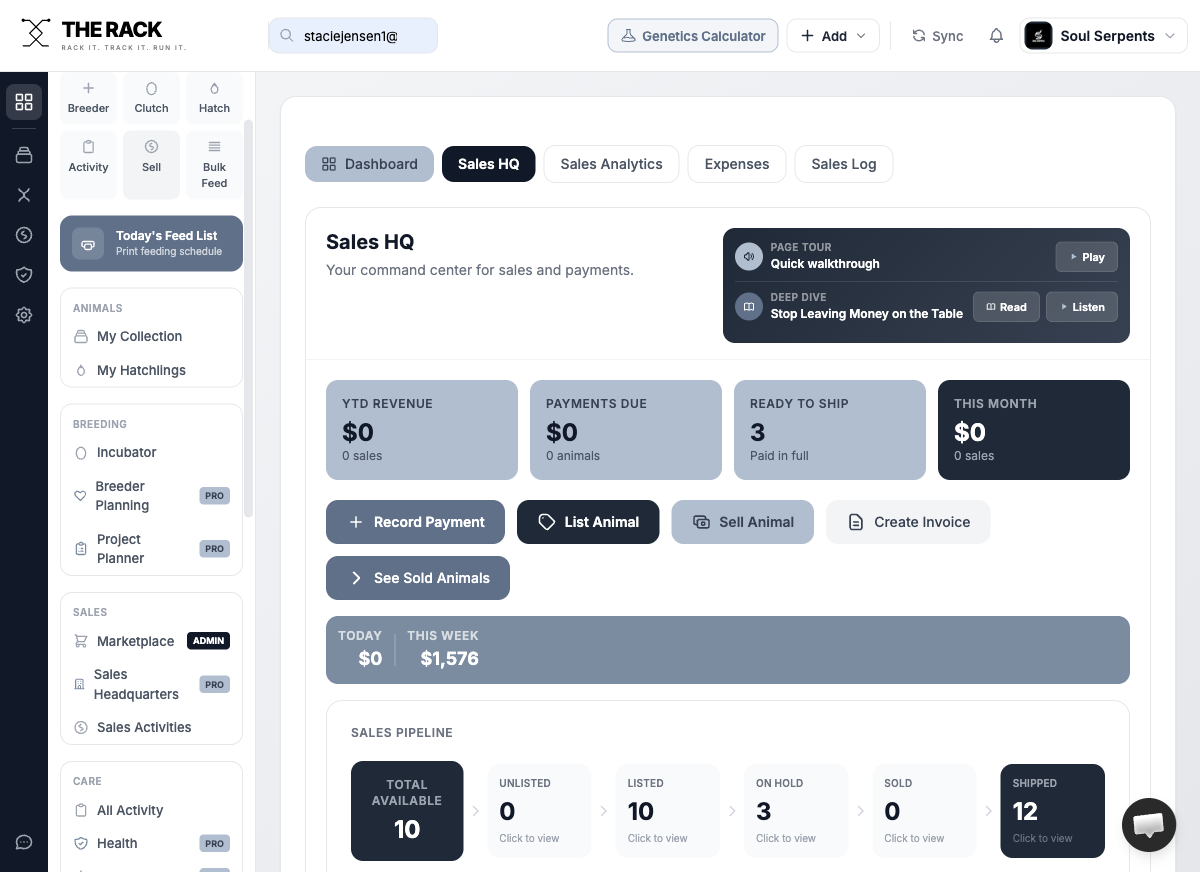
Want this exact planning system for your breeding program?
Map Your Season. Track Every Project.
THE RACK gives you a full project planner, breeding pipeline, and sales tracking so every pairing has a purpose and every hatchling has a plan.
See How It WorksStep 4: Track and Adjust Through the Season
No season goes exactly according to plan. Females refuse males. Clutches come in smaller than expected. A surprise double clutch throws your incubator schedule off. The plan is not a rigid document. It is a framework you adjust as real data comes in.
The breeders who stay profitable are the ones tracking results against their plan in real time. When a pairing fails, they know immediately and can reassign the male. When a clutch exceeds expectations, they update their sales projections and adjust pricing.
This is facility management software at work. Not a notebook. Not a spreadsheet you update once a month. A living system you reference daily throughout the season.
Season Planning Checklist
Define projects. Assign pairings. Set production targets. Build your schedule around facility capacity. Track results and adjust weekly.
Planning Is the Competitive Advantage
The breeders who treat their season like a business operation, with defined projects, clear timelines, and realistic production goals, are the ones who move animals consistently and build a reputation buyers trust. They are not scrambling to figure out what they produced. They know what is coming, who it is for, and when it will be ready.
Breeding season planning is not extra work. It is the work. And it is what separates a program from a collection.
Built by a Breeder
Plan Your Season.
Run Your Program.
Project planner. Breeding pipeline. Sales tracking. Weight trends. All in one place.
See THE RACKFree for up to 5 animals. Keeper $10/mo. Breeder $20/mo. 7-day money-back guarantee.