
News / Ball Python Breeding Records: What Every Breede...
Ball Python Breeding Records: What Every Breeder Must Track
- The difference between two breeders with identical genetics is often records, not skill. Documentation determines whether you prove out hets or waste a season.
- Every animal needs a core identity record: unique ID, confirmed sex, full genetics, acquisition source, and lineage at least two generations deep.
- Breeding-specific records compound fast: pairing attempts, reproductive events, clutch data, hatchling records, and het verification all need to link together.
- The records most breeders skip; feed costs per animal, days on market, sale prices tied to genetics; are the ones separating breeding programs from breeding hobbies.
A breeder pairs two siblings from a het Pied project. It is an intentional decision; both animals are confirmed 66% possible het, and pairing them gives the best probability of proving it out in one generation. The clutch drops. Three Pieds. Project proved. He lists the holdbacks with full lineage documentation, and buyers pay a premium because they can see what is behind each animal.
Down the road, another breeder has the same two animals. Same genetics. Same potential. But he does not know they are siblings. He does not know either parent was het anything. He pairs them to a completely unrelated animal instead, and the project gets pushed back another year instead of proving out this season. Or worse; he sells them separately with no lineage data, and two buyers end up with animals they cannot make informed decisions about.
The difference between these two breeders is not skill. It is records.
In ball pythons, pairing related animals is a standard and widely used breeding strategy. It is not the same conversation as inbreeding in mammals. Ball pythons do not carry the same density of deleterious recessive alleles mammals carry. Decades of captive breeding with sibling and parent-to-offspring pairings have produced healthy, thriving animals. The genetic load is different. Breeders who pair siblings are doing so with a clear goal: proving out heterozygous genetics, locking in a visual combination, or building a multi-generational project line.
On the other side, plenty of experienced breeders prefer outcrossing whenever possible. Introducing unrelated bloodlines can strengthen feeding response, increase clutch size across time, and build a broader genetic foundation. Neither approach is more professional than the other. They reflect different priorities and different project goals. The breeders who get into trouble are not the ones choosing one strategy across the other. They are the ones making pairings without knowing the lineage behind their animals at all.
Good breeding is intentional breeding, and intentional breeding requires knowing what is behind every animal in the pairing.
The Non-Negotiable Records
Before breeding strategy, before genetics projects, before sales; there is a baseline. Every animal in your facility needs a core identity record. No exceptions, no "I will add it later."
Animal Identity
- Unique ID. Not a name. A system-level identifier you can reference in pairing logs, sale records, and lineage chains without ambiguity.
- Sex. Confirmed method and date of confirmation. Probed, popped, or visual; it matters when questions come up later.
- Genetics. Full morph and het profile. Include "possible hets" with clear notation so you never accidentally sell an unproven het as confirmed.
- Acquisition source. Who you got the animal from, when, and what documentation came with it. This is your chain of custody.
- Date acquired or hatched. Age is a health metric, a breeding readiness metric, and a sales data point all in one.
Lineage
- Sire and dam. Linked to their own records, not written as a name on a notecard.
- Generation depth. At minimum two generations back. Three is better. Buyers doing long-term projects will ask.
- Sibling groups. Knowing which animals share parents lets you make intentional decisions about related pairings; whether you are proving out hets or avoiding inbreeding depression in a tight line.
Weight History
- Regular weigh-ins. Monthly at minimum. Weekly during breeding season.
- Growth trends across time. A single weight means nothing. A trendline tells you if an animal is thriving, stalling, or declining.
- Breeding readiness indicators. Weight thresholds for females before pairing. Recovery weight for males between pairings.
Feeding Log
- Meal dates and prey size. Not "fed regularly." Dates. Sizes. Documented.
- Refusals. A single skipped meal is nothing. A pattern of refusals is a diagnostic signal for health, husbandry, or breeding behavior.
- Prey type transitions. Tracking when you switch from live to frozen-thawed, or size up from small rats to mediums, gives you feeding protocol history for each animal.
The Standard
If you cannot pull up an animal's full identity, lineage, weight history, and feeding log in under 60 seconds, your record system is costing you time on every decision you make.
Breeding-Specific Records
Once breeding season starts, the data requirements compound fast. A feeding log is one entry per week. Breeding records are dozens of data points per pairing, per female, per clutch, all connected.
Pairing Attempts and Results
- Date paired. Which male, which female, what time introduced.
- Observed behavior. Locks confirmed or not. Duration if possible.
- Number of introductions. Some pairings take one night. Some take weeks of cycling. The record should reflect the effort.
- Outcome. Did the pairing produce? If not, was the issue the male, the female, or timing?
Reproductive Events
- Follicle development. Dates when building was first observed.
- Ovulation date. Confirmed or estimated. This is the anchor for your entire incubation timeline.
- Pre-lay shed date. The countdown to egg laying starts here. Miss it and you miss the lay box window.
- Lay date. Eggs on substrate vs. in the box. Condition of the female post-lay.
Clutch Data
- Total egg count. Good eggs vs. slugs.
- Fertility rate. Tracked per female and per male across seasons. Patterns show up fast when the data is clean.
- Incubation conditions. Temperature, humidity, substrate. When something goes wrong mid-incubation, you need to know what the conditions were, not guess.
Hatchling Records
- Linked to parents. Every hatchling record should trace back to the sire and dam with a single lookup.
- Hatch date and weight. First feeding date. First shed. These early data points set the baseline for the animal's entire life in your facility or someone else's.
- Morph identification. Documented at hatch with photos. Morphs can look different at different ages. The hatch photo is the reference point.
Het Verification
- Clutch results are the proof. When a pairing produces a visual recessive, every sibling in the clutch is confirmed 66% possible het at minimum. Without linking clutch data back to the parents and the pairing record, you lose the verification.
- Proven hets sell for significantly more than possible hets. The difference between a possible het and a proven het is documentation. The animal is the same. The records are what change the price.
- Project planning depends on verified genetics. If you are building a three-generation project, every unverified het is a gamble with the power to cost you an entire season. Accurate clutch records tied to lineage eliminate the guesswork.
Your records are the business. Everything else is built on top of them.
The Records Most Breeders Skip
Everything above is the operational minimum. The records below are where breeding programs separate from breeding hobbies. Most breeders do not track these. And most breeders cannot tell you whether their program made or lost money last season.
Feed Costs Per Animal
You know what you spent on rodents last month. But do you know the annual feed cost per animal? Per rack? Per project group? When you are deciding whether to hold back or sell, the carrying cost of an animal is critical information. Without the numbers, you are guessing.
Days on Market Per Sale
How long does it take to move a Pastel het Clown versus a normal? If you are not tracking days listed to days sold, you do not know which morphs move and which sit. Animals sitting on the market are animals eating into your margin every single week.
Sale Prices Tied to Genetics and Lineage
You sold a Banana Pied female for a strong price last season. But was it the genetics, the lineage, the photos, or the time of year? When sale records link back to the parents, the morph, and the listing date, you start seeing pricing patterns. You learn what buyers will pay a premium for. You learn what to produce more of.
Male Workload and Recovery
Males get treated like utilities. Pair him, move him, pair him again. But male fertility drops when they are overworked and under-recovered. Tracking how many females each male services, the spacing between pairings, and his weight through the season tells you whether he is being managed well or run into the ground. A tired male means slugs. Slugs mean a wasted season for the female too.
The Business Records
Feed costs. Time on market. Sale price history. Male workload. These are the records turning a breeding program into a breeding business.
What Works, What Breaks, and When
Every breeder starts with a system. The question is whether it scales with the program.
Notebooks
The classic. Handwritten entries, one page per animal or per rack. Notebooks work when you have a small number of animals and a simple program. You can flip to a page, find what you need, and move on. But notebooks have no search function. They cannot cross-reference a sire's clutch history with a dam's weight trend. They get water damaged, lost, or left at the wrong location. And when you need to pull lineage data for a buyer while standing at an expo, you are flipping through pages instead of pulling up a record.
Notebooks do not fail because they are bad. They fail because programs grow faster than paper can keep up.
Spreadsheets
The upgrade. Columns for everything. Tabs for feeding, breeding, sales, lineage. Formulas to calculate fertility rates and feed costs. Spreadsheets are powerful. For breeders comfortable with them, they can hold a lot of data.
The problems are structural. A deleted tab wipes a season of records. A broken formula gives you wrong fertility numbers you do not notice until tax season. Spreadsheets do not link records the way breeding data needs to be linked. You cannot click a hatchling and see its parents, their clutch history, and their lineage in one view. You build workarounds until the workarounds need their own workarounds.
Spreadsheets do not fail because breeders use them wrong. They fail because they were not designed for this kind of relational data.
Purpose-Built Software
Software designed for breeding program management solves the structural problems. Records link to each other. A hatchling connects to its parents. A clutch connects to the pairing record, the ovulation date, and the incubation log. Weight trends display across time without building a chart from scratch. Lineage goes back as many generations as you have data for.
The difference is not about features on a checklist. It is about how the data connects. Breeding programs generate relational data. Parents produce offspring. Offspring have genetics inherited from those parents. Pairings produce clutches. Clutches produce hatchlings. Sales connect to animals. Animals connect to lineage. When the system understands those relationships, every record becomes more useful.
The right question is not "what can it track?" The right question is "does it understand how breeding data connects?"
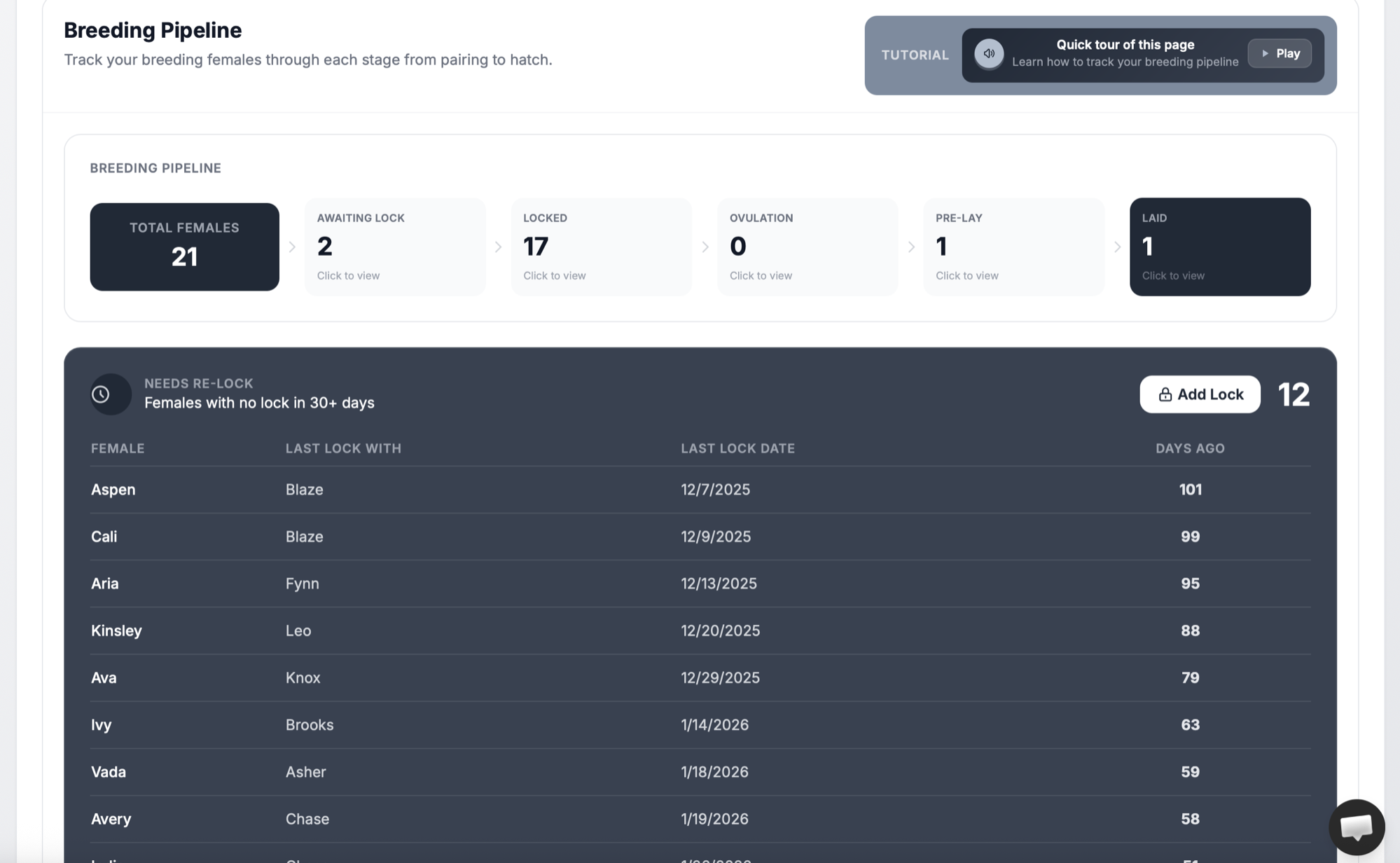
Want this exact system for your breeding records?
Lineage, pairings, clutch data, and health. One system.
THE RACK links the data the way your program links the animals. Click a hatchling, see its parents. Click a pairing, see the clutch history. No spreadsheet engineering required.
See THE RACKRecords Are the Business
Here is the truth no one wants to hear. You can lose animals to illness and recover. You can have a bad breeding season and come back. You can miss an expo and catch the next one. But if you lose your records, you lose the ability to prove lineage, verify genetics, track health history, and make informed decisions about every animal in your facility. You are starting across with living animals and no documentation. It is the one loss a breeding program cannot bounce back from quickly.
Your records are not a chore you do after the real work. They are the real work. They protect your reputation. They protect your buyers. They protect the animals. And they protect the years of selective breeding decisions you have already made.
The system you use to keep those records should respect the complexity of what you are doing. It should connect the data the way your program connects the animals. And it should not require you to become a spreadsheet engineer to use it.
Built by a Breeder
Every record in this post.
One system.
Lineage tracking across generations. Breeding and pairing logs. Clutch records linked to parents. A project planner mapping your genetic goals season by season. Suggested pairings surfacing the best combinations in your collection. THE RACK was built for breeders who take their records seriously.
See THE RACKFree for up to 5 animals. Keeper $10/mo. Breeder $20/mo. 7-day money-back guarantee.