
News / Ball Python Care Guide: Everything You Need to ...
Ball Python Care Guide: Everything You Need to Know (2026)
- Ball pythons need a thermal gradient (88-92F hot side, 76-80F cool side) and 55-70% humidity as non-negotiable baselines.
- Every heat source must be on a thermostat. No exceptions. Unregulated heat kills.
- Feed frozen/thawed rodents sized at 10-15% of body weight. Frequency decreases as the snake grows.
- A healthy ball python can live 20 to 30 years with consistent husbandry and proper enclosure setup.
Ball pythons are one of the most popular pet snakes in the world, and for good reason. They stay a manageable size, tolerate handling well, and come in hundreds of color and pattern variations called morphs. But keeping one healthy for 20 to 30 years requires more than a tank and a heat lamp. This guide covers everything you need to know about ball python care in 2026, written from the perspective of someone who keeps these animals daily.
Ball Python Overview
Natural Habitat and Behavior
Ball pythons (Python regius) are native to the grasslands and open forests of West and Central Africa. They are ground-dwelling snakes with a preference for termite mounds, rodent burrows, and other tight, enclosed spaces. In the wild, they are most active at dawn and dusk, spending daylight hours hidden underground or beneath cover.
This behavior translates directly to captive care. Ball pythons need tight hides, consistent warmth, and a predictable day-night cycle. They are ambush predators by nature. Slow, deliberate, and most comfortable when they feel secure. Understanding this instinct is the foundation for getting their enclosure right.
Lifespan in Captivity
A healthy ball python in a well-maintained enclosure can live 20 to 30 years. Some have been documented past 40. This is a long-term commitment. The snake you bring home today will still be in your care when the next decade rolls around. Good husbandry from day one is the single biggest factor in reaching the upper end of the lifespan range.
Temperament and Personality
Ball pythons earned their common name from their defensive habit of curling into a tight ball with their head tucked inside. They are not aggressive snakes. Most tolerate regular handling without issue, and many become visibly comfortable being held. Individual personalities vary; some are bold explorers from day one, while others need weeks to settle in before they relax outside the enclosure.
Quick Stats
Adult size: 3-5 feet. Lifespan: 20-30+ years. Temperament: Docile, handleable. Activity: Crepuscular (dawn and dusk). Diet: Rodents (frozen/thawed recommended).
Enclosure Setup
Enclosure Size by Age
Enclosure size should scale with the snake. Hatchlings do well in smaller spaces where they feel secure, while adults need room to stretch and thermoregulate. Here are the general guidelines most experienced keepers follow:
- Hatchlings (under 300g): 10-20 gallon equivalent or 24"x12"x12" tub. Small enough for the snake to feel secure while establishing feeding habits.
- Juveniles (300g-800g): 30-40 gallon equivalent or 36"x18"x12". Enough room for a warm side, cool side, and proper gradient.
- Adults (800g+): 40 gallon minimum, or 48"x24"x12" and larger. A 4'x2'x2' PVC enclosure is the gold standard for adult ball pythons.
Bigger is fine as long as the enclosure has enough cover. The old advice about large enclosures stressing out ball pythons is outdated. The real issue is empty space without hides or clutter. Fill the enclosure properly and the snake will use every inch of it.
Glass vs. PVC vs. Tub
Each enclosure type has tradeoffs:
- Glass tanks: Easy to find, good visibility, but difficult to hold humidity. Screen tops lose heat and moisture rapidly. Workable with modifications (covering part of the screen, adding damp substrate) but not ideal long-term.
- PVC enclosures: The preferred choice for most serious keepers. They retain heat and humidity efficiently, stack well, and come in purpose-built sizes for ball pythons. Higher upfront cost, but worth the investment.
- Tubs: Affordable, excellent humidity retention, easy to clean, and widely used by breeders. Less visibility, but ball pythons do not care about the view. A well-set-up tub keeps parameters stable with minimal effort.
Substrate Options
Substrate controls humidity, absorbs waste, and gives the snake a natural surface to move across. Good options include:
- Coconut fiber (coco husk): Holds humidity well, easy to spot clean, widely available.
- Cypress mulch: Excellent moisture retention, natural appearance, resists mold when kept clean.
- Paper towels or newspaper: Easy to clean, best for quarantine or monitoring health. No humidity benefits.
Avoid: Cedar and pine shavings (toxic oils), sand (impaction risk), and anything with added fragrance or chemicals.
Hides
Every ball python enclosure needs two hides minimum: one on the warm side and one on the cool side. The snake should be able to choose its temperature without sacrificing security. Each hide should be snug. The snake should touch the walls and top when coiled inside. An oversized hide is the same as no hide at all.
A humid hide (a third hide with damp sphagnum moss) is valuable during shedding and in drier environments. Some keepers keep one available full-time.
Water Bowl Size and Placement
The water bowl should be large enough for the snake to soak in if it chooses, but it does not need to be massive. Place it on the cool side to reduce evaporation rate. Change the water every one to two days, or immediately if soiled. A heavy ceramic bowl prevents tipping.
Enrichment and Climbing Opportunities
Ball pythons are not arboreal, but they will climb branches, ledges, and cork bark when given the opportunity. Adding vertical elements and clutter (fake plants, cork tubes, branches) reduces stress, encourages natural movement, and gives the snake more options for thermoregulation. A bare enclosure with two hides and a water bowl is the minimum. Most experienced keepers add more.
Good husbandry is not complicated. It is consistent.
Temperature Requirements
Hot Side, Cool Side, and Ambient Temps
Ball pythons are ectotherms. They rely entirely on their environment to regulate body temperature. A proper thermal gradient gives the snake the ability to move between warmer and cooler zones throughout the day.
- Hot side (basking surface): 88-92F
- Cool side: 76-80F
- Ambient (middle of enclosure): 82-86F
Measure temperatures with a digital thermometer or infrared temp gun. Stick-on dial thermometers are unreliable and should not be trusted for accurate readings.
Heating Methods
Multiple heating options work for ball pythons. The best choice depends on your enclosure type:
- Heat mats (UTH): Common for tubs and smaller enclosures. Provide belly heat through the floor. Must be used with a thermostat.
- Radiant heat panels (RHP): Mounted on the ceiling of PVC enclosures. Provide even overhead heat and are the go-to choice for most PVC setups.
- Ceramic heat emitters (CHE): Screw into a standard dome fixture. No light output. Good for supplementing ambient heat, especially on glass tanks.
- Deep heat projectors (DHP): Produce infrared-A and infrared-B wavelengths similar to sunlight. No visible light. A strong option for overhead heating in any enclosure.
Thermostats: Non-Negotiable
Every heat source connected to a ball python enclosure must be on a thermostat. No exceptions. An unregulated heat mat can reach surface temperatures above 150F. A CHE without a thermostat will cook the air inside a closed enclosure. Thermostats prevent burns, overheating, and thermal runaway. A proportional or dimming thermostat provides the most stable control.
Night Temperature Drops
A small temperature drop at night (5-8F on the hot side) is natural and fine. Ball pythons experience cooler nighttime temperatures in the wild. Many keepers set their thermostats to lower the hot side to 82-84F overnight. Do not let the cool side dip below 72F.
Humidity Requirements
Ideal Humidity Range
Ball pythons need 55-70% humidity as a baseline, with spikes to 80% during shedding. Low humidity is the most common cause of stuck sheds, respiratory issues, and dehydration in captive ball pythons. If your humidity sits below 50% consistently, your husbandry needs adjustment before anything else.
How to Raise Humidity
- Switch to a moisture-retaining substrate (coconut fiber, cypress mulch)
- Pour water directly into a corner of the substrate to create a moisture pocket
- Cover part or all of a screen top with aluminum tape, HVAC tape, or a cut piece of acrylic
- Move to a PVC or tub enclosure if glass cannot maintain adequate levels
- Use a larger water bowl placed on the warm side temporarily (increases evaporation)
Humidity During Shedding
When your ball python enters a shed cycle (blue/opaque eyes, dull skin, reduced appetite), bump humidity to 70-80%. A humid hide with damp sphagnum moss gives the snake a microclimate for the process. A complete shed should come off in one piece. If your snake is shredding in patches, humidity was too low during the cycle.
Want feeding schedules and health alerts in one place?
Your Ball Python's Care, Managed For You
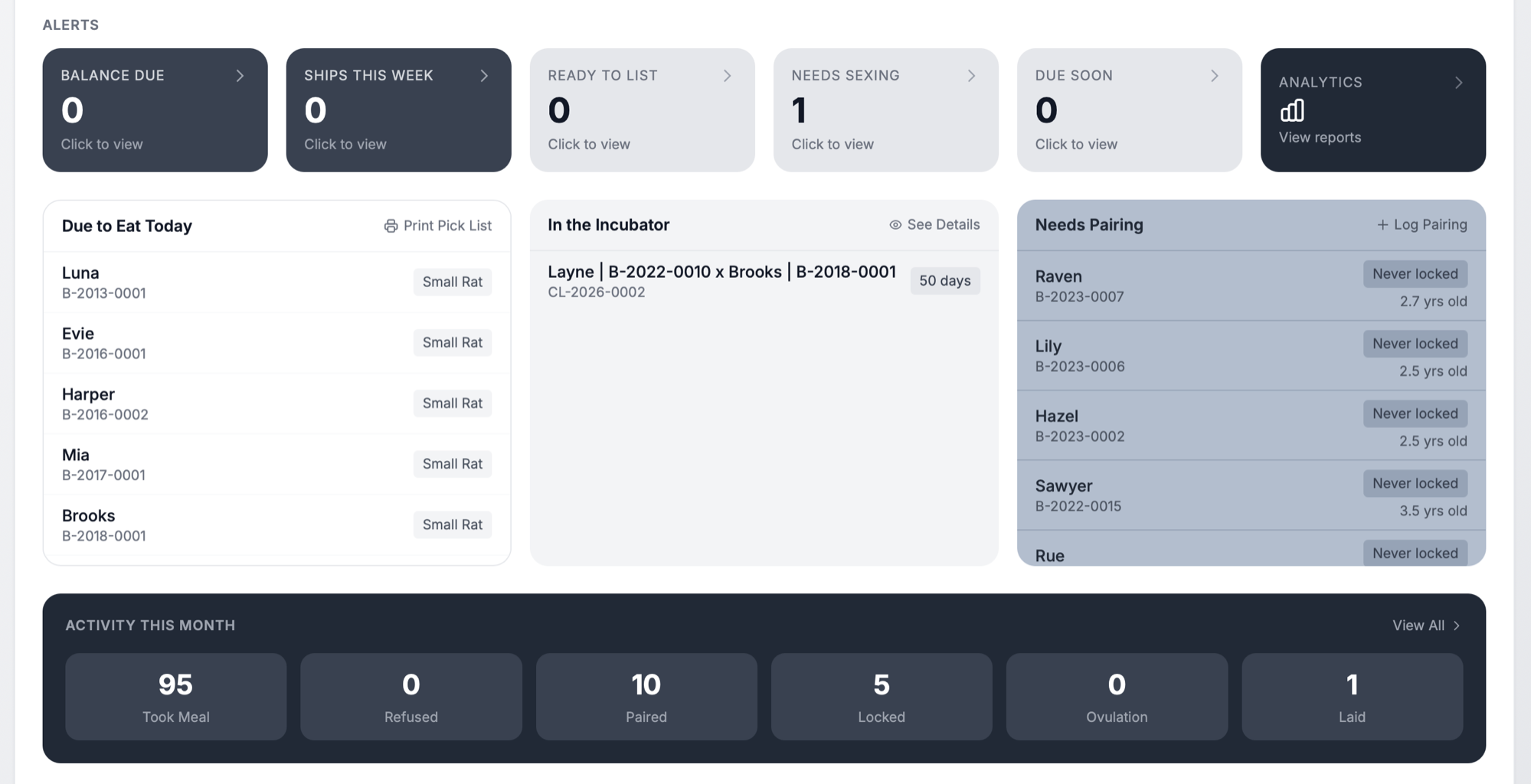
THE RACK surfaces upcoming feedings, tracks weight history, and flags animals needing attention. Built by a breeder for keepers who want one place for everything.
Get Started FreeFeeding Your Ball Python
What Ball Pythons Eat
Ball pythons are obligate carnivores feeding exclusively on rodents. In captivity, mice and rats are the standard prey items. Most keepers transition juveniles to rats as soon as the snake can handle an appropriate size, since rats scale better with the snake's growth and eliminate the need for multiple prey items per feeding.
Feeding Schedule by Age and Weight
Feeding frequency decreases as the snake grows. Here is the general schedule most experienced keepers follow:
- Hatchlings (under 200g): Every 5-7 days
- Juveniles (200g-800g): Every 7-10 days
- Sub-adults (800g-1500g): Every 10-14 days
- Adults (1500g+): Every 14-21 days
These are starting points. Adjust based on body condition, weight trends, and the individual animal's metabolism. A snake gaining too fast gets stretched out on the schedule. A slow grower gets fed more frequently. Monitoring weight trends in a facility management system tells you more than any fixed schedule.
Prey Size Guidelines
The prey item should be roughly 10-15% of the snake's body weight, or about the same width as the widest part of the snake's body. A slight visible lump after feeding is normal. If the snake looks like it swallowed a softball, the prey was too large. If there is no visible lump at all, the prey is too small to be nutritionally meaningful.
Frozen/Thawed vs. Live
Frozen/thawed is the recommended feeding method. The prey is humanely euthanized and flash-frozen, then thawed to room temperature before offering. Benefits:
- No risk of the rodent injuring the snake (live rats can bite, scratch, and cause serious wounds)
- Easier to store and manage (buy in bulk, keep in a dedicated freezer)
- Consistent availability year-round
Some ball pythons refuse frozen/thawed, especially wild-caught or long-term live-fed individuals. Transitioning takes patience. Warming the prey under hot water, drying it thoroughly, and presenting it with tongs in low light works for most animals. If your snake eats live exclusively, supervise every feeding and never leave a live rodent unattended in the enclosure.
When Your Ball Python Refuses Food
Ball pythons are notorious for going off feed. A healthy adult can refuse food for weeks or even months without health consequences. Before panicking, check:
- Temperatures: Is the hot side at 88-92F? Cold snakes will not eat.
- Humidity: Is it above 55%? Dehydrated snakes lose appetite.
- Hides: Does the snake have secure, snug hides on both sides?
- Stress: Recent move, enclosure change, or excessive handling?
- Season: Many ball pythons (especially males) go off feed during winter breeding season. This is normal and not cause for alarm.
- Shed cycle: Most snakes refuse food while in shed.
If husbandry checks out and the snake is maintaining weight, wait it out. If weight drops significantly (10% or more of body weight), consult a reptile veterinarian. For a deeper look at feeding refusal, read our guide on ball python not eating.
Handling and Socialization
When to Start Handling
Give a new ball python at least 5-7 days to settle into its enclosure before handling. Wait for it to accept its first meal in the new space. Once it is eating consistently, short handling sessions (10-15 minutes) a few times per week help the snake acclimate. Avoid handling for 48 hours after feeding to prevent regurgitation.
How to Pick Up a Ball Python Safely
Approach from the side, not from above (overhead movement mimics a predator). Slide one hand under the body at mid-length and support with the second hand. Let the snake move through your hands at its own pace. Avoid gripping or restraining. A relaxed ball python will tongue-flick and move through your hands calmly. A stressed one will ball up, hiss, or strike.
Signs of Stress to Watch For
- Curling into a tight ball and refusing to uncurl
- Hissing or striking when approached
- Rapid, jerky movements (trying to escape)
- Staying buried in substrate for days
- Refusing multiple consecutive meals
If you see consistent stress signals, reduce handling frequency, double-check husbandry parameters, and make sure the enclosure has enough cover. Most stress in captive ball pythons traces back to either incorrect temperatures, inadequate hides, or too much disturbance.
Shedding
The Shedding Process
Ball pythons shed their skin in one piece as they grow. The full cycle from the first signs of blue to a completed shed takes 7-14 days. During this time, a fluid layer develops between the old skin and the new skin underneath, giving the snake a dull, washed-out appearance and cloudy blue eyes.
Signs Your Ball Python Is About to Shed
- Blue or milky eyes: The eye caps become opaque. The snake has limited vision during this phase.
- Dull, faded coloring: The entire body looks hazy or muted.
- Reduced or no appetite: Most snakes refuse food during the shed cycle.
- Increased hiding: The snake will spend more time in its hides, especially the humid hide if one is available.
- Pink belly: The belly scales turn pinkish as the new skin develops underneath.
Dealing with Stuck Shed
If pieces of skin remain after the shed, humidity was too low. To address a stuck shed:
- Place the snake in a shallow, lukewarm water bath (1 inch deep) for 15-20 minutes
- Gently work the stuck pieces off with a damp cloth or your fingers
- Check the tail tip and eye caps. Retained eye caps and tail tip skin restrict blood flow and can cause tissue damage if left
- Raise enclosure humidity to prevent it from happening again
The Humidity Rule
55-70% baseline humidity. 70-80% during shedding. A complete shed comes off in one piece. If it does not, your humidity is the first thing to fix.
Common Health Issues
Respiratory Infections
Symptoms include open-mouth breathing, wheezing, mucus bubbles around the nostrils, and excessive saliva. RIs are almost always caused by low temperatures, high-but-stagnant humidity without ventilation, or dirty substrate. Correct the environment immediately and see a reptile vet for treatment. Left untreated, respiratory infections can become fatal.
Mites
Snake mites are tiny black or reddish-brown parasites visible on the skin, around the eyes, and in the water bowl (they drown and appear as small black specks). Treatment involves removing all substrate, treating the enclosure and the snake with a reptile-safe mite treatment, and repeating the process to break the mite life cycle. Quarantine any new animals before introducing them to your collection.
Scale Rot
Scale rot appears as discolored, blistered, or necrotic scales on the belly and lower sides. It is caused by prolonged contact with wet or dirty substrate. Treatment for mild cases involves cleaning the affected area with dilute betadine, keeping the snake on dry paper towels, and correcting the substrate conditions. Severe cases need veterinary attention.
When to See a Reptile Vet
Find a reptile vet before you need one. Not every veterinarian is qualified to treat snakes. Search for a herp vet in your area and establish the relationship ahead of time. See a vet if your ball python shows:
- Open-mouth breathing or audible wheezing
- Significant weight loss (10%+ of body weight)
- Visible wounds, blisters, or necrotic tissue
- Prolonged food refusal with visible weight loss
- Lethargy far beyond normal resting behavior
- Abnormal posture (stargazing, inability to right itself)
Supplies Checklist
Everything you need before bringing a ball python home:
- Enclosure (PVC, glass tank, or tub; sized for the snake's age)
- Heat source (heat mat, radiant heat panel, CHE, or DHP)
- Thermostat (proportional or dimming; non-negotiable)
- Digital thermometer (probe or infrared temp gun)
- Hygrometer (digital; measures humidity)
- Substrate (coconut fiber, cypress mulch, or paper towels)
- Warm side hide (snug fit)
- Cool side hide (snug fit)
- Humid hide (with sphagnum moss; optional but recommended)
- Water bowl (heavy ceramic, large enough to soak in)
- Feeding tongs (10-12 inch; stainless steel or bamboo)
- Frozen rodents (appropriate size for your snake)
- Spray bottle (for misting substrate if humidity dips)
- Scale (digital kitchen scale for tracking weight)
Not sure what enclosure size to start with? Our free enclosure calculator recommends the right size based on your snake's current length and weight.
Frequently Asked Questions
Are Ball Pythons Good for Beginners?
Yes. Ball pythons are widely considered one of the best beginner snakes. They are docile, stay a reasonable size, and tolerate a range of conditions better than many other species. The learning curve is manageable as long as you commit to proper husbandry from the start.
How Big Do Ball Pythons Get?
Adult females typically reach 3.5-5 feet and 1500-2500 grams. Adult males are smaller, averaging 2.5-3.5 feet and 800-1500 grams. Size varies by genetics and feeding history, but ball pythons are not large snakes by any standard.
Do Ball Pythons Bite?
Bites are rare from well-handled ball pythons. When they do happen, the bite from a juvenile or sub-adult feels like a quick pinch. An adult bite is more startling than painful. Ball pythons are far more likely to ball up or flee than strike. Defensive bites almost always result from the snake being startled or mistaking a warm hand for food during feeding time. Use tongs, and you will avoid the second scenario entirely.
How Much Does a Ball Python Cost?
A normal (wild-type) ball python is among the most affordable reptiles you can buy. Prices increase with morph complexity. Multi-gene designer morphs command higher prices, while single-gene animals from common lines remain very accessible. The snake itself is often the smallest part of the total investment. The enclosure, heating, thermostat, and ongoing rodent costs add up across the life of the animal. Our feeding cost calculator helps you estimate the annual cost of keeping your ball python fed.
Built by a Breeder
Your Ball Python's Health,
In One Place
Feeding schedules. Weight tracking. Health alerts. Enclosure notes. Ball python facility management software built for keepers who want everything organized.
See THE RACKFree for up to 5 animals. Keeper $10/mo. Breeder $20/mo. 7-day money-back guarantee.