
News / Ball Python Feeding Schedule by Age: The Comple...
Ball Python Feeding Schedule by Age: The Complete Guide
- Feeding intervals change by life stage: hatchlings every 5 to 7 days, juveniles every 7 to 10, sub-adults every 10 to 14, adults every 14 to 21.
- Group animals by feeding day, not individual schedule. Two or three set feeding days per week keeps rodent ordering predictable and refusals visible.
- Feeding logs worth keeping track four things: meal taken or refused, prey size, weight correlation, and feed cost per animal.
- Seasonal refusals, problem feeders, and the six-week rule all depend on having consistent data to tell the difference between normal and concerning.
In This Article
Five ball pythons is a feeding routine. Fifty is a logistics operation. Somewhere between those two numbers, every breeder hits the wall where memory stops being reliable and the spreadsheet you swore you would maintain is three weeks out of date. This is where a real ball python feeding schedule becomes the difference between a program running smoothly and one bleeding money.
When your collection is small, you remember who ate and who did not. You know the picky ones by name. You can eyeball prey sizes. But the moment you scale past a dozen animals, feeding day turns into a production. And without a system, things slip. Meals get doubled. Refusals go unlogged. A snake drops weight for six weeks before you notice.
None of this means you are doing something wrong. It means the mental system you started with was never built for the program you are running now. So here is how to build a snake feeding schedule you can rely on, no matter how large your collection grows.
Feeding Frequency by Life Stage
Feeding intervals are not one-size-fits-all. Every breeder develops their own philosophy based on their animals and their goals. The ranges below are starting points. Your snakes will tell you when the timing is right.
Hatchlings
Every 5 to 7 days. Hatchlings are growing fast and burning through energy. Consistent meals at this stage set the foundation for healthy development. Most breeders offer rat pinkies or fuzzies depending on hatchling size, stepping up quickly as weight allows.
Juveniles
Every 7 to 10 days. Growth is still a priority, but the pace slows down. This is the stage where you start dialing in prey size relative to body weight. A good rule of thumb: prey should be roughly 10 to 15 percent of the snake's body weight. Weigh the snake. Weigh the prey. The guessing game ends when the scale comes out.
Sub-Adults
Every 10 to 14 days. The gap between meals widens as metabolism shifts. Sub-adults are approaching their adult frame, and overfeeding here leads to obesity problems later. This is where a consistent ball python feeding log starts paying dividends. You can see weight trends over months and adjust before an animal gets too heavy or too lean.
Adult Breeders
Every 14 to 21 days, with significant variation depending on season, sex, and breeding status. Males in breeding season often reduce their intake or refuse food altogether for weeks. This is normal. A healthy male in good weight going off feed during the breeding season is not a crisis. It is biology.
Females pre-breeding are a different conversation. Some breeders increase feeding frequency to build body condition before pairing. Others maintain a steady schedule and let the female's natural weight trajectory guide the decision. Power feeding is a tool, but it comes with risks: fatty liver disease and shortened reproductive lifespan being the most common concerns. Know the tradeoffs before you push it.
Hatchlings every 5 to 7 days. Juveniles every 7 to 10. Sub-adults every 10 to 14. Adults every 14 to 21. These are starting points. Your animals and your goals set the final number.
Building the Schedule
The mistake most breeders make when their collection grows is trying to track feeding on a per-animal basis. When you have 40 snakes on individual feeding days, you are managing 40 separate calendars. It is unsustainable.
The fix: group by feeding day, not by individual animal.
Set two or three feeding days per week. Assign animals to groups based on their life stage and feeding interval. Monday might be your hatchling group. Thursday covers juveniles and sub-adults. Every other Saturday handles adults. The animals rotate in and out of groups as they age, but the structure stays fixed.
This does three things for you:
- Rodent ordering gets predictable. You know how many of each size you need per week because your groups are defined.
- Feeding day is contained. Instead of thawing rats every other night, you batch the work into set sessions.
- Refusals are easier to catch. When you feed a group of 15 and three refuse, you log it immediately. It does not slip through the cracks two weeks later.
Breeding females need their own consideration within this system. A female being conditioned for pairing is on a different cadence than a resting female. Flag these animals in your schedule so they do not get lumped into the standard adult rotation.
If you are still opening a spreadsheet and entering rows one animal at a time, the system falls apart the moment your collection outgrows the sheet. THE RACK's Bulk Feeding page lets you log meals for an entire group in one pass. Select the group, confirm the prey size, mark refusals, done. Work Mode takes it further; it walks you through your daily facility tasks step by step, feeding included, so nothing gets skipped and every entry is logged in real time.
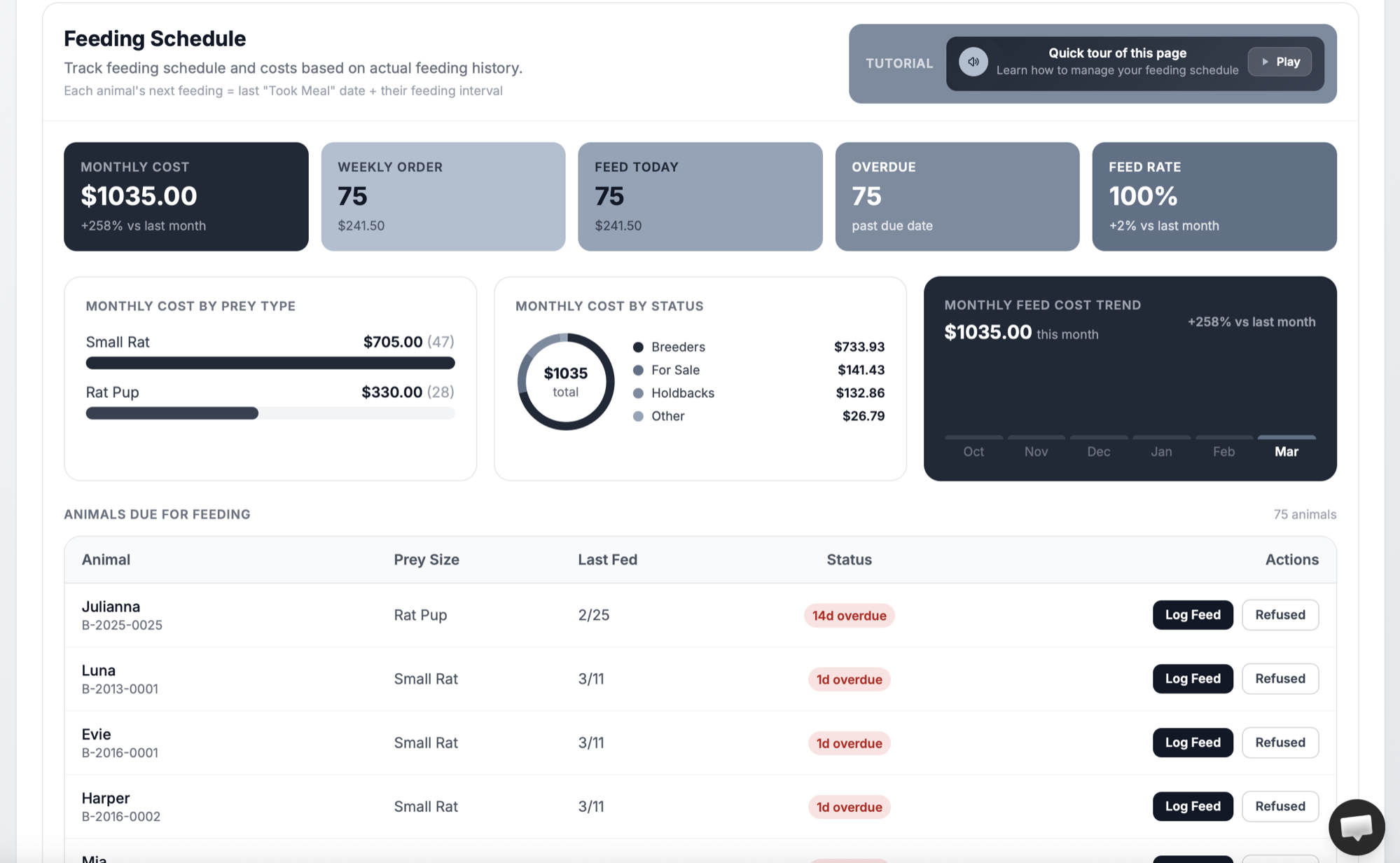
Want this exact system for your feeding schedule?
Log meals for your entire group in one pass
THE RACK's Bulk Feeding selects the group, confirms prey sizes, and marks refusals in minutes. Work Mode walks your daily facility routine so nothing gets skipped.
See How It WorksTracking What Matters
Logging a feeding is not the same as tracking it. Writing down "fed Tuesday" tells you nothing useful three months from now. A ball python feeding schedule worth keeping tracks the data points informing decisions.
- Meal taken or refused. This is the baseline. Every feeding attempt gets logged, successful or not. Refusal patterns over time reveal problems before they become emergencies.
- Prey size and type. When did you bump from small rats to mediums? Did the snake accept the transition smoothly? This matters when you are sizing up dozens of animals at different stages.
- Weight correlation. Regular weigh-ins paired with feeding data show you the real picture. Is this animal gaining at the right rate? Is this one stalling? Without both data points, you are guessing.
- Feed cost per animal over time. Feeding is the single biggest recurring expense in a breeding program. If you are not tracking what each animal costs you in rodents per month, you do not know your true cost of production. When it comes time to price offspring, this number matters.
The breeders who run their programs like a business track all four. The ones who wing it wonder why margins feel thin at the end of the season.
Most tools force you to piece this picture together yourself; feeding data in one place, weight data in another, costs in a third. THE RACK keeps per-animal feeding logs with meal dates, prey size, and refusals alongside weight trends and health monitoring on a single screen. When you weigh an animal and see a dip, the feeding history is right there. No toggling between tabs or cross-referencing notebooks.
Feeding is the biggest recurring cost in your program. If you are not tracking it, you are not tracking your money.
When the Schedule Breaks
No feeding schedule survives the year without disruption. Knowing when and why it breaks is part of building one.
Seasonal Refusals
Ball pythons go off feed. It happens. Males during breeding season will often refuse meals for weeks or months. Some females do the same in the lead-up to ovulation. Winter cooling periods can trigger refusals across the board. If the animal is at a healthy weight and shows no signs of illness, a seasonal refusal is not a problem. It is expected.
The key is having the data to know the difference. A snake at peak weight refusing food in January reads very differently than an underweight animal refusing in July. Without a feeding log, both situations look the same: a snake not eating. With one, you know where you stand.
Problem Feeders
Every collection has them. The animals who refuse for reasons beyond season or breeding. Stress from new enclosure placement, incorrect husbandry parameters, sensitivity to prey type. Problem feeders need their own protocol: smaller prey, different presentation methods, isolated feeding attempts.
Track every attempt. What was offered, how it was offered, the result. Over time, patterns emerge. A snake who refuses live but takes frozen-thawed when left alone overnight. A female who will not eat within 48 hours of being handled. These patterns are only visible in the data.
The Six-Week Rule
Six consecutive weeks of refusal on an otherwise healthy adult ball python is the general threshold where most experienced breeders escalate their concern. Before six weeks: monitor weight, check husbandry parameters, offer meals on schedule. After six weeks with continued weight loss: reassess everything. Enclosure temps, humidity, stress factors, potential health issues.
This rule only works if you are tracking refusals consistently. If you do not know when the last successful meal was, you cannot count the weeks. A reliable ball python feeding schedule is as much about logging refusals as it is about logging meals.
Meal taken or refused. Prey size progression. Weight trends over time. Feed cost per animal. These are the numbers a real feeding schedule captures.
Putting It All Together
A ball python feeding schedule is not a calendar reminder to thaw rats. It is the operational backbone of your program's health monitoring and financial tracking. When it works, you know which animals need feeding today. You see who has refused and for how long. You watch weight trends develop over months. You know what each animal costs you to maintain.
When it does not work, you are guessing. And guessing at scale gets expensive.
THE RACK was built for this. Bulk Feeding logs meals across your entire group in one session. Work Mode guides your daily facility routine so nothing falls through the cracks. Per-animal feeding logs and weight trends sit side by side, giving you the full picture without assembling it yourself. It is facility management software built by a breeder who needed the same system you are reading about right now.
Built by a Breeder
Your feeding data.
Finally working for you.
Bulk Feeding. Work Mode. Per-animal feeding logs. Weight trends tied to meal history. THE RACK puts it all in one system so you spend less time logging and more time managing your facility.
See THE RACKFree for up to 5 animals. Keeper $10/mo. Breeder $20/mo. 7-day money-back guarantee.