
News / Run Your Ball Python Breeding Program Like a Bu...
Run Your Ball Python Breeding Program Like a Business
- The gap between hobby and business is not more animals. It is systems for tracking costs, planning production, and managing sales.
- Know your cost per hatchling. Most breeders can quote gross revenue. Very few know their actual profit per animal.
- Every pairing needs a plan. What you produce, who buys it, and how long it sits all determine whether a season is profitable.
- Professional documentation, consistent branding, and organized records are what separate programs buyers remember from ones they forget.
There is a point in every breeder's arc where the hobby becomes a decision. You are feeding 30, 50, 80 animals. Your rodent bill is a line item. Your snake room has a budget. But your records are still a notebook and some texts to yourself. The gap between "I breed ball pythons" and "I run a breeding program" is not more animals. It is systems.
In This Guide
The mindset shift
Hobbyists buy animals they like. Business-minded breeders buy animals that fit a plan. The difference is not the animals. It is the intention behind every acquisition, every pairing, and every sale.
Running a program means knowing answers to questions most hobbyists never ask. What is my cost per hatchling? Which morph combos sell fastest? How long does the average animal sit before it sells? What is my return on investment per breeding female? If you cannot answer those questions right now, you are running a hobby with a business-sized rodent bill.
This is not an insult. Every successful breeder started here. The ones who make it work long-term are the ones who build the systems to see what is happening in their program.
Know your numbers
The first system every program needs is financial visibility. Not a tax accountant. Visibility. You need to see what you are spending, what you are earning, and whether the gap is moving in the right direction.
- Revenue tracking. Every sale recorded with the animal, the price, the buyer, and the date. Not a DM screenshot. A record.
- Expense tracking. Rodent costs, substrate, electricity, vet bills, shipping supplies, expo fees. Break it down by month at minimum.
- Per-animal cost. How much has each animal cost to maintain? An animal sitting in your rack for eight months has accumulated hundreds in feeding costs. You need to see that number before pricing it.
- Margin analysis. Revenue minus costs equals your actual profit. Not the number you tell your friends at the expo. The real one.
Reality Check
Most breeders can tell you their gross revenue. Very few can tell you their actual profit per animal after production costs, feed, and overhead. The breeders who know this number make better decisions about what to produce next season.
Ready to run your program like a business?
Facility Management Software Built by a Breeder.
THE RACK gives you breeding pipeline tracking, sales analytics, feeding costs, project planning, and health monitoring in one system. Free to start with 5 animals.
See THE RACKProduction planning
Pair with purpose
Every pairing in your program should have a reason behind it. What are you trying to produce? Why? Is there market demand for the offspring? Do you have a plan for the hatchlings before they hatch?
The project planner approach to breeding means defining your goals before the season starts. Which morphs are you targeting? How many clutches can your incubation space handle? How many hatchlings can you realistically sell before next season's babies arrive? These questions have to be answered before you start pairing, not after you are sitting on 60 hatchlings with no buyers.
Manage your pipeline
Once pairings begin, your program becomes a pipeline. Females move through stages: paired, locked, ovulating, pre-lay shed, laid, incubating, hatched. Every stage has a timeline. Every stage needs monitoring.
A breeding pipeline view shows you where every female sits in the cycle at a glance. Without it, you are checking individual records and trying to hold the full picture in your head. With 5 females, that works. With 15 or 20, it does not.
A breeding program without systems is a collection with a rodent bill.
Customer management
Professional documentation
The way you sell an animal says as much about your program as the animal itself. A buyer who receives a ball python with a professional invoice, feeding history, lineage breakdown, and a health record will remember your name. A buyer who gets a snake in a deli cup with no paperwork will remember the experience too, but not the way you want.
Report cards and invoices are not extras. They are the standard for serious programs. Every animal leaves your facility with documentation. This builds trust, drives referrals, and separates your program from the breeders selling out of their DMs with no records.
Deposit and hold tracking
Once your program has a reputation, you will start getting holds and deposits before animals are even hatched. Managing those commitments without a system is a recipe for forgotten deposits, double-sold animals, and angry buyers. Track every hold: who, how much, when it was placed, and when it expires.
Health as a business function
Animal health is not separate from business operations. It is central to them. A breeding female who misses ovulation costs you a clutch worth thousands. A male who loses too much weight during breeding season is out of production for months. A hatchling with a respiratory infection delays the sale and racks up vet bills.
Weight trends, feeding logs, and reproductive tracking are business tools, not pet owner features. They protect your production capacity.
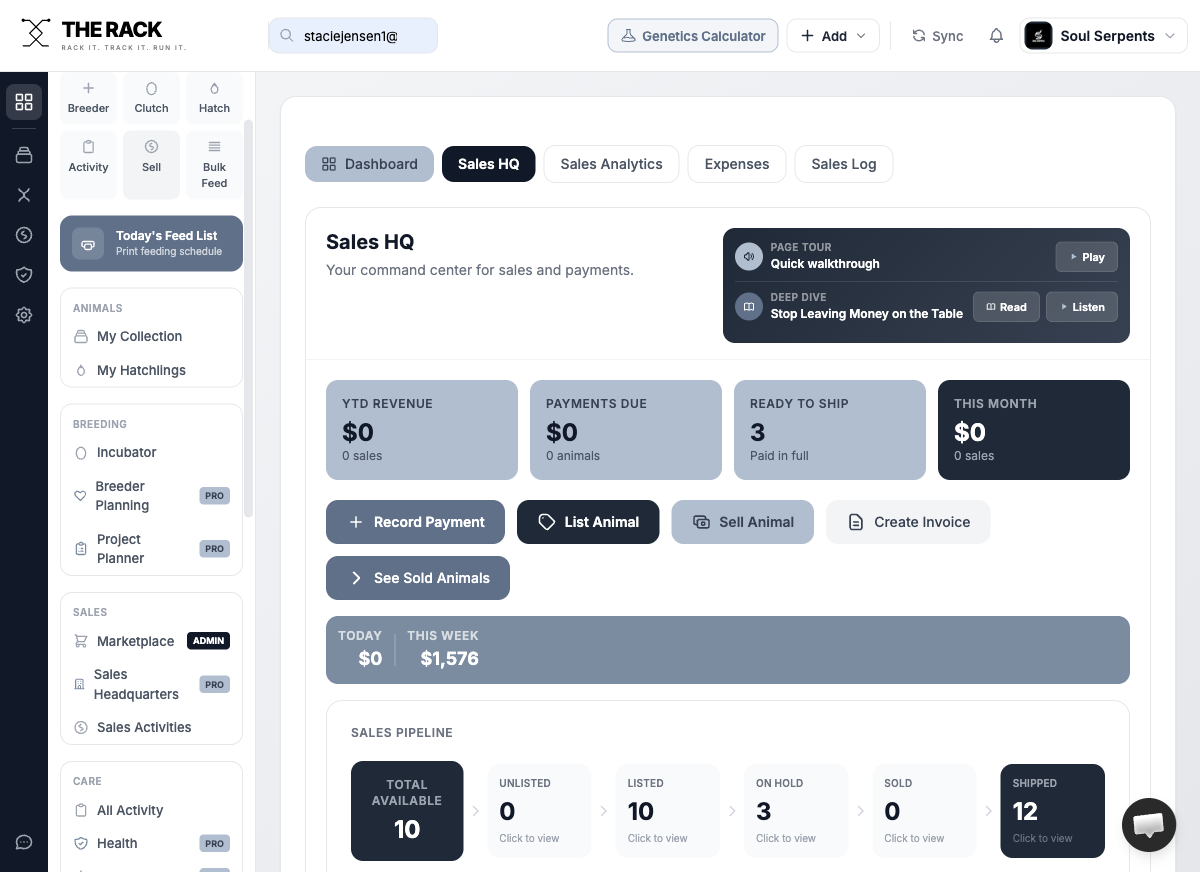
Want to see your entire program in one view?
Pipeline. Sales. Health. All in One Place.
THE RACK is facility management software built by a breeder who needed a real system. Breeding pipeline, sales analytics, feeding costs, project planning, and health monitoring. Free to start with 5 animals.
See THE RACKBrand building
Your program name is a brand whether you treat it like one or not. Buyers look you up before they buy. They check your MorphMarket reviews, your social media, and whether other breeders vouch for you. A professional presence does not require a marketing budget. It requires consistency.
- Consistent animal photography. Same background, same lighting, every animal. It looks professional and it takes five extra minutes.
- Social media presence. Post updates, hatching photos, and available animals regularly. Buyers follow programs they trust, and trust builds over time.
- Professional communication. Respond to inquiries promptly. Be clear about pricing, shipping, and policies. Follow up after delivery.
- Documentation with every sale. Invoices, report cards, and care guides. These are cheap to produce and they separate you from 90% of sellers.
The Business Equation
Production planning + financial tracking + professional sales + health management = a breeding program that grows sustainably. Remove any piece and the system has a gap the market will find.
Tax season is a business event
If you are selling animals, you are generating income. The IRS does not care whether you consider yourself a business or a hobbyist. If your revenue exceeds your costs, you owe taxes on the difference. If you receive payments through PayPal, Venmo, or Zelle above the 1099-K threshold, those platforms are reporting it.
Keep clean records. Every sale, every expense, every receipt. When tax season arrives, you should be able to produce a profit and loss statement without spending a weekend digging through text messages and Venmo screenshots. Sales analytics in THE RACK give you revenue data by morph, by animal, and by date range. Export it and hand it to your accountant.
Content verified against THE RACK breeding database. Business workflows and pipeline management sourced from active breeder programs. Last reviewed April 2026.
Built by a Breeder
Run Your Program.
Like a Business.
Breeding pipeline. Sales analytics. Feeding costs. Project planning. Health monitoring. THE RACK is facility management software for breeders who are done with spreadsheets.
See THE RACKFree for up to 5 animals. Keeper $10/mo. Breeder $20/mo. 7-day money-back guarantee.