
News / How to Breed Ball Pythons: A Complete Breeding ...
How to Breed Ball Pythons: A Complete Breeding Guide
Breeding ball pythons is a process measured in months, not days. From fall preparation to the last hatchling emerging in July or August, a full breeding season demands planning, patience, and documentation at every stage. This guide covers the complete timeline: conditioning, pairing, ovulation, egg laying, incubation, and recovery. Every step, laid out in order.
Before you start: prerequisites
Female Readiness
Female ball pythons should reach a minimum weight of 1500 grams before their first breeding attempt. Many experienced breeders wait until 1700-1800 grams or until the female is at least three years old. Weight alone is not the only indicator; body condition matters. A heavy female with poor muscle tone is not the same as a well-conditioned female at the same weight.
Breeding an underweight female risks egg binding, poor clutch viability, and long recovery periods. Patience here pays off with healthier clutches and a female who bounces back faster post-lay.
Male Readiness
Males reach breeding weight earlier, typically around 700-800 grams at 12-18 months. Males will often show breeding behavior (restlessness, food refusal, increased activity at night) before they are physically ready. Let weight be the deciding factor, not behavior.
Health Checks
Both animals should be healthy, well-fed, and free from respiratory infections, mites, or other health issues before the season starts. Breeding is physically demanding. A snake carrying parasites or fighting an illness will not produce a good clutch; it will produce a vet bill.
Planning your first breeding season?
Map Every Stage. From Cooling to Clutch.
THE RACK's breeding pipeline tracks pairings, dates, ovulation, and clutch outcomes in one place. No spreadsheets. No sticky notes.
See THE RACKThe breeding timeline: month by month
September: Preparation
Start building your females up in September. Increase feeding frequency slightly for females you plan to breed. The goal is having them at peak body condition going into cooling. This is also the time to finalize your project planner and decide which pairings you are running for the season.
October - November: Cooling (optional)
Some breeders drop nighttime temperatures to 72-75F on the cool side while keeping the hot side at 82-84F during the day. This gradual reduction mimics the dry season temperature shift ball pythons experience in West Africa and can help trigger reproductive behavior. Other breeders skip cooling entirely and still produce clutches through natural seasonal cues and photoperiod changes.
For breeders who choose to cool, the hormonal response is well documented. The temperature drop encourages follicle development in females and sperm production in males. Drop temperatures slowly over one to two weeks. Most breeders who cool run it for 6-8 weeks total.
Feeding typically continues during cooling, though many males will go off feed. Females should still accept meals; keep feeding them. You are building the reserves she will draw on during egg development.
If you cool
Nighttime low: 72-75F. Daytime hot side: 82-84F. Duration: 6-8 weeks. Gradual transitions. No sudden drops. Not every program uses cooling. Track your results either way.
December - January: Pairing
Once cooling has been in effect for four to six weeks, begin introducing males to females. Place the male in the female's enclosure in the evening. Ball pythons are most active at night, and pairing success rates are higher when introductions happen after lights go off.
A receptive female will allow the male to align alongside her body. The male uses his spurs (vestigial limbs near the vent) to stimulate the female. Copulation can last anywhere from four to twelve hours. You will see the male's tail wrapped beneath the female's with their vents aligned.
Pair multiple times over several weeks to increase the odds of successful fertilization. Many breeders introduce the male two to three times per week, rotating males between females if running multiple projects. Log every pairing date in your breeding logs; these records become critical when calculating lay dates later.
February: Warm Back Up
Return temperatures to normal over one to two weeks. Hot side back to 88-92F, cool side to 76-80F. Resume normal feeding schedules. Females who have been successfully bred will begin building follicles, and you will notice a visible thickening in the lower third of the body.
March - April: Ovulation
Ovulation is the single most important event in the breeding timeline, and it is easy to miss if you are not watching. A female who has ovulated will show a dramatic mid-body swell. The swelling looks like she swallowed a large meal, but it is concentrated in the middle of the body, not near the stomach.
The swell typically lasts 24-48 hours and then subsides. After ovulation, the female enters a predictable timeline:
- Post-ovulation shed (POS): 14-18 days after ovulation
- Egg laying: 28-35 days after the post-ovulation shed
Mark the ovulation date and the POS date in your breeding pipeline. They are your countdown clock. If you miss the ovulation swell, the POS becomes your anchor point. Every female sheds after ovulation, and it is unmistakable; the entire skin comes off in one piece and is often unusually large.
Breeding is not one event. It is a season of decisions.
April - May: Pre-Lay
After the post-ovulation shed, the female is in her final stretch. She will refuse food entirely. Her body is redirecting all energy into egg calcification. You will notice her spending more time on the warm side, often inverted with her belly exposed to the heat source. This is called "belly basking" and is a reliable pre-lay behavior.
Some breeders add a lay box during this period: a plastic container with a lid (hole cut for entry), filled with damp sphagnum moss. Others let the female lay directly in her enclosure. Either approach works as long as humidity is adequate and the female has a secure space.
May - June: Egg Laying
Egg laying happens 28-35 days after the post-ovulation shed. The female will deposit the clutch and coil around the eggs. Ball python females are maternal; they will incubate the eggs themselves if left alone. Most breeders pull the eggs for artificial incubation because it offers more control over temperature and humidity.
A typical clutch is 4-8 eggs, though first-time mothers often produce smaller clutches. Record the number of eggs, any slugs (infertile eggs), and the condition of the clutch. Separate the eggs carefully if they are stuck together; a dull knife or dental floss works for gentle separation.
June - August: Incubation
Place eggs in an incubator at 88-90F with high humidity (90-100%). Most breeders use a substrate of damp vermiculite, perlite, or a purpose-built egg container with a water reservoir. The eggs should not sit in standing water, but the air around them needs to stay saturated.
Incubation takes 55-65 days. During this period, do not rotate the eggs after the first 24 hours. Ball python embryos attach to the shell wall, and rotating can detach the embryo. Candle the eggs after two weeks to check for veining; viable eggs will show visible blood vessel development.
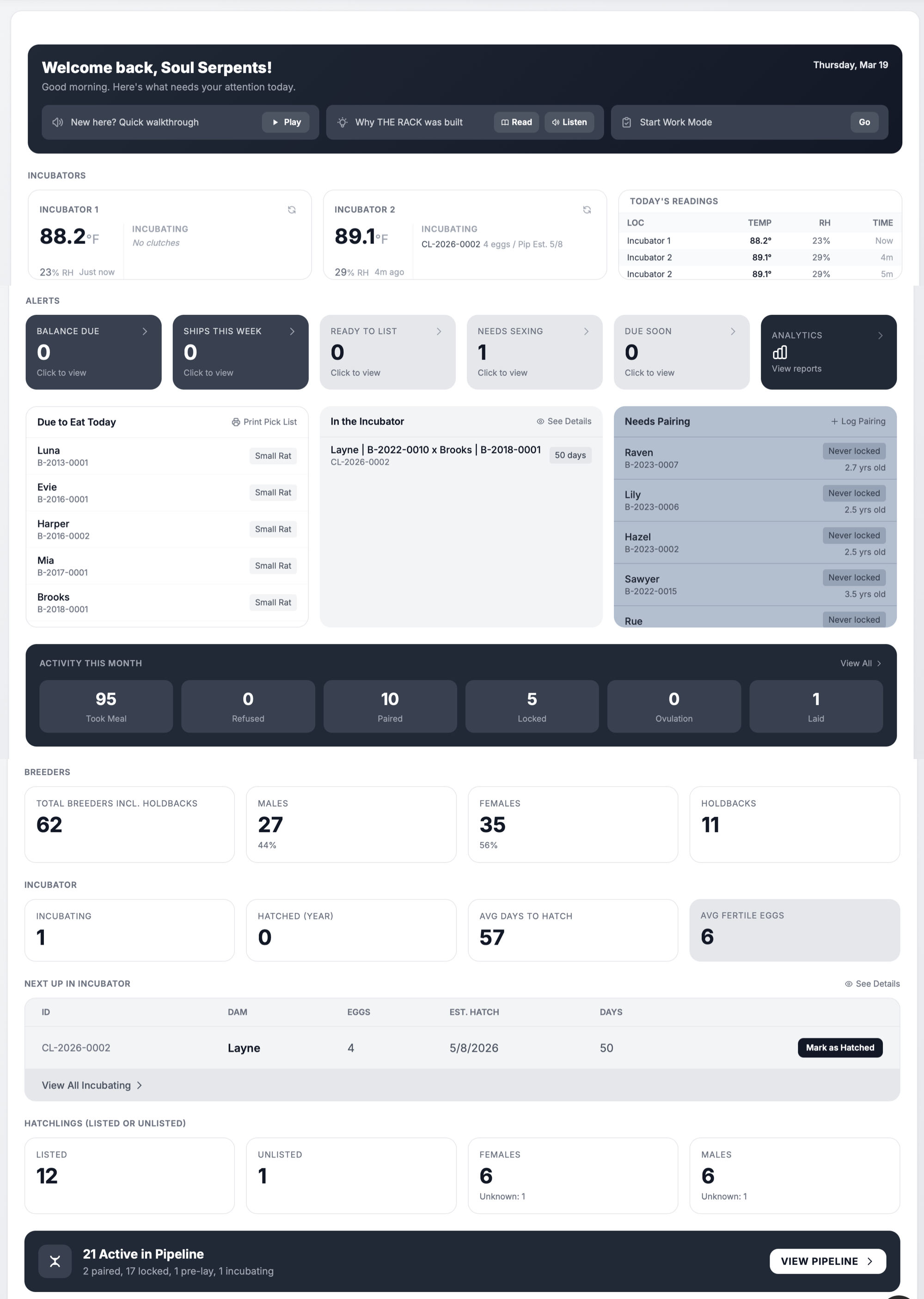
Want this exact pipeline for your breeding program?
Every Pairing. Every Date. Every Clutch.
THE RACK's breeding pipeline logs pairings, tracks ovulation and POS dates, records clutch outcomes, and gives you a season view across your entire program.
See THE RACKHatching
Signs of Pipping
Near the end of incubation, eggs will begin to sweat and dimple slightly. Then one or more hatchlings will cut a slit in the egg with their egg tooth. This is called pipping. Once the first pip appears, the hatchling will sit with its head poking out of the egg for up to 24-48 hours before fully emerging. Do not pull them out. Let them come out on their own timeline.
Not all eggs pip at the same time. A clutch can take two to three days from first pip to last hatchling emerging. Patience.
First Days After Hatching
Hatchlings should be placed in individual containers with damp paper towel substrate, a small hide, a water bowl, and warm-side temps of 88-90F. Do not offer food until after the first shed, which typically occurs 7-10 days after hatching. The yolk sac provides nutrition during this initial period.
First meals are pinky or hopper mice, depending on the hatchling's size. Not all hatchlings eat on the first attempt. Some take two to three weeks and multiple offers before their first meal. Log everything: first shed date, first meal date, prey size accepted. These early records form the foundation of each animal's feeding logs going forward.
Season Timeline at a Glance
Sep: Build up females. Oct-Nov: Condition (cooling optional). Dec-Jan: Pair. Feb: Resume normal temps. Mar-Apr: Ovulation. May-Jun: Eggs laid. Jun-Aug: Incubation, hatching, and recovery feeding.
Post-season recovery: getting animals back on feed
After egg laying, the female is depleted. She has not eaten for weeks to months and has given significant body mass to the clutch. Do not rush the first meal. Give her 7 to 10 days to rest after laying. Then offer a prey item one size smaller than her normal meal. If she refuses, leave the food overnight and try again in 5 to 7 days.
Most females accept their first post-lay meal within two weeks. From there, feed consistently on a 7-day schedule and weigh her weekly. She should show a steady upward weight trend within the first month. If she is not gaining after three to four weeks of consistent feeding, evaluate prey size and offer frequency. Most females regain pre-breeding weight within two to three months.
Males need the same attention. Males who fasted during breeding can take weeks to restart feeding. Offer smaller prey every 5 to 7 days. Do not force it. Log every offer and every refusal in your feeding logs. The day he takes his first meal marks the start of recovery. From there, increase prey size gradually and watch for his weight trend to stabilize.
Track post-lay weight recovery alongside weight trends in THE RACK. The recovery curve tells you when the female is ready to breed again. Some breeders breed females back-to-back seasons. Others give a year off. Body condition, not the calendar, should drive this decision.
A good breeding season is one where every date is recorded, every clutch is documented, every animal is recovered, and the next season's plan starts building before this one ends. The breeders who keep detailed breeding logs are the ones who improve their results year after year.
Built by a Breeder
Your Entire Season,
In One Place
Pairing records. Ovulation dates. Clutch outcomes. Hatchling tracking. THE RACK's breeding pipeline manages your season so nothing falls through the cracks.
See THE RACKFree for up to 5 animals. Keeper $10/mo. Breeder $20/mo. 7-day money-back guarantee.