
News / Is Ball Python Breeding Profitable? How to Actu...
Is Ball Python Breeding Profitable? How to Actually Know
- Ball python breeding profitability is a math question, not a forum opinion. The answer requires two numbers most breeders have never seen side by side.
- Revenue is not profit. A breeder who sold $10,000 in animals and spent $9,500 maintaining them made $500.
- Per-project profitability is the number worth knowing. Program-wide averages hide losing projects behind winning ones.
- THE RACK connects feeding costs per animal to sales revenue per morph so the answer stops being a guess. One-time purchase. Not a subscription.
Search "is ball python breeding profitable" and you will find hundreds of opinions. Some say yes. Some say not a chance. None of them show their math. The reason is simple: they do not have it. Profitability is not a yes-or-no question. It is a math question. And the math requires two numbers most breeders have never seen in the same place: what each animal costs to maintain and what each animal earns when it sells.
In This Guide
Every breeder who has been in this longer than one season has an opinion about profitability. The problem is not the opinions. The problem is nobody can back them up with receipts. "I think I made money this year." "We broke even, more or less." "Breeding is not worth it." All feelings. Zero numbers. The question deserves a real answer. And a real answer comes from your own data, not someone else's guess.
Why every profitability answer online is a guess
Every forum thread, every Facebook group discussion, every video on ball python breeding profitability is anecdotal. "I made money." "I broke even." "I lost my shirt." All vibes. Zero receipts.
The reason is not laziness. The reason is no breeder has had a system connecting costs to revenue at the per-animal level. Revenue is the easy number. Every breeder knows roughly what they sold this season. But revenue is not profit.
The cost side is where the data falls apart. Rodent receipts in a bank statement. Expo fees on a credit card. Acquisition costs buried in a text thread. Nothing connected. Nothing per-animal. Nothing usable for an honest profit-and-loss calculation.
Ball python breeding profitability is not a forum opinion. It is a data answer. And the data requires both sides of the equation: what you spent and what you earned, connected to the same animal.
The question is not "is breeding profitable." The question is "is YOUR program profitable." Whether you call it a hobby or a business, the money is real. The rodent bill is real. The expo table fee is real. What if the one thing you add to the snake room is the thing giving you clarity on all of it? Not more work. Better visibility into the work you are already doing.
The hidden cost
Revenue is not profit. A breeder who sold $10,000 in animals and spent $9,500 maintaining them made $500. Without per-animal cost data, the breeder thinks they had a great year.
The two numbers answering the question
Profitability comes down to two numbers: total cost per animal and sale price per animal.
Total cost per animal: acquisition cost plus accumulated feeding costs plus the proportional share of housing, electricity, substrate, and supplies. This is the number breeders do not have.
Sale price per animal: the number breeders know. What the animal sold for minus shipping costs and payment processing.
When both numbers exist for the same animal, the breeder sees margin. Margin per animal. Margin per clutch. Margin per project. Margin per season. Ball python breeding profit and loss stops being a mystery and becomes arithmetic.
The two numbers are not complicated. They are feeding cost and sale price. The problem has never been the math. The problem has been having both numbers in the same place.
Profitability starts with pricing. If you do not know your cost floor, you do not know whether your price leaves a margin or erases one. Here is how to build a pricing strategy from your own data.
What profitability looks like when you can see it
Picture feeding costs and revenue in the same system. Not a spreadsheet tab next to another spreadsheet tab. One connected view.
A breeder logs feedings. Costs accumulate per animal with every meal. The running total builds on its own. A breeder records a sale. Revenue logs against the animal. The system shows the difference: margin per animal, per clutch, per morph project.
Across a full season, some projects produce real profit. Others produce revenue consumed by costs nobody was watching. The breeder who can see this makes different decisions the following year. Better pairings. Smarter holdback choices. Faster pricing adjustments on animals sitting too long.
Facility management software connects both sides of the equation in one system. Sales analytics shows revenue per morph, days on market, buyer patterns, and seasonal trends. Feeding costs show accumulated per-animal expense from every feeding logged. Together, a breeder sees which morphs generate real margin and which ones sell at a loss after expenses. One-time purchase. The data stays in your account.
THE RACK does not tell you breeding is profitable. It tells you whether YOUR breeding is profitable. Different question. Real answer.
Want to see whether your program is profitable?
Revenue minus costs. THE RACK shows you both.
Sales analytics per morph. Feeding costs per animal. One system. One-time purchase.
See Sales AnalyticsIs ball python breeding profitable? It depends on your numbers. The only way to know is to have them.
Profitability is not a yes-or-no question
The internet wants a binary answer. "Is breeding profitable: yes or no?" The real answer is: it depends on the project.
A breeder running one morph project can be deep in the black. The same breeder running a second project can be losing money on every clutch without knowing it. Profitability is per-project, per-morph, per-season. Not program-wide.
You cannot calculate profitability without knowing your true costs per animal. Here is what it costs to run a ball python breeding program.
A breeder with five active projects might have three producing strong margins and two losing money. Without per-project data, all five look the same. The profitable ones subsidize the unprofitable ones and the breeder never knows which is which.
A breeder who knows margin per project can double down on the projects producing real returns. Kill the projects eating money. Price holdback decisions based on data instead of hope. Walk into an expo knowing the floor price on every animal at the table.
Program-wide profitability is the wrong metric. Per-project profitability is the number changing your breeding decisions.
The real metric
A breeder with five active projects might have three producing strong margins and two losing money. Without per-project data, all five look the same. The profitable ones subsidize the unprofitable ones and the breeder never knows.
What changes when you know your real numbers
Knowing your ball python ROI per project changes three things. Not in theory. In the decisions you make next season.
Project decisions
A breeder considering a new morph project can look at the cost profile: dam maintenance, sire maintenance, expected clutch size, time to sale weight. Model whether the project produces margin before committing. No guessing. No impulse acquisitions built on excitement instead of numbers.
Holdback decisions
A holdback is an investment with an accumulating cost. A breeder with per-animal cost visibility knows what the holdback has consumed in feed, housing, and time. The holdback decision becomes a business decision, not an emotional one. Hold because the numbers say hold. Move the animal because the numbers say the margin is gone.
Pricing confidence
A breeder who knows their cost floor prices with confidence. No anxiety about whether the number is right. No second-guessing after a lowball offer. The cost basis is the floor. Everything above it is margin. Everything below it is a choice the breeder makes with open eyes, not closed books.
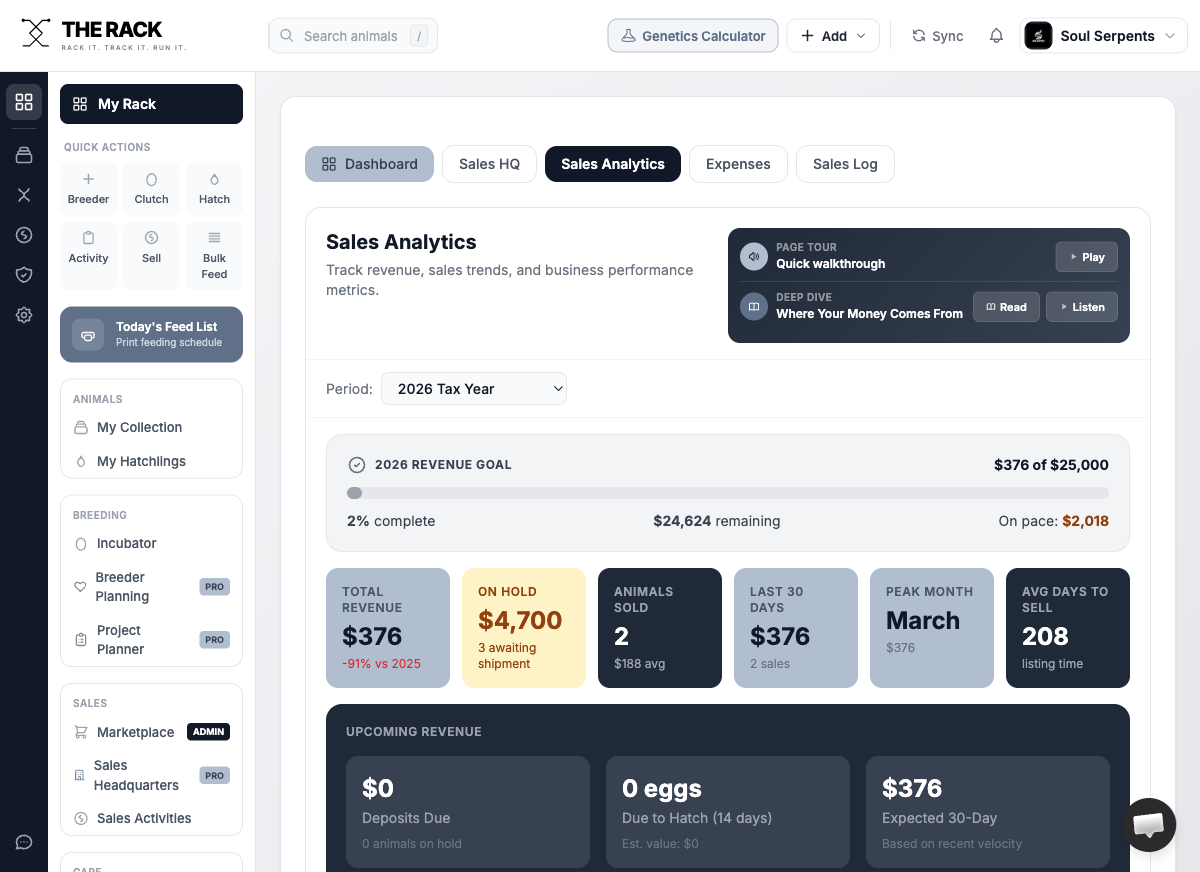
See your real margins per project
Sales data and feeding costs, connected in one system
Revenue per morph. Accumulated feeding expense per animal. The gap between them is your margin. Built by a breeder. One-time purchase.
See How It WorksStop guessing. Start measuring.
The question "is ball python breeding profitable" will never have a universal answer. Programs are different. Morphs are different. Markets shift. Costs vary by region.
The only answer worth having is the one specific to your program. And the only way to get it is to measure both sides: what you spend and what you earn, per animal, per project, per season.
THE RACK is facility management software built for breeders who want to run their program with real data. Sales analytics and feeding costs are not separate features living in separate tabs. They are two sides of the same equation, connected to the same animals, in one system.
This is why THE RACK was built by a breeder who needed these numbers for her own program first. Not a tech company guessing at what breeders need. A breeder who was tired of wondering whether her projects were making money or losing it.
Every breeder can answer the profitability question. The ones who do are the ones who measured their numbers. The rest are guessing. The math is not hard. Having both numbers in the same place has been the hard part. It is not anymore.
Content verified against THE RACK breeding database. Feeding cost ranges and sales analytics data sourced from active breeder programs. Last reviewed May 2026.
Built by a Breeder
Stop Guessing.
Start Knowing.
Sales analytics per morph. Feeding costs per animal. Profit-and-loss per project. One system built to answer the profitability question with real data.
See THE RACKOne-time purchase. Not a subscription.