
News / Pricing Your Hatchlings: How to Set Prices That...
Pricing Your Hatchlings: How to Set Prices That Actually Sell
- The market sets the price, not your investment, your time, or what you think the morph is worth
- Research MorphMarket sold listings before pricing anything. Active listings show asking prices. Sold listings show what buyers pay
- New breeders need to price competitively. You do not have reviews or reputation yet. Your advantage is price
- Time and space cost money. An animal sitting for 6 months at a higher price often nets less than one sold in 3 weeks at a lower price
- Track your actual sales data season over season. Your own results tell you which pairings are profitable and which are not
You hatched your first clutch. Now you are staring at MorphMarket listings trying to figure out what to charge. Price too high and they sit for months. Price too low and you leave money on the table or signal low quality. Get it right and they move in weeks.
In This Guide
The Market Sets the Price, Not You
This is the hardest thing for new breeders to accept: what you paid for the parents does not matter. What you think the morph is worth does not matter. How much time you spent does not matter.
The market determines what buyers will pay. Your job is to understand the market, then position yourself within it.
Step 1: Research Current Prices
Before you list anything, spend time on MorphMarket studying comparable animals.
Search for the exact morph (or closest equivalent) you are selling. Filter by:
- Same morph and gene combination
- Same sex (males often sell for less than females)
- Same age range (hatchling vs. juvenile vs. adult)
- Similar het status if applicable
Look at three things:
1. Active listings: What are other breeders asking right now? Note the range from lowest to highest.
2. Sold listings: More important than asking prices. What did animals sell for? MorphMarket shows recent sales. This is what buyers are paying.
3. Time on market: Are similar animals sitting for months, or do they sell within days? Fast turnover suggests demand is strong at current prices. Long listings suggest oversupply or overpricing.
Know which pairings are worth producing
Track Every Sale. See What Sells.
THE RACK logs sale prices, time to sell, and buyer data alongside your breeding records. After a few seasons, you see which genetics are profitable and which are vanity projects. Data-driven pricing starts with organized sales history.
See Sales ToolsStep 2: Know Your Position
Not all breeders are equal in the buyer's eyes. Be honest about where you stand.
Established breeders with reputation: Can price at or above market. Buyers pay for the name, the track record, the guarantee that they are getting what is advertised. Years of reviews, social media presence, show appearances. This takes time to build.
New breeders: Need to price competitively to attract first buyers. You do not have reviews yet. You do not have a track record. Your advantage is price. Accept this.
Mid-tier breeders: Have some reputation, some reviews. Can price at market rate. Neither premium nor discount.
If you are new, pricing above established breeders for the same morph is a guaranteed way to not sell anything.
Step 3: Calculate Your Actual Costs
You need to know your breakeven point. Not to set prices (the market does that), but to know if a sale is profitable or if you are losing money.
Direct Costs Per Hatchling
- Feeding (6-10 meals before selling)
- Substrate and supplies for individual housing
- Shipping supplies if you ship (box, heat/cold pack, insulation)
- MorphMarket or other listing fees
Indirect Costs (Spread Across Your Operation)
- Electricity (heat, lighting)
- Rack and enclosure depreciation
- Incubator depreciation
- Breeder acquisition cost (amortized over years of production)
- Vet visits if needed
- Your time (if you value it)
Most hobby breeders do not track costs precisely. At minimum, know your direct costs per animal so you are not selling at a loss.
Step 4: Set Your Price
With research done, here is the decision framework:
If you need to sell quickly (running out of space, need cash flow, first-time breeder building reviews): Price at or slightly below the lower end of market range. Sell volume, build reputation.
If you can wait (have space, not desperate, have some reputation): Price at market midpoint. Hold for the right buyer.
If you have something special (exceptional animal, rare combo, proven genetics, strong reputation): Price at or above market high end. Justify it with quality photos and detailed descriptions.
For most new breeders with common morphs, the right strategy is: price to move.
The Real Math Nobody Talks About
Scenario A: You price at the high end of market. After 4 months, you drop the price. After 2 more months, you sell at a lower number. Revenue looks fine on paper. But you spent 6 months feeding and housing that animal. Your net is lower than you think, plus the frustration of watching it sit.
Scenario B: You price competitively. It sells in 3 weeks. Feeding cost is minimal. Housing space frees up immediately. Your net is higher because the carrying costs are near zero.
The "higher" price made you less money because the animal sat.
The Pricing Truth
Time has a cost. Space has a cost. Holding onto animals waiting for your dream price costs more than pricing to sell. The breeders who sell consistently understand this.
Price what buyers will pay.
Not what you wish they would.
What Photos and Descriptions Do for Price
Two identical animals. Same morph. Same age. Same genetics.
One listing has a blurry photo taken on a paper towel under harsh lighting. No description. Generic title.
One listing has crisp photos on a neutral background, multiple angles, shed skin visible, detailed genetic description, feeding history, hatch date.
The second one sells first, often at a higher price. Presentation signals professionalism. Buyers pay for confidence that they are getting a quality animal from a competent breeder.
Good photos do not cost money. They cost time and attention. Invest it.
When to Drop Prices
If an animal sits for 60+ days with no inquiries, the price is wrong. Either:
- The market for that morph is saturated
- Your price is above market
- Your photos or description are not competitive
- The morph is not in demand
Drop the price. Every month it sits, you are paying to feed and house it while it depreciates. Hatchlings lose the "fresh" appeal as they age.
Some animals you need to sell at a loss to free up space. Better to take a small loss than keep feeding an animal nobody wants for years.
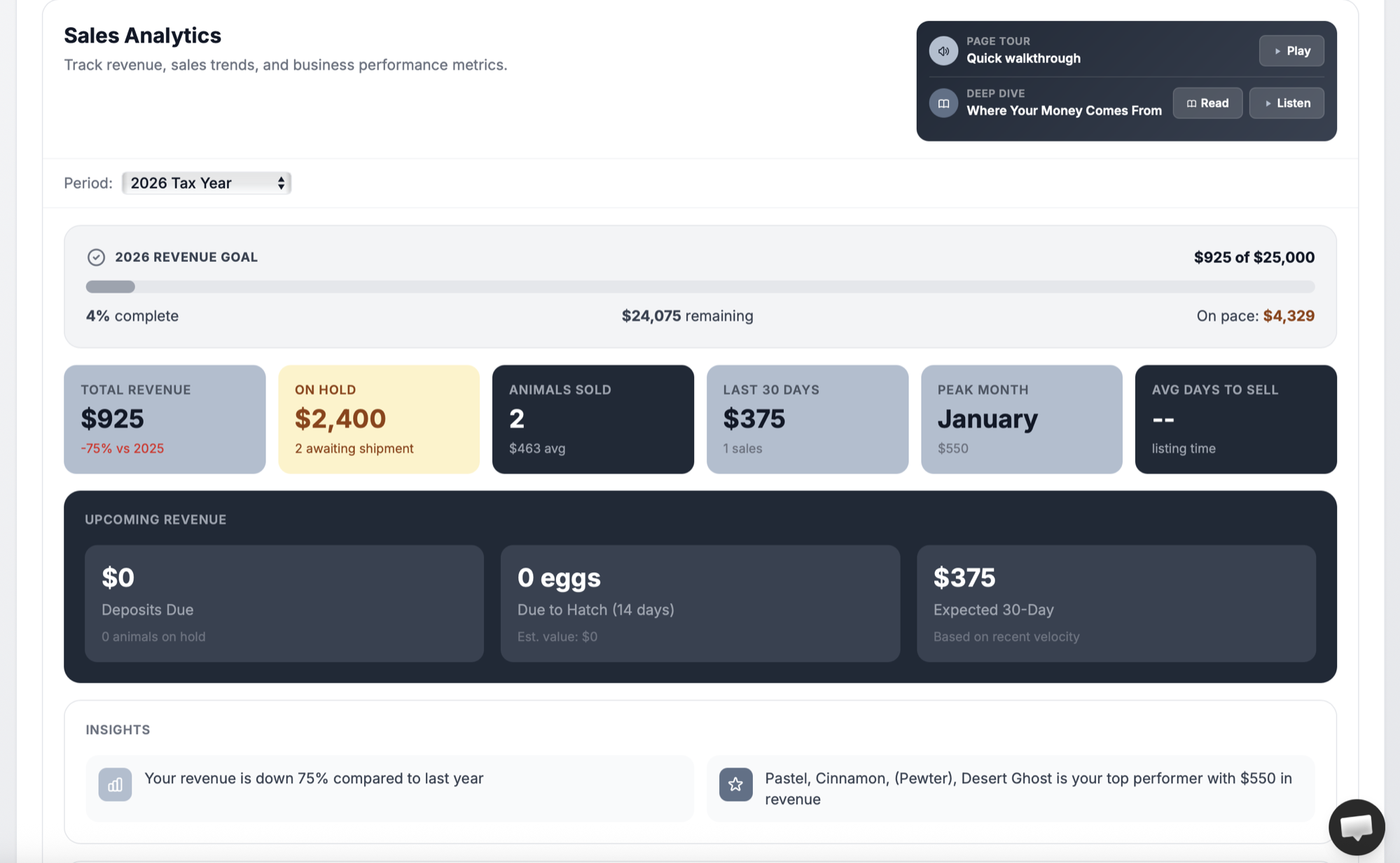
Stop guessing which morphs are profitable
Revenue by Month. Days to Sell. Your Best Genetics.
THE RACK is ball python facility management software built by a breeder. Log every sale, see time-to-sell trends, and identify which pairings are worth repeating. Your own data tells you more than any Facebook group ever will.
See Sales AnalyticsTracking What Works
The best pricing insights come from your own data over time. Track:
- What you listed at
- What you sold at
- How long it took to sell
- Which morphs moved fast
- Which morphs sat
After a few seasons, you will know what sells in your market and what does not.
THE RACK tracks sales data alongside your collection and breeding records. When you sell an animal, you log the sale price, date, and buyer info. Over time, you build a database of what your hatchlings sold for, not what you hoped they would sell for. That data tells you which pairings are profitable and which are not.
The Bottom Line
Pricing is not about what you want. It is about what buyers will pay in a competitive market.
- Research current market prices before listing
- Be honest about your position as a breeder
- Know your costs so you do not sell at a loss
- Price to move, especially when starting out
- Factor in time and space costs, not the purchase price
- Invest in good photos and descriptions
- Track your results and adjust
The breeders who sell consistently are not necessarily producing the best animals. They are the ones who understand pricing, present well, and meet the market where it is.
Content verified against THE RACK breeding database. Pricing frameworks and sales analytics sourced from active breeder programs. Last reviewed April 2026.
Built by a Breeder
Know Your Numbers.
Price With Confidence.
Sales tracking. Revenue analytics. Time-to-sell data. THE RACK gives you the pricing intelligence most breeders never have.
See THE RACKFree for up to 5 animals. Keeper $10/mo. Breeder $20/mo. 7-day money-back guarantee.