
News / Ball Python Stress Signs: What to Watch For
Ball Python Stress Signs: What to Watch For
- Ball pythons communicate stress through behavior, posture, and patterns over time, not single events.
- Most stress traces back to one environmental variable being off. Check temps first, then humidity, then hides.
- One skipped meal is normal. Four in a row with good husbandry is not. The data tells you which pattern you are looking at.
- Chronic stress suppresses the immune system. It is not the disease; it is the door the disease walks through.
Ball pythons are quiet animals. They do not vocalize when something is wrong. They do not pace or whine. They communicate through behavior, posture, and patterns. If you know what to look for, a stressed ball python tells you everything. If you do not, the signs look like a snake being a snake. This guide breaks down the real indicators of stress and what each one means for your husbandry.
Behavioral stress signs
Constant hiding
Ball pythons hide. This is normal. But a snake hiding 24 hours a day, never coming out to explore, thermoregulate, or sit in the open at night, is a snake in survival mode. Healthy ball pythons emerge periodically, especially after dark. If the snake never leaves the hide, something in the enclosure is making it feel unsafe.
Check the enclosure for adequate cover. A single hide is not enough. Two hides, one on the warm side and one on the cool side, are the minimum. Clutter between the hides helps the snake move without feeling exposed. Sometimes the fix is adding a piece of cork bark.
Excessive movement and glass surfing
The opposite of constant hiding. A ball python repeatedly pushing against the glass, climbing the walls, or restlessly moving around the enclosure is trying to escape its environment. This is not curiosity. This is a stress response.
Common causes: temperatures too high, no temperature gradient, enclosure too small, or the snake was recently relocated. Check your hot side. If it exceeds 95F, the snake cannot cool down and will try to leave. Verify the cool side sits around 76-80F. The snake needs options.
Want to catch stress patterns before they escalate?
Log the Behavior. See the Pattern.
THE RACK's health log records every observation, feeding response, and weight change. When stress shows up in the data, you catch it early instead of guessing.
See THE RACKDefensive postures
A ball python in a tight ball is not relaxed. It is defensive. The ball posture is a last-resort defense mechanism. If your snake balls up every time you open the enclosure, it perceives you as a threat. This is common in new animals and in snakes kept in high-traffic areas.
Hissing and striking are escalated stress responses. A ball python hissing at routine enclosure maintenance is communicating discomfort. Reduce handling frequency. Approach slowly. Give the animal time to settle in its environment before expecting calm behavior.
Feeding refusal
A single skipped meal is not a stress indicator. A pattern of refusals is. When a ball python stops eating for multiple consecutive offerings and husbandry checks out, stress is a likely factor. The snake is diverting energy from digestion to threat response.
Log every feeding attempt with your feeding logs. Date, prey type, prey size, accepted or refused. Across three to four data points, the pattern becomes visible. Seasonal fasting looks different from stress-related refusal. The data tells you which one you are looking at.
Stress vs. Normal Behavior
Hiding during the day is normal. Hiding 24/7 is not. Sitting in a ball when startled is normal. Balling up at every interaction is not. One skipped meal is normal. Four in a row with good husbandry is not.
Physical stress signs
Soaking in the water bowl
A ball python sitting in its water bowl occasionally is fine. A ball python soaking for hours or days at a time is telling you something. The two most common causes: mites and incorrect humidity. Mites drive snakes to soak as a way to drown the parasites. Low humidity drives them to seek moisture through the water bowl.
Inspect the snake carefully. Check around the eyes, under the chin, and in the heat pits for tiny black or red dots. Check humidity levels. If the enclosure sits below 50%, the snake is dehydrated and using the bowl as a last resort. Fix the humidity before you fix anything else.
Retained shed
A healthy ball python sheds in one piece. Stress, dehydration, or poor humidity causes the shed to come off in patches. Retained eye caps, stuck pieces along the body, and rough incomplete sheds are signs the environment is not right.
Retained shed is a symptom, not the disease. The disease is almost always humidity. Raise it to 60-70% and maintain it there. A humidity box (a container with damp sphagnum moss and an entry hole) gives the snake a microclimate for shedding even when ambient humidity fluctuates.
The snake is not the problem. The enclosure is the problem.
Weight loss without explanation
Weight loss paired with feeding refusal and behavioral changes is a red flag. A ball python losing weight while refusing food and displaying other stress signs needs immediate attention. Weigh weekly and log it. A 10% drop in body weight from baseline is the threshold for concern.
Weight trends in THE RACK show you the trajectory at a glance. A slow decline is different from a sharp drop. Both need attention, but the speed of loss tells you how urgent the situation is.
Unusual posture and stargazing
A ball python holding its head at an odd angle, pointing straight up (stargazing), or unable to right itself when flipped is showing neurological symptoms. This goes beyond stress and into potential illness. Inclusion body disease, respiratory infection, and neurological issues from certain morphs (like the spider gene) can all present this way.
If you see stargazing or persistent abnormal posture, this is a vet visit. Do not wait. Do not troubleshoot husbandry. Get the animal examined.
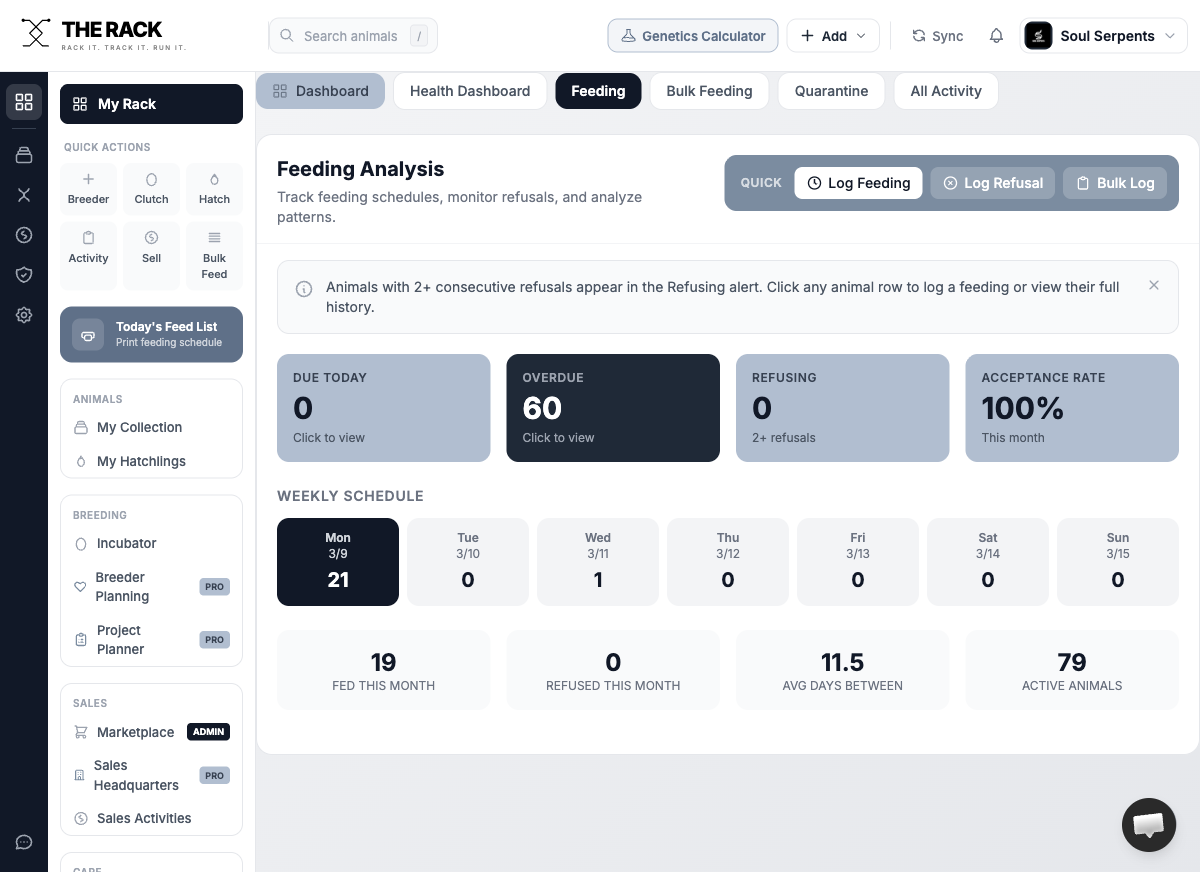
Want to see health patterns across your entire collection?
Every Animal. Every Data Point.
THE RACK logs feeding responses, weight changes, shed quality, and health observations for every animal. When something shifts, the data shows it before the snake shows it.
See THE RACKEnvironmental causes and fixes
The checklist approach
When a ball python shows stress signs, work through the environment systematically. Do not change everything at once. Check one variable at a time.
- Hot side surface temp: 88-92F
- Cool side ambient temp: 76-80F
- Humidity: 55-70%
- Hides: Minimum two, snug-fitting, one warm and one cool
- Clutter: Enough to break sightlines across the enclosure
- Enclosure location: Low traffic, away from windows and speakers
- Light cycle: Consistent day/night pattern, no 24-hour lighting
- Substrate: Appropriate for humidity retention
Most stress in ball pythons comes down to one of these variables being off. Fix the environment and the behavior corrects itself. It does not happen overnight. Give the snake two to three weeks after making changes before evaluating whether the fix worked.
The Priority Order
When troubleshooting stress: check temperatures first, then humidity, then hides and clutter, then enclosure placement. Solve the most common cause before investigating the rare ones.
When stress becomes a health problem
Chronic stress suppresses the immune system. A ball python stressed for weeks or months becomes vulnerable to respiratory infections, parasites, and other opportunistic illnesses. The stress itself is not the disease. It is the door the disease walks through.
This is why logging matters. When you can see two months of feeding data, weight data, and behavioral notes, you can tell the difference between a snake adjusting to a new enclosure and a snake in decline. The first resolves itself. The second escalates if you do not intervene.
The goal is catching the pattern early. A ball python communicates through weeks and months of data, not single events. One skipped meal means nothing. Six skipped meals with a weight drop and increased hiding means something specific. Your records tell the story.
Built by a Breeder
See the Signs.
Before They Escalate.
Health logs. Feeding records. Weight trends. Shed tracking. THE RACK gives you the data to catch problems early and keep every animal healthy.
See THE RACKFree for up to 5 animals. Keeper $10/mo. Breeder $20/mo. 7-day money-back guarantee.