
News / Are You Actually Making Money as a Ball Python ...
Are You Actually Making Money as a Ball Python Breeder? How to Know for Sure
- Revenue is not profit. You can sell $20,000 worth of animals and still lose money after feed, electricity, substrate, and vet costs.
- Four metrics tell you the truth: revenue by year, profit margins per sale, average sale price by sex, and average days to sell.
- Spreadsheets fail because they require manual entry for everything and nothing connects to the rest of your operation.
- The breeders who consistently grow are the ones who know their numbers, not the ones with the rarest morphs.
Every ball python breeder has had the same thought at the end of a season: "I think I did okay this year." You sold animals, money came in, and it felt like things were moving in the right direction. But feeling profitable and being profitable are two very different things. Most breeders have no idea which one they are.
The Problem With Feeling Profitable
Revenue is not profit. This is the single most dangerous blind spot in the ball python breeding world. You can sell $20,000 worth of animals in a season and still lose money. Feed costs, electricity, substrate, rack equipment, shipping supplies, vet visits, and the cost of the animals themselves all eat into the number. If you are not tracking those costs against your revenue, you are running your facility management software on vibes instead of data.
The problem gets worse across time. A breeder who does not track margins will keep producing animals feeling like winners but are losers. The Pastel pairing you run every year because the babies sell fast? If you factored in production and rearing costs, you might find you are breaking even at best. Meanwhile, a less popular combo taking longer to sell could be your most profitable pairing because the margins are significantly higher.
Without real numbers, you cannot tell the difference. You keep doing what feels right and hope it works out.
Revenue by year. Profit margins per sale. Average sale price by sex. Average days to sell. Four numbers every breeder needs to know.
What Ball Python Breeders Need to Track
Revenue Year After Year
This is the starting point. If you do not know whether your revenue went up or down compared to last season, you have no way of knowing if your program is growing or shrinking. Revenue by year gives you the big picture. It tells you whether your decisions are compounding in the right direction or whether you are spinning your wheels. It also helps you plan. If you know your average revenue per season, you can forecast what you need to produce to hit your goals next year.
Profit Margins Per Sale
Revenue tells you what came in. Margins tell you what you kept. A $1,200 sale with a 60% margin puts $720 in your pocket. A $400 sale with an 85% margin puts $340 in your pocket. But ten of those $400 sales at 85% margin outperform three $1,200 sales at 60%. Margins change the math on which pairings are worth running, which animals are worth holding, and which morphs deserve more rack space next season.
Average Sale Price by Sex
Males and females sell at different price points for almost every morph. If you are not tracking this separately, you are averaging two very different numbers into one misleading figure. Knowing the female premium for a specific morph changes how you plan pairings, how you allocate rack space, and how you set expectations for each clutch. It also helps you identify when the market is shifting. If your female premium starts shrinking for a specific morph, that signal is worth catching early.
Average Days to Sell
This is the metric most breeders never think about, and it might be the most important one. An animal sitting unsold is not without a buyer. It is an animal eating, occupying rack space, and tying up capital. Days to sell tells you how liquid your inventory is. Fast-moving morphs free up space and cash for the next round. Slow movers tie everything up. If you know your average days to sell by morph, you can price more aggressively on slow movers and protect your margins on fast ones.
You cannot improve what you cannot measure.
Why Spreadsheets Do Not Cut It
Some breeders try to solve this with spreadsheets. They set up columns for sale date, animal, morph, price, buyer, and sex. The problem is not the spreadsheet itself. The problem is spreadsheets require you to do everything manually, every single time, and to never miss an entry.
One forgotten sale throws off your averages. One missing cost entry makes your margins look better than they are. And calculating something like days to sell requires you to track the date each animal became available, the date it sold, and then run the subtraction yourself. Across dozens or hundreds of animals per season, hours of tedious data entry kills the effort within a few months.
Spreadsheets also do not connect to the rest of your operation. Your feeding logs and weight trends live in one place. Your sales data lives in another. Your breeding records live somewhere else. Nothing talks to anything, and you end up with fragments of information that never come together into a complete picture.
How THE RACK Solves This
THE RACK is facility management software built for ball python breeders. When you record a sale in THE RACK, it automatically calculates your revenue, tracks your margins, logs the sale date, and feeds everything into your analytics dashboard. There is no separate step. There is no spreadsheet to update. The data builds itself as you run your program.
Your Sales HQ dashboard gives you all four numbers at a glance. Revenue by year so you can see if your program is growing. Profit margins per sale so you know what you are keeping. Average sale price broken down by sex so you can plan pairings with real data. And average days to sell so you know which morphs are moving and which are sitting.
THE RACK also connects your sales data to the rest of your operation. You can trace an animal from pairing to incubation to hatching to sale, with every cost and data point attached. When you sit down to plan next season, you are not guessing which pairings are worth running. You know, because the numbers are right there.
The genetics calculator helps you plan pairings based on probability. Your sales analytics tell you which outcomes are worth producing. Together, they turn breeding from a guessing game into a strategy.
When you record a sale, the numbers update automatically. Open it up, see the truth, make better decisions.
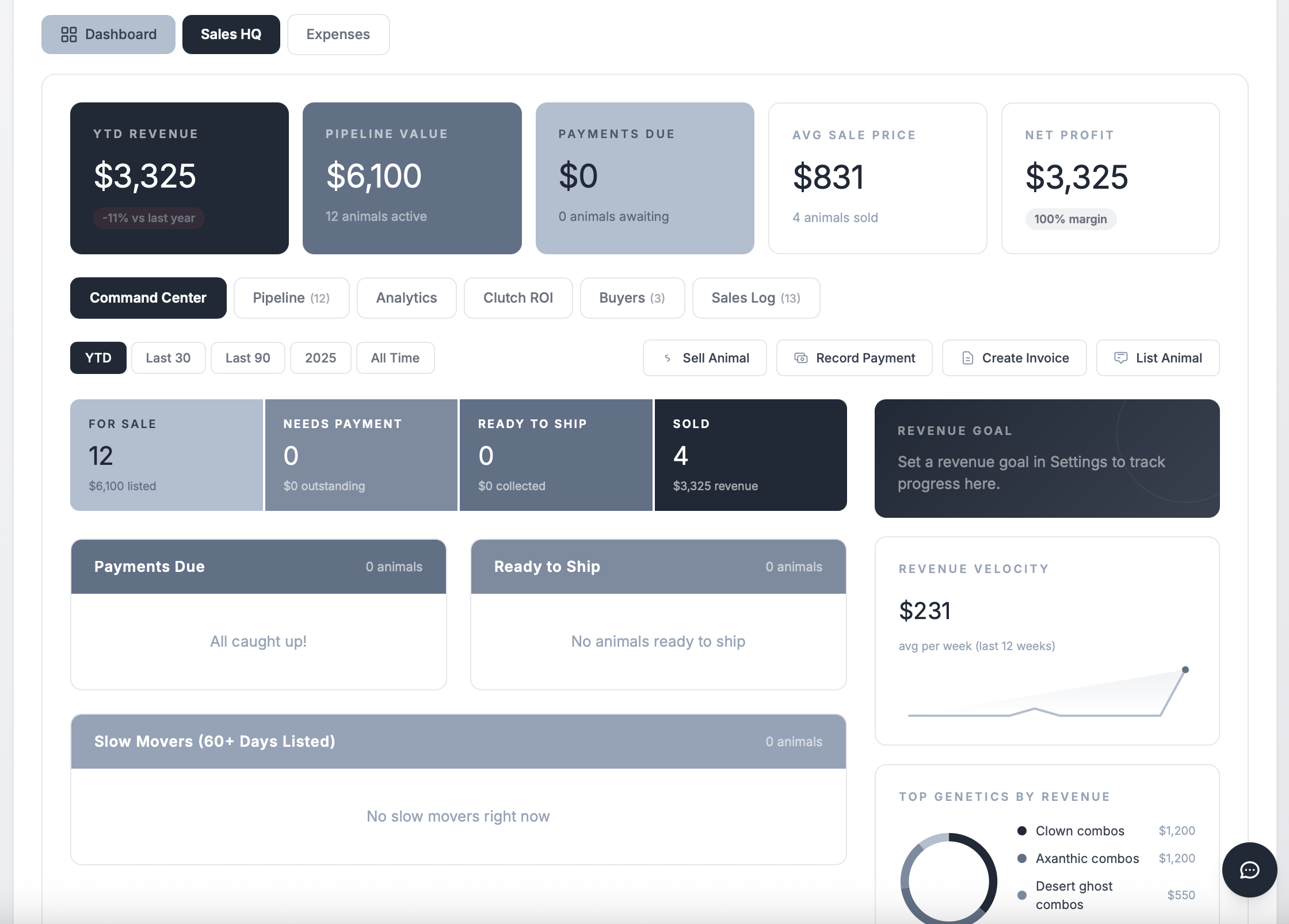
See your real profit at a glance
THE RACK tracks revenue, margins, and sale velocity automatically. No formulas. No spreadsheets.
See THE RACKThe Question Worth Asking
At the end of every season, ask yourself one question: do I know exactly how much money I made, or do I think I know? If the answer is anything less than a specific number backed by real data, you have a gap in your operation costing you money every single season.
The breeders who consistently grow their programs are not necessarily the ones with the rarest morphs or the biggest collections. They are the ones who know their numbers. They know which pairings produce strong returns and which ones barely break even. They know how long their animals sit before selling. They know whether this year was better than last year, and by exactly how much.
Clarity does not come from memory or intuition. It comes from having the right system in place, one capturing the data as you work and turning it into answers without requiring extra effort. THE RACK was built for this. Not more work for you. Better information, so every decision you make is grounded in what is happening in your program.
Get started free and find out whether you are making money, or think you are.
Know your numbers.
Grow your program.
Revenue tracking. Profit margins. Sale velocity. Genetics ROI. All automatic.
See THE RACKFree for up to 5 animals. Keeper $10/mo. Breeder $20/mo. 7-day money-back guarantee.