
News / Ball Python Breeders: Are You Pricing Your Anim...
Ball Python Breeders: Are You Pricing Your Animals Wrong?
- Pricing too low trains buyers to expect discounts and undercuts the market. If your animal sells in 48 hours, you left money on the table.
- Pricing too high means the animal sits unsold eating into your margin every week. A $500 sale in one week is more profitable than $700 after six months.
- Smart pricing requires four data points: average sale price by morph, average sale price by sex, days to sell, and price distribution.
- Most breeders do not have this information because the tools are too painful to use. THE RACK automates it.
Most ball python breeders spend months planning pairings, weeks waiting on locks, and the entire incubation period dreaming about what will hatch. Then, when it comes time to price those animals, they check MorphMarket for five minutes and pick a number. Not a pricing strategy. A guess. And guessing is costing you money.
Two Ways Breeders Lose Money on Pricing
Pricing mistakes go in both directions, and most breeders have no idea which one they are making.
Pricing Too Low
This is the most common mistake, especially for newer breeders. You hatch something incredible, check what a few other sellers are listing the same morph for, and price yours in the same range. The problem is you are not seeing what those animals sold for. You are seeing what people are asking. Listings sit for months at inflated prices while sales happen at a completely different number. If your animal sells in 48 hours, you almost certainly left money on the table.
Pricing too low does not cost you on one sale alone. It trains your buyers to expect low prices from you. It undercuts the market for the morph. And it means you are subsidizing your breeding program with money belonging in the profit column.
Pricing Too High
The opposite mistake is the same expense, but slower and harder to see. You price an animal at what you think it is worth, and it sits. Weeks pass. Then months. The animal is eating, taking up rack space, and tying up capital working for you somewhere else. Every week an animal sits unsold, your effective margin drops. A $500 animal selling in a week is more profitable than a $700 animal sitting for six months.
The real cost is not the feeding and housing alone. It is the opportunity cost. The rack space could hold a new hatchling. The capital could fund your next pairing.
Price too low and you leave money on the table. Price too high and your money sits in a rack eating frozen rats. Both mistakes are invisible without data.
The Data You Need for Smart Pricing
Gut instinct is not a pricing tool. If you want to price accurately, you need numbers from your own program. Not what someone on a Facebook group says a morph is worth. Not what the top listing on MorphMarket shows. Your numbers, from your sales, in your market.
Here is what smart pricing requires:
- Average sale price by morph. What do your Pastels sell for? Your Pinstripes? Your combos? If you do not know this number for every morph you produce, you are guessing.
- Average sale price by sex. Males and females sell at different price points. If you are pricing them the same, you are losing on one end or the other.
- Days to sell. How long does each morph take to move? This tells you which animals are hot and which are sitting. It also tells you when your pricing is off.
- Price distribution. Are your sales clustered in a tight range, or spread all across? A tight cluster means your pricing is consistent. A wide spread means you are reacting instead of strategizing.
Most breeders do not have any of this information. They have a rough sense, a feeling, a memory of what they sold something for last season. Not enough to run a breeding facility like a business.
Feelings are a terrible pricing strategy.
Why Most Breeders Never Analyze Their Pricing
It is not because they do not care. It is because the tools do not exist, or they are too painful to use. Spreadsheets require manual entry for every sale. You have to remember to log the date, the morph, the price, the buyer, the sex, and then somehow turn all of it into something meaningful. Most breeders start a spreadsheet in January and abandon it by March.
Even if you are disciplined enough to maintain a spreadsheet, turning raw data into pricing intelligence takes time and skill. You need to calculate averages, filter by morph, compare across seasons, and look for trends. Analysis work, not breeding work. And most breeders got into this because they love the animals, not because they love pivot tables.
The result is most pricing decisions come down to a quick scan, a gut check, and a number feeling about right. How you end up with a season where you worked harder than ever and somehow made less money.
What Smart Pricing Looks Like
A breeder who prices smart does not spend more time on pricing. They spend less. But they have better information. When they pull an animal out of the incubator, they already know what the morph has been selling for, how long it takes to move, and whether males or females are in higher demand the season.
Smart pricing means knowing your floor. The lowest price you will accept for a given morph based on your cost to produce it, including feeding, housing, electricity, and the cost of the parents' rack space during breeding season. If you do not know your floor, you cannot negotiate with confidence.
Smart pricing also means knowing your ceiling. What is the highest price you have received for the morph? Not what someone listed it for. What someone paid. The gap between your floor and your ceiling is where your pricing strategy lives.
With a feeding cost calculator and real sale data, you can set prices competitive without being cheap, and ambitious without being unrealistic.
Average sale price by morph and by sex. Days to sell for every animal. Price distribution across the season. This is what turns guessing into a strategy.
How THE RACK Gives You Pricing Intelligence
THE RACK is facility management software built specifically for ball python breeders. Every sale you log feeds directly into your analytics. No spreadsheets. No manual calculations. No forgetting to log something for three months and then trying to reconstruct it from PayPal receipts.
Your sales analytics dashboard shows you what you need to price with confidence:
- Average sale price by genetics. See what each morph combination sells for in your program, not what the market says it should be worth.
- Average sale price by sex. Know how much more females are bringing compared to males, broken down by morph.
- Days to sell. See which morphs move fast and which sit. Adjust your pricing or your production accordingly.
- Revenue by time period. Track whether your pricing is improving season to season, or trending in the wrong direction.
- Price distribution. See if your sales are consistent or all across the board. Consistency means you have a strategy. Inconsistency means you are reacting.
All of this happens automatically when you log sales through THE RACK's sales pipeline. No extra work. No separate tracking system. The data builds as you run your program.
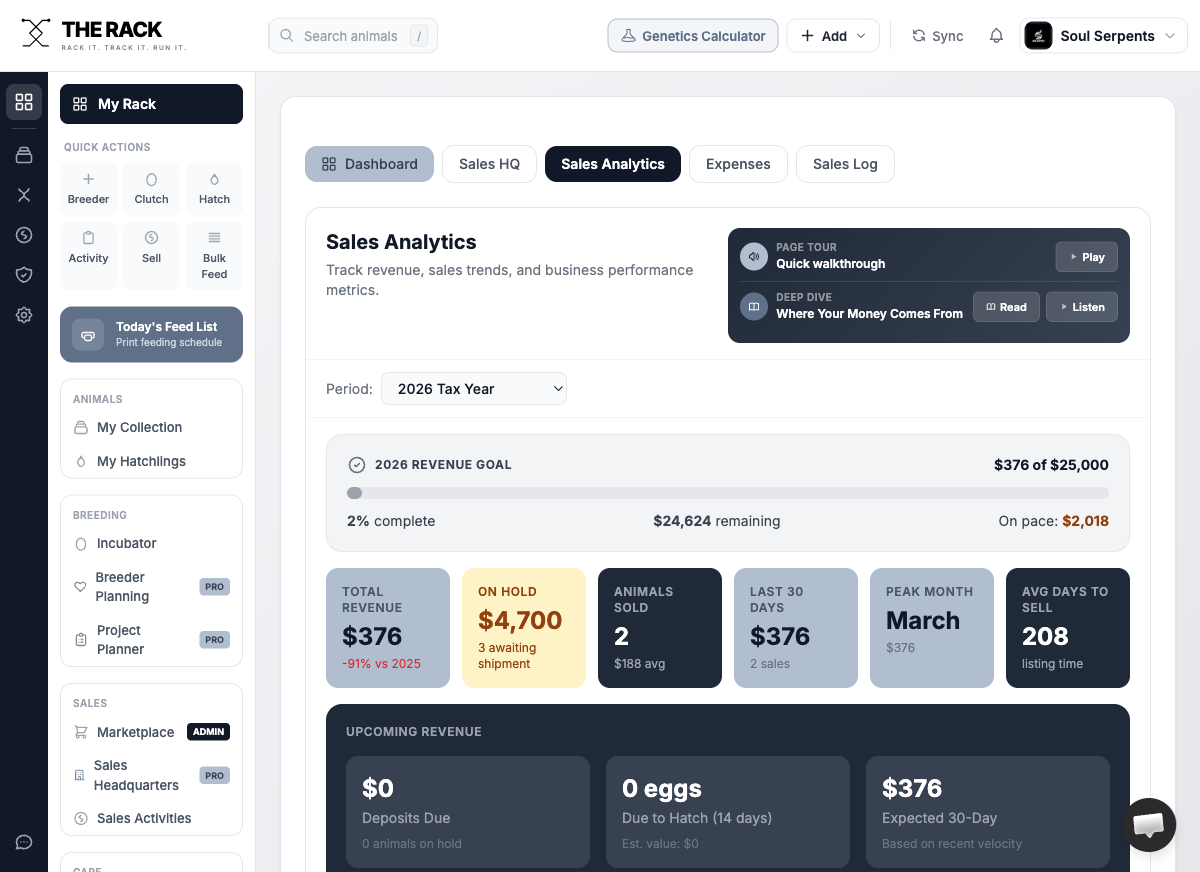
Price with data, not gut instinct
THE RACK shows average sale price by genetics, sex, and time period. Plus days to sell and price distribution.
See THE RACKThe Pricing Check Every Breeder Should Do
Before you price your next animal, answer these five questions:
- What did this morph sell for last season? Not what you listed it for. What someone paid.
- How long did it take to sell? If the answer is "I do not know," there is the problem.
- What is my cost to produce this animal? Include feeding, housing, electricity, and the proportional cost of the parents during breeding season.
- Am I pricing males and females differently? If not, you are leaving money on one side.
- Is this price based on data or a feeling? If the answer is a feeling, you need better tools.
If you cannot answer those questions with real numbers, you are pricing blind. You might get lucky. But luck is not a business strategy, and breeding is a business whether you treat it like one or not.
The breeders who consistently make money are not the ones with the flashiest morphs or the biggest collections. They are the ones who know their numbers. They price based on what the data says, adjust based on what the market does, and make decisions with information instead of instinct.
Getting started with THE RACK gives you this. Not more work. Better information. So every animal you price, every negotiation you enter, and every season you plan is backed by real data from your own program.
Stop guessing.
Start pricing smart.
Sale price analysis. Days to sell. Revenue by genetics. Price distribution. All automatic.
See THE RACKFree for up to 5 animals. Keeper $10/mo. Breeder $20/mo. 7-day money-back guarantee.