
News / Ball Python Clutch Tracking: Lay Day to Hatch Day
Ball Python Clutch Tracking: Lay Day to Hatch Day
- A complete clutch record links parent records, reproductive timeline, egg data, and hatchling outcomes into one connected chain.
- Incubation tracking requires consistent documentation of temperature, humidity, substrate, and estimated hatch dates tied to each clutch.
- The moment eggs pip, hatchling records must link back to the clutch and parents. One break in that chain and lineage is gone.
- Season-level clutch data reveals fertility trends, slug rates, and male and female performance patterns invisible in a single clutch.
A clutch of eggs sits in the incubator. You know the female laid them. You know the sire was a Pastel het Clown. You know there are six good eggs and one slug. What most breeders miss; unless they tracked it; is the exact lay date, the ovulation date that anchors the entire timeline, the incubation temperature that has held since day one, and the precise window when those eggs are expected to pip. Every one of those data points matters. And the breeders who track them produce better outcomes than the ones who estimate.
Clutch tracking is not paperwork. It is the system that connects a pairing decision to an incubation result to a group of hatchlings with verified genetics and documented lineage. Every clutch record you keep is data you can use to make better decisions next season. Every one you skip is a gap in your program's history.
What a Clutch Record Needs to Contain
A complete clutch record links back to the breeding records that produced it and forward to the hatchlings that come from it. Here is the minimum.
Parent Identification
- Sire. Linked to his record in your system. Not a name written on a label. A link that lets you click through and see his full breeding history, genetics, and every other clutch he has sired.
- Dam. Same treatment. Linked to her record so you can see her reproductive history, weight trends heading into the season, and clutch-to-clutch performance across multiple years.
- Pairing record. When the pairing started. How many introductions. When locks were confirmed. This context makes the clutch record complete.
Reproductive Timeline
- Ovulation date. Confirmed or estimated. This is the anchor point. Everything in the incubation timeline cascades from this date.
- Pre-lay shed date. Typically occurs 14 to 21 days after ovulation. When you see the pre-lay shed, the lay box should already be in place.
- Lay date. The day eggs hit the substrate. This is day zero for incubation. If you do not record this date precisely, your hatch window is a guess.
Egg Data
- Total eggs. Count at lay. This includes both good eggs and slugs.
- Good eggs vs. slugs. The fertility rate for this clutch. Track this per female and per male across seasons; patterns emerge that inform future pairing decisions.
- Egg condition at lay. Were they stuck together or individually laid? Any abnormalities? This is the kind of note that becomes useful when you are reviewing a female's clutch history three seasons from now.
The Clutch Record Standard
Parents linked. Ovulation, pre-lay shed, and lay dates documented. Egg count and fertility rate logged. If any piece is missing, the record cannot do its job.
Incubation Tracking
Once eggs are in the incubator, the tracking shifts from reproductive events to environmental management. The incubation period for ball pythons typically runs 55 to 60 days, depending on temperature. Every day of that window is a day where conditions need to remain stable.
Temperature and Humidity
Standard incubation temperature for ball pythons sits at 88 to 90 degrees Fahrenheit. Some breeders run slightly cooler; some slightly warmer. What matters is consistency and documentation. If something goes wrong during incubation, you need to know what the conditions were. Not what you think they were. What they were.
Humidity should remain high throughout incubation. Desiccation is one of the most common causes of egg loss. If eggs are dimpling or losing mass, the humidity record tells you when the conditions shifted.
Incubation Method and Substrate
Record the method. Perlite, vermiculite, or another substrate. Egg boxes or open-air in the incubator. Sealed tubs or vented containers. These details matter when you are comparing incubation success rates across clutches. A clutch that had higher egg loss in one substrate versus another is data you can use. A clutch where you changed methods mid-incubation and do not remember the specifics is a lost lesson.
Estimated Hatch Date
Calculate the estimated hatch window from the lay date. At standard incubation temperatures, ball python eggs typically pip between day 55 and day 60. A system that calculates this automatically from your recorded lay date and incubation settings saves you from doing the math every time and surfaces the approaching dates on your dashboard so you are prepared.
Every clutch is a data set. The breeders who treat it that way make better decisions next season.
From Clutch to Hatchlings
The moment eggs pip, the clutch record transitions into hatchling records. This handoff is where many breeders lose data. If hatchlings are not linked to the clutch; and the clutch is not linked to the parents; lineage breaks on day one.
Logging Hatchlings
- Count and condition. How many pipped. Any assisted hatches. Hatch weights. Every data point at this stage becomes the baseline for the animal's entire life.
- Genetics. Identify morphs at hatch. Record them with photos. Morphs can present differently at different ages; the hatch photo is the reference point for accurate identification.
- Parent linkage. Every hatchling record should trace back to the sire and dam with a single click. This is what makes lineage tracking possible across generations. If you are manually typing parent names into each hatchling record, you are creating opportunities for errors and missing the entire point of connected data.
Het Verification Through Clutch Data
Clutch results are how you verify heterozygous genetics. When a pairing of two het Clown animals produces a visual Clown, every sibling in the clutch is at minimum 66% possible het Clown. Without a clutch record linking those siblings to the pairing, the verification is lost. The animal is still the same animal. But the documentation that proves its genetic potential is gone, and the price difference between a "possible het" and a "proven het" is significant.
Clutch tracking is not about record-keeping for its own sake. It is the mechanism that converts genetics from guesswork into data-backed confidence.
Lineage Starts Here
Every hatchling linked to its clutch. Every clutch linked to its parents. One break in the chain and the lineage is gone.
Tracking Across Multiple Clutches
A single clutch is manageable. Breeding season is not. When you are managing 10, 15, or 20 clutches at different stages of incubation, the system you use determines whether you stay ahead of hatch dates or get caught off guard.
The Incubator View
A list of active clutches with estimated hatch dates, sorted by which ones are closest to pipping. This view should be one click from your main dashboard. Every morning during breeding season, the first thing a breeder needs to see is which clutches are close and which ones need attention.
Season-Level Data
After hatch day, the clutch record becomes historical data. Season-level tracking lets you see total eggs produced, overall fertility rate, slug rate, and hatch success across all clutches. Compare this data season over season. A female whose fertility rate drops from 85% to 60% is a trend you need to see early. A male whose slug rate is climbing across multiple pairings is a signal worth acting on.
Without clutch tracking that aggregates across the season, these patterns stay invisible until they cost you a full breeding cycle.
The Role of Software
Facility management software designed for breeding connects clutch data to everything else in your program. The clutch links to the pairing record. The pairing record links to the breeding pipeline. The hatchlings link to their parents. The parents link to their own clutch history. This is relational data, and it needs a relational system.
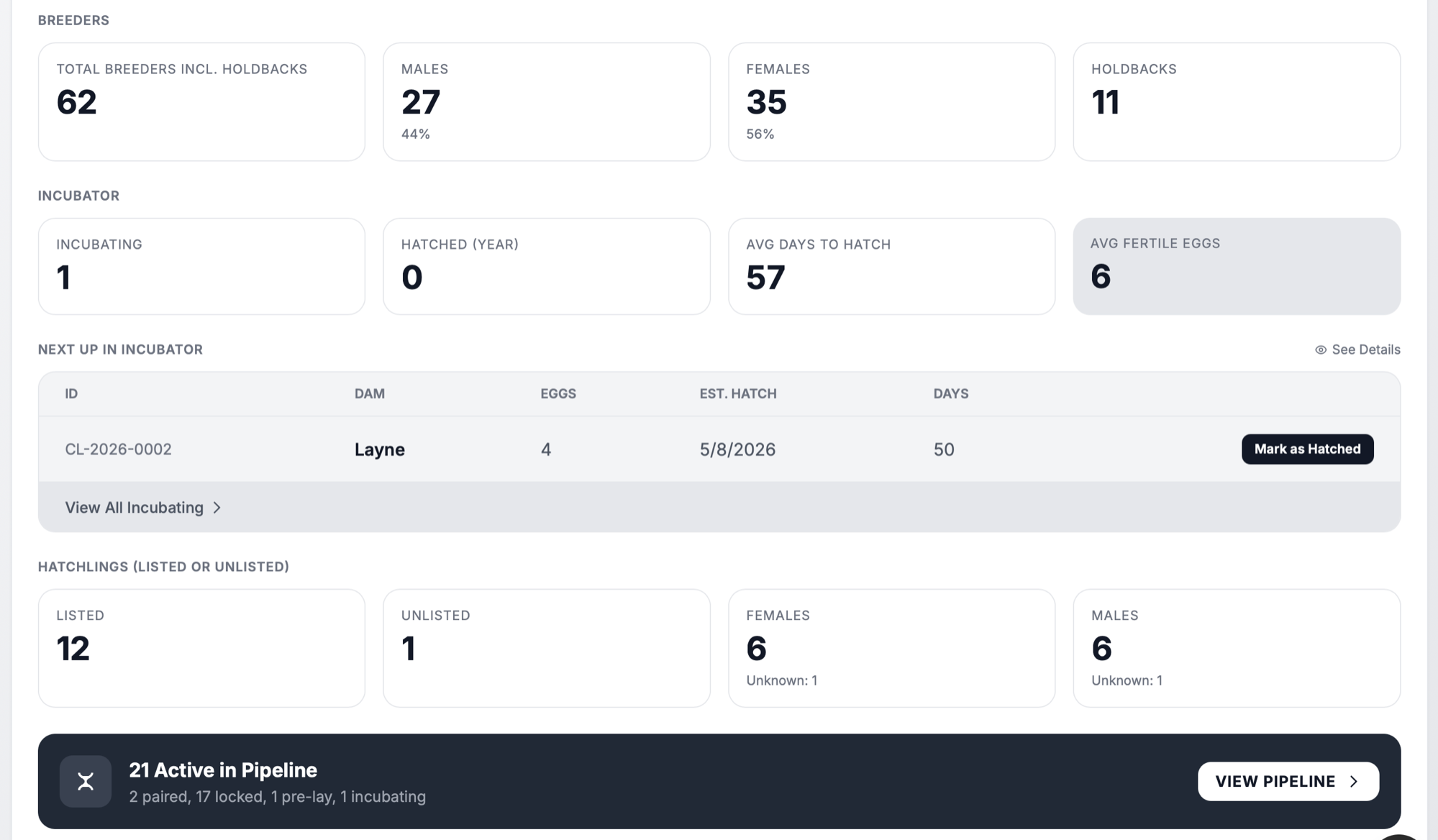
Want this exact incubator view for your clutches?
Every clutch. Every countdown. One screen.
THE RACK tracks sire and dam, calculates hatch dates from your incubation settings, and logs hatchlings directly into the system with genetics inherited from the parents. No manual data entry. No broken lineage.
See THE RACKWhy This Data Compounds
A single clutch record is useful for one season. Five seasons of clutch records are a strategic asset. When you can look at a female and see her clutch history across years; fertility rates, egg counts, hatch success, offspring quality; you make fundamentally different decisions about your program.
You know which females consistently produce large, healthy clutches. You know which males pair well with specific females based on lock rates and clutch results. You know whether your incubation protocol is improving or drifting. You know what your program produces, not what you hope it produces.
Every clutch record you skip is a season of data you cannot reference later. Every one you keep is a building block for decisions that get smarter over time.
Built by a Breeder
From pairing to pip.
Every clutch tracked.
Sire and dam linked. Automatic hatch date calculation. Breeding pipeline integration. Hatchling records with inherited genetics. THE RACK manages your clutches the way your program produces them; connected, documented, and ready for the next season.
See THE RACKFree for up to 5 animals. Keeper $10/mo. Breeder $20/mo. 7-day money-back guarantee.