
News / Ball Python Egg Incubation Guide: Temp, Humidit...
Ball Python Egg Incubation Guide: Temp, Humidity, Timeline
- Incubation temperature: 88-90F. 89F is the sweet spot most breeders target.
- Humidity: 90-100%. Perlite or vermiculite mixed 1:1 by weight with water holds moisture consistently.
- Hatch timeline: 55-60 days from lay date. Some clutches go as early as 52 or as late as 65.
- Do not rotate eggs. Mark the tops on day 0 and leave them in place.
- When a hatchling pips, do not help unless 48+ hours pass with zero progress.
Ball python eggs need consistent warmth and high humidity for approximately 55-60 days. The incubation process is straightforward once you understand the parameters, but small mistakes in temperature or moisture can have serious consequences. This guide covers everything from the moment the female lays to the moment the first hatchling pips.
In This Guide
The Parameters
Ball python egg incubation has a narrow window. Stay inside it, and hatching success rates are high. Drift outside of it, and you risk developmental problems, dead-in-egg, or deformities.
- Temperature: 88-90F. This is the target range. 89F is the sweet spot most breeders aim for.
- Humidity: 90-100%. The incubation medium and container should maintain near-saturation humidity.
- Duration: 55-60 days from the date the eggs are laid. Some clutches go as early as 52 days; others stretch to 65. The majority fall in the 55-60 window.
Logging these parameters for each clutch gives you data you can reference season after season. THE RACK lets you log incubation temperatures, humidity readings, lay dates, and expected pip dates per clutch. When you are running multiple clutches simultaneously, having this information organized in one place changes everything.
Want clutch data and incubation logs in one system?
Every Clutch. Every Parameter. All Logged.
THE RACK tracks lay dates, incubation temps, egg counts, and expected pip dates per clutch. When you are managing a full incubator, the data keeps you ahead of every hatch window.
See Clutch ToolsSetting Up the Incubator
Incubator Options
You have two main paths: a purpose-built reptile incubator or a DIY setup using a modified cooler or cabinet.
Purpose-built incubators (like the Hova-Bator, ReptiPro, or GQF models) come with built-in heating elements and thermostats. They work well and require minimal modification. The main consideration is capacity; make sure the incubator fits the number of egg containers you plan to run simultaneously.
DIY incubators use an insulated cooler or cabinet, a heat source (heat tape, heat cable, or a small ceramic heat emitter), and a thermostat. The advantage is customization and capacity. Many breeders build walk-in incubation rooms or large cabinet incubators handling dozens of clutches at once.
Incubation Medium
The incubation medium holds moisture and keeps humidity levels stable around the eggs. The two most common options:
- Perlite. Mixed with water at roughly a 1:1 ratio by weight. The perlite should be damp enough to clump when squeezed but not so wet water drips out. This is the traditional method and it works well.
- Vermiculite. Same mixing ratio and principles as perlite. Vermiculite holds more water than perlite, so it requires less frequent rehydration.
Some breeders skip the medium entirely and use a "no-medium" or suspended egg method, where eggs sit on a plastic grate above a water reservoir. This method works but requires more precise humidity control in the incubator chamber itself.
The Egg Container
A plastic shoebox-size container with a snap-on lid works well. Drill a few small ventilation holes in the sides (not the top). Fill the bottom 2-3 inches with your incubation medium. Place the eggs on top of the medium, spaced so they are not touching the container walls.
If the eggs are stuck together in a cluster (common with ball pythons), do not separate them. They are fine incubating as a group. Attempting to pull them apart can tear the shells.
PRINT YOUR CLUTCH CARD
This is an import piece of data that should get taped to the lid of every clutch within your incubator. If you are a user of The Rack you will automatically be able to print these with data prefilled to moment you log a clutch.

Target Parameters
88-90F incubation temperature. 90-100% humidity. 55-60 days to hatch. Stay inside these windows.
From Lay Day to Pip Day
Day 0: Egg Collection
After the female lays, allow her to remain with the clutch for a few hours unless she is showing signs of distress. When you collect the eggs, mark the top of each egg with a soft pencil or marker. Eggs should not be rotated during incubation; the embryo orients itself within the first few hours, and flipping the egg can drown it.
Count the eggs. Note any slugs (infertile eggs). Slugs are typically smaller, yellowed, and irregular in shape compared to fertile eggs, which are white, plump, and uniformly round or slightly elongated.
Week 1-2: Initial Check
Resist the urge to open the incubation container frequently. Every time you open it, you disrupt the microclimate. Check once every 3-5 days during the first two weeks to confirm humidity levels and look for obvious problems (mold, collapsed eggs).
Healthy eggs will remain white and firm. A small amount of condensation on the inside of the container lid is normal and indicates good humidity. Excessive pooling of water means the medium is too wet; remove the lid for a few hours to let excess moisture evaporate.
Week 3-6: The Wait
This is the long stretch. Maintain temperature and humidity. Check every 5-7 days. Healthy eggs often develop visible veining when candled (held up to a light in a dark room). Some breeders candle to confirm fertility; others prefer not to handle the eggs at all during this period. Both approaches work.
Around day 30-40, fertile eggs often start to "sweat," developing small water droplets on the shell surface. This is normal. It indicates the embryo is metabolizing and the egg is exchanging gases properly.
Day 50+: Pre-Pip Signs
As hatch day approaches, eggs can dimple slightly or develop a chalky, translucent appearance. These are normal signs of the embryo preparing to pip. Do not panic. Do not open the egg. The hatchling will cut through the shell on its own with its egg tooth.

The Rack App manages all clutches so that you do not miss a single detail.
Consistent conditions hatch healthy clutches.
Pipping and Hatching
Pipping is the moment the hatchling cuts through the eggshell with its egg tooth. You will see a small slit or opening in the shell. From the first pip, it can take 24-48 hours for the hatchling to fully emerge. This is normal.
Do Not Help
The instinct to help a slow hatchling is strong. Resist it. The hatchling is absorbing its yolk sac during this period. Pulling it out of the egg early can result in a torn or unabsorbed yolk sac, which can be fatal. Let the snake emerge on its own timeline.
The exception: if a hatchling has pipped but shows no progress after 48 hours and appears stuck, you can carefully enlarge the pip hole with small scissors. Do not pull the snake out. Enlarge the opening and let the snake exit on its own. If you see an attached yolk sac, leave it alone. The snake will absorb it.
Staggered Hatching
Not all eggs in a clutch pip at the same time. It is common for the first egg to pip 12-48 hours before the last. Do not remove hatched babies from the incubation container immediately. Let them sit until all eggs have hatched or until it is clear the remaining eggs are not going to pip.
Troubleshooting
Moldy Eggs
A small amount of surface mold on an egg is common and usually harmless. Gently wipe it off with a dry cotton swab. If mold is spreading aggressively across multiple eggs, your humidity is too high or ventilation is insufficient. Increase airflow by adding or enlarging ventilation holes in the container.
Collapsed or Dented Eggs
Eggs denting or collapsing early in incubation are usually dehydrating. Add a small amount of water to the incubation medium (not directly on the eggs). If the egg was fertile, it can plump back up within 24-48 hours. If it stays collapsed and turns yellow, it was likely infertile or the embryo died early.
Temperature Spikes
A brief spike to 92-93F is not ideal but is usually survivable. Sustained temperatures above 94F cause developmental problems and death. If your incubator overheats, open the lid to vent heat immediately and troubleshoot the thermostat. This is why a quality thermostat with an accurate probe is non-negotiable.
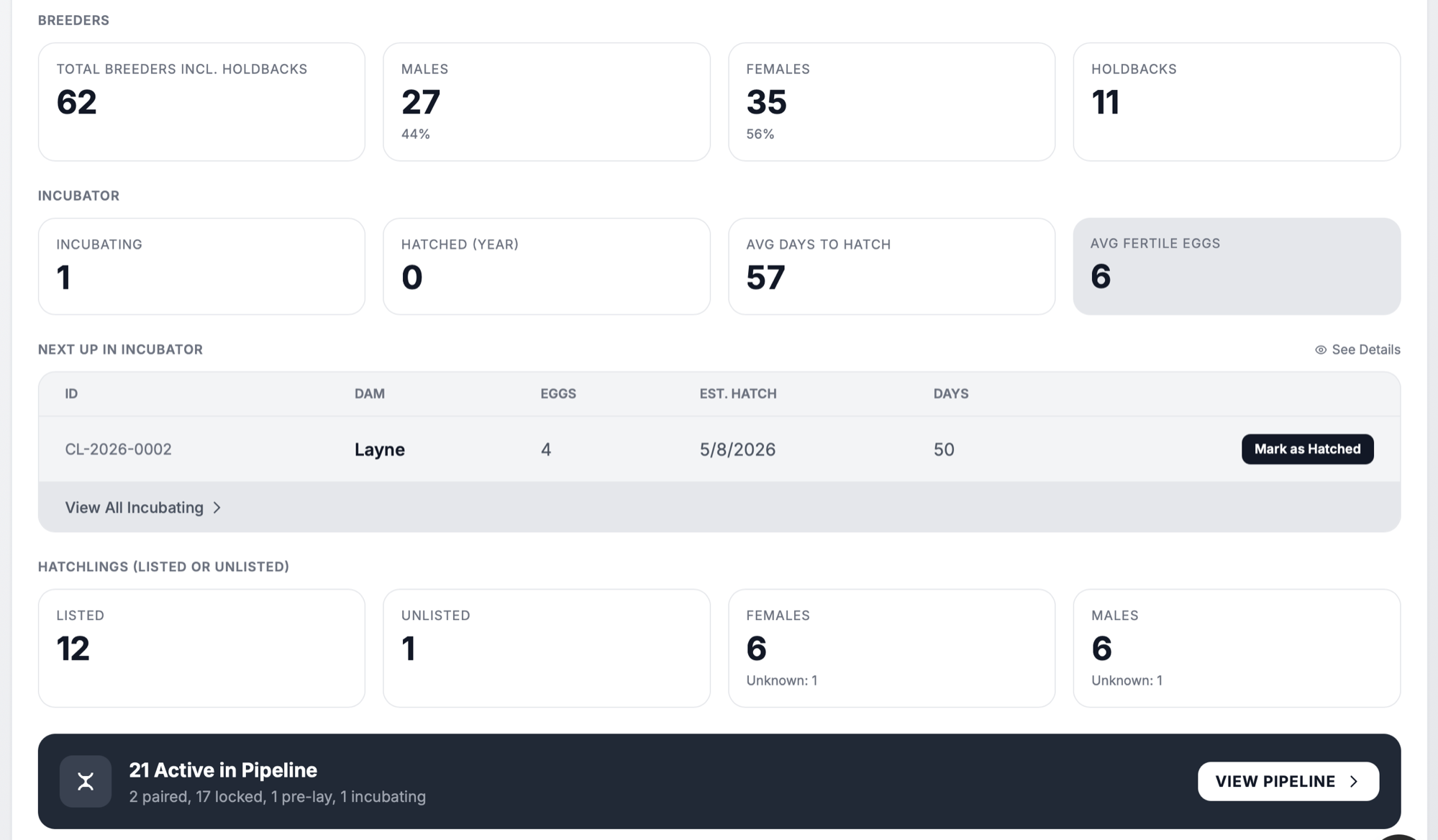
Want every clutch logged from lay to hatch?
Clutch Tracking, From Egg to Hatchling
THE RACK logs lay dates, egg counts, incubation parameters, pip dates, and hatchling outcomes for every clutch. Season-to-season data builds year after year.
See Breeding ToolsMaternal Incubation vs. Artificial Incubation
Ball pythons are one of the few snake species exhibiting maternal incubation. The female coils around the eggs and uses muscular contractions (shivering) to generate heat. She will stay coiled for the entire incubation period, leaving the eggs only to drink.
Maternal incubation works. Females have been hatching their own eggs successfully for millions of years. The practical concern for breeders: the female loses significant body condition during the 55-60 day incubation period because she is not eating. Artificial incubation allows you to remove the eggs, begin recovering the female's weight immediately, and control the incubation parameters more precisely.
Most breeders use artificial incubation. If you choose maternal incubation, provide a large water bowl within reach and monitor the female's body condition throughout. She will need aggressive recovery feeding after the eggs hatch.
Incubation Checklist
Mark the tops of eggs on day 0. Do not rotate. Check humidity every 3-5 days. Do not assist pipping unless 48+ hours with no progress.
Content verified against THE RACK breeding database. Incubation parameters and timelines sourced from active breeder clutch records. Last reviewed April 2026.
Built by a Breeder
Every Clutch,
From Lay to Hatch
Clutch tracking. Incubation logging. Pip date projections. Hatchling records. THE RACK manages your entire breeding season in one system.
See THE RACKFree for up to 5 animals. Keeper $10/mo. Breeder $20/mo. 7-day money-back guarantee.