
News / Tub vs Tank vs PVC: Best Ball Python Enclosure?
Tub vs Tank vs PVC: Best Ball Python Enclosure?
- Glass tanks: Best visibility, worst humidity retention. Good for 1-2 pet ball pythons in a display setup.
- Tubs in rack systems: Best humidity and heat control, lowest cost. The standard for breeders and multi-animal keepers.
- PVC enclosures: Best balance of display quality and climate control. Higher cost, professional look.
- All three work. The right choice depends on your budget, your space, and how many animals you keep.
There is no single best enclosure for a ball python. Tubs, glass tanks, and PVC enclosures all work. The right choice depends on how many animals you keep, what your budget looks like, and what matters most to you in terms of visibility, humidity control, and space. Here is an honest comparison.
In This Guide
Glass Tanks
Glass terrariums are where most people start. They are available at every pet store, they look good in a living room, and they let you see the animal without opening the enclosure. For a single pet ball python in a visible part of your home, glass is a solid choice.
Pros
- Visibility. Clear on all sides. You can observe the snake without disturbing it.
- Availability. Sold at every pet store. Easy to find in standard sizes (20 gallon, 40 gallon breeder).
- Aesthetics. Looks clean in a bedroom, office, or living room setup.
- Accessories. Wide range of screen lids, light fixtures, and mounting hardware designed for glass tanks.
Cons
- Humidity loss. Screen tops vent moisture rapidly. You will fight humidity in dry climates unless you modify the lid (covering part of the screen with foil or HVAC tape).
- Heat retention. Glass loses heat faster than plastic or PVC. Heating costs are higher and temperature gradients are harder to maintain.
- Weight. A 40-gallon glass tank is heavy. Moving, cleaning, and stacking are all harder.
- Cost at scale. One glass tank is affordable. Twenty is expensive and takes up far more space than equivalent tub or rack setups.
- Stress potential. Clear sides on all four walls can make some ball pythons feel exposed. Covering three sides with background material helps.
The enclosure calculator can help you figure out the right size tank for your snake's current weight and length.
Want enclosure assignments and maintenance schedules in one system?
Know Where Every Animal Lives. Know When It Needs Attention.
THE RACK ties each animal to its enclosure and builds maintenance schedules around your setup. Spot cleaning, deep cleans, substrate changes; all logged.
See Enclosure ToolsPlastic Tubs (Rack Systems)
Tubs in a rack system are the standard for anyone keeping more than a handful of ball pythons. They are inexpensive, efficient, and excellent at holding humidity and heat. Most breeders use tubs.
Pros
- Humidity and heat retention. The tight-fitting lid seals in moisture and warmth. Humidity stays in the 55-70% range without modification in most environments.
- Space efficiency. Rack systems stack tubs vertically, housing many animals in a small footprint.
- Cost. A tub costs a fraction of what a glass tank or PVC enclosure costs. At scale, the savings are significant.
- Easy to clean. Smooth plastic. No corners for waste to collect. Wipe, rinse, done.
- Security. Ball pythons feel secure in the enclosed space. No open sides to cause stress.
Cons
- No visibility. You cannot see the snake without opening the tub. Daily observation requires physically pulling the tub out.
- Requires a rack. Tubs need a rack system to be practical. Standalone tubs on a shelf work but are less efficient.
- Aesthetics. A rack system looks like a utility setup, not a display piece. Fine for a snake room; not ideal for a living room.
- Ventilation. Tubs need properly sized ventilation holes. Over-ventilating kills humidity. Under-ventilating causes stale air and condensation buildup.
Practical Reality
Most breeders use tubs in rack systems for the bulk of their animals. They are the most practical, cost-effective enclosure for ball pythons at any scale beyond a few individuals.
PVC Enclosures
PVC enclosures sit between glass tanks and tubs. They offer better humidity and heat retention than glass, better visibility than tubs, and a cleaner look than either. The tradeoff is price and lead time.
Pros
- Humidity retention. PVC holds humidity well without modification. Front-opening doors seal tighter than screen tops.
- Heat efficiency. PVC is a better insulator than glass. Heating costs are lower and gradients are easier to maintain.
- Front-opening access. Approaching from the front is less startling than reaching in from above (as with glass tanks or tubs).
- Built-in features. Many PVC enclosures come with integrated cord ports, light fixtures, and lock systems.
- Stackable. Designed to stack. A column of PVC enclosures looks clean and uses vertical space well.
- Display quality. Clear front panel provides good visibility while three solid sides keep the snake feeling secure.
Cons
- Cost. A quality PVC enclosure runs significantly more than a glass tank or tub. Outfitting an entire room gets expensive.
- Lead time. Custom and semi-custom PVC enclosures often have wait times measured in weeks or months.
- Weight. Lighter than glass, heavier than tubs. A stacked column of PVC enclosures is a permanent fixture.
- Not ideal for rack-scale operations. For breeders housing large numbers of animals, the cost per enclosure makes PVC impractical compared to tubs in racks.
The best enclosure is the one the snake thrives in.
Which One Should You Choose?
If You Have One or Two Ball Pythons as Pets
Glass tank or PVC enclosure. Either gives you visibility, display quality, and a setup you are proud to show people. Modify the glass tank's screen top to manage humidity, or go PVC if you want better climate control out of the box.
If You Are Starting a Breeding Program
Tubs in a rack system. The cost savings compound fast when you are housing multiple animals, and the climate control benefits are real. You can always add a few PVC display enclosures later for your favorite animals or holdbacks.
If You Want the Best of Both Worlds
PVC enclosures offer display quality with tub-level humidity retention. The cost is higher, but for a small to medium program where you want your setup to look professional, PVC is a strong middle ground.
Enclosure Size Guidelines
Regardless of enclosure type, ball pythons need enough space to stretch out and thermoregulate. A general guideline: the enclosure's length plus width should equal or exceed the snake's total length. A 4-foot ball python does well in a 36" x 18" enclosure or equivalent.
- Hatchlings: 6-quart to 15-quart tub, or 10-gallon tank.
- Juveniles: 28-quart to 41-quart tub, or 20-gallon tank.
- Adults: 70-quart+ tub, 40-gallon breeder tank, or 4' x 2' x 2' PVC enclosure.
Bigger is not always better for ball pythons. A large, open enclosure without enough clutter and hides can make the snake feel exposed. Fill the space with appropriate furnishing before sizing up.
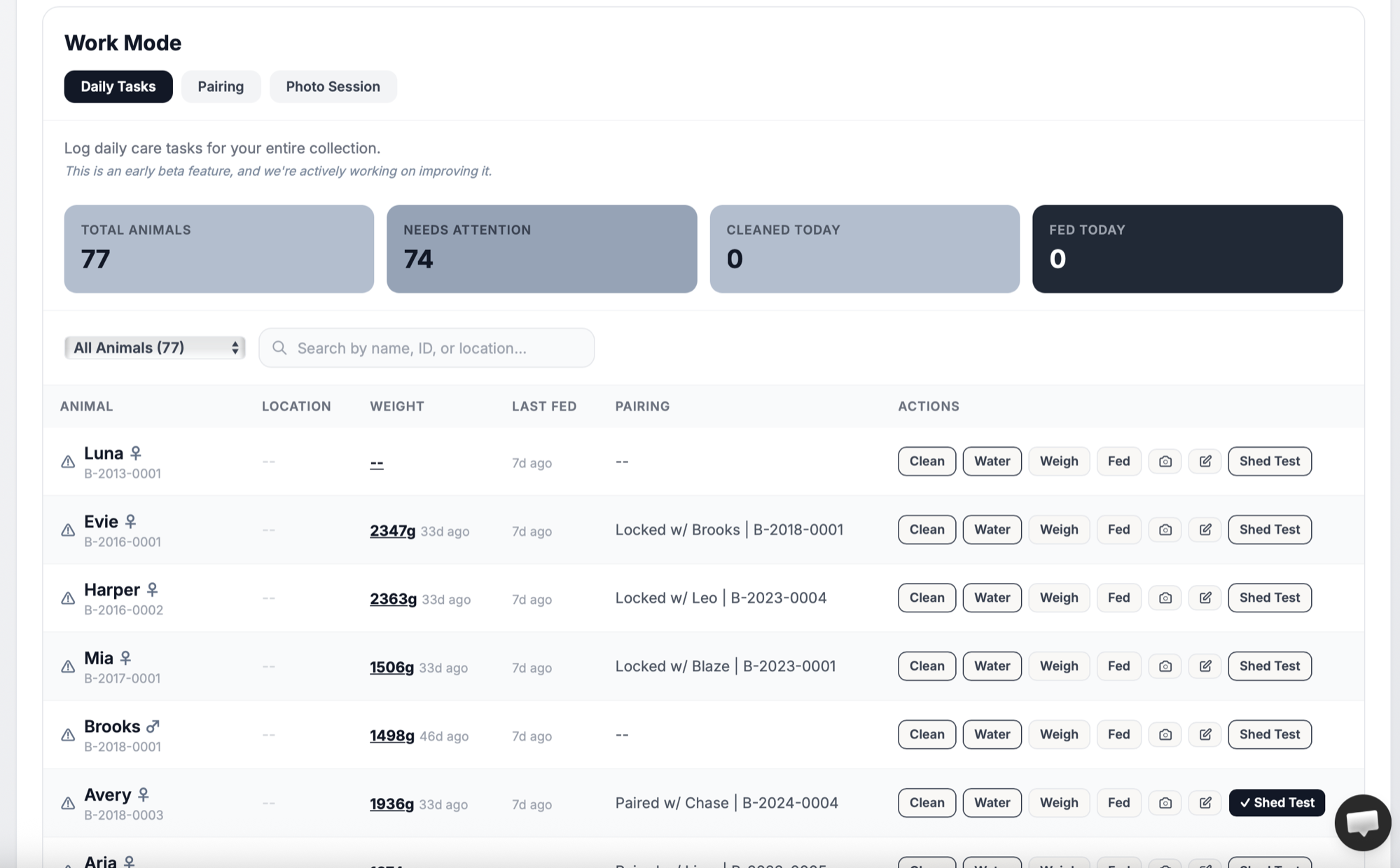
Want maintenance schedules tied to every enclosure?
Every Tub, Every Tank, Every Task Logged
THE RACK assigns each animal to its enclosure and builds maintenance schedules around your setup. Cleaning, substrate changes, and equipment checks; all in one place.
See How It WorksMaintenance Comparison
- Glass tanks: Spot clean weekly. Deep clean with full substrate change monthly. Screen top collects dust and debris; wipe down regularly. Glass cleaner for visibility.
- Tubs: Spot clean weekly. Deep clean monthly. Smooth plastic surfaces make full sanitization fast. Replace tubs if they crack or warp.
- PVC enclosures: Spot clean weekly. Deep clean monthly. PVC resists warping and holds up to repeated sanitization. Front-opening doors make access easy without disturbing the snake.
Whichever enclosure you use, consistency matters more than frequency. A maintenance schedule you follow every time is more effective than an aggressive schedule you forget about. Logging cleaning dates helps you see patterns and catch things before they become problems.
Bottom Line
All three enclosure types work for ball pythons. The right choice depends on your budget, your space, and how many animals you are managing.
Content verified against THE RACK breeding database. Enclosure parameters and husbandry ranges sourced from active breeder programs. Last reviewed April 2026.
Built by a Breeder
Your Facility,
Organized
Enclosure assignments. Maintenance logs. Husbandry parameters. THE RACK manages your facility so nothing falls through the cracks.
See THE RACKFree for up to 5 animals. Keeper $10/mo. Breeder $20/mo. 7-day money-back guarantee.