
News / Is Ball Python Breeding Profitable? An Honest B...
Is Ball Python Breeding Profitable? An Honest Breakdown
- Most breeders operate at a loss for the first 1-2 years. Break-even typically lands in year 2-3.
- Feeding costs, holding costs, and electricity are the expenses catching new breeders off guard.
- Genetics strategy determines your revenue ceiling. Multi-gene projects with demand sell faster at higher margins.
- Underpricing is the most common profitability killer. Know your cost per hatchling before setting a price.
- The difference between a profitable program and an expensive hobby is knowing your numbers from day one.
Ball python breeding can be profitable. But "can be" is doing a lot of work in this sentence. The honest answer is most breeders spend more than they earn in the first couple of years, and profitability depends on genetics investment, overhead control, and whether you treat the program like a business or a hobby sometimes selling a snake.
In This Guide
The Honest Timeline
If you start from scratch, buying your first breeding animals and building your infrastructure today, expect to operate at a loss for the first 1-2 years. Break-even typically lands in year 2-3 for breeders who are intentional about their investment and their pricing.
Here is why. Your first major expenses happen before you sell a single hatchling. Breeding stock. Enclosures. Rack systems. Heat. Thermostat equipment. Incubation setup. Feeders for months or years before your females are large enough to breed. These costs stack up before any revenue comes in.
Then there is the time factor. A female ball python needs to reach breeding weight (1,500g minimum, ideally 1,700g+). Depending on when you acquire her and her age at purchase, this could be 1-3 years of feeding and housing before she produces her first clutch. And her first clutch might be small.
This is not a business producing income in month three. Knowing your numbers, from day one, is the difference between a strategic ramp-up and a slow bleed. THE RACK gives you sales data, expense tracking, and ROI per clutch so you always know where you stand.
Want to see your real numbers from day one?
Sales. Expenses. ROI. All in One Place.
THE RACK tracks every sale, every expense, and calculates ROI per clutch and per animal. When you know the real numbers, you make better decisions.
See Sales HQThe Costs Nobody Talks About
New breeders budget for the obvious expenses: breeding animals, enclosures, feeders. The costs catching people off guard are the ongoing ones.
Feeding Costs
Every animal eats whether it produces income or not. Your entire collection consumes feeders every week. Breeding females eat more during conditioning. Hatchlings eat frequently. Males eat during the off-season and fast during breeding season (but they still need housing, heating, and maintenance). The feeding cost calculator helps you project annual feeding costs before they surprise you.
The Cost of Unsold Animals
A hatchling not selling in 60 days is an animal you are feeding, housing, and maintaining at your expense. Multiply this by 10 unsold hatchlings, and the holding cost adds up fast. This is one of the most overlooked expenses in breeding. Every day an animal sits in your rack unsold, it is consuming resources.
Electricity
Heat pads, ceramic heat emitters, radiant heat panels, and room heating for your snake room run 24/7 for 365 days. The electricity cost for a dedicated snake room is a real line item. It scales with the number of enclosures.
Veterinary Care
Reptile vet visits are not cheap. Egg binding, respiratory infections, prolapse, or other emergencies can cost hundreds of dollars per visit. You need a vet budget even if you never use it. Because when you need it, you need it immediately.
Expo Costs
Table fees, travel, hotel stays, food, and the time spent away from your day job or other responsibilities. Expos are a primary sales channel for many breeders, but they are not free. A table at a major show can run several hundred dollars before you factor in travel.
Reality Check
Every animal in your facility costs money every single day whether it produces income or not. Profitable breeders know their holding cost per animal. Do you?
What Makes a Breeding Program Profitable
Genetics Strategy
The animals you choose to invest in determine your revenue ceiling. Breeding common single-gene morphs in a saturated market produces low-margin hatchlings difficult to sell. Investing in multi-gene projects with strong demand produces hatchlings commanding higher prices and sell faster.
This does not mean you need to spend a fortune on founder animals. It means you need a plan. What morphs are you working with? What are the expected outcomes per pairing? How many generations will it take to produce the combos you are aiming for? A clear project planner maps this out and keeps your investment focused.
Expense Awareness
Profitable breeders know their numbers. They know what each animal costs to maintain per month. They know their total feeding bill. They know their electricity cost. They know how long an unsold hatchling has been sitting and the holding cost per animal. This information is not optional; it is the foundation of every pricing decision and every purchase decision.
Pricing Discipline
Underpricing is the most common profitability killer. New breeders price hatchlings based on what other breeders are asking instead of what the animal costs to produce. If your breeding female cost thousands, you fed her for two years, she produced 6 eggs, and you price the hatchlings to match the lowest listing on the market, you will never break even.
Know your cost-per-hatchling. Factor in the female's acquisition cost, feeding, housing, incubation, the male's contribution, and the time invested. Then price accordingly.
Sales Velocity
A hatchling sold in 30 days costs a fraction of a hatchling sold in 180 days. Speed of sale matters for profitability. Good photography, accurate morph descriptions, fair pricing, and consistent presence on sales platforms all contribute to faster sales.
A breeding program is a business. Treat the numbers like it.
A Realistic First-Year Scenario
Here is a broad picture of what year one might look like for a new breeding program. These are general ranges, not specific prescriptions.
Startup Expenses
- Breeding stock (2-4 females, 1-2 males): This varies enormously depending on genetics. Budget anywhere from a few thousand to well beyond ten thousand for quality multi-gene breeders.
- Rack system and tubs: A few hundred to more than a thousand depending on size and quality.
- Heating, thermostats, humidity equipment: Several hundred.
- Incubator: A hundred to a few hundred depending on whether you go commercial or DIY.
- Initial feeder stock: A few hundred for a bulk order of frozen rats.
Year One Revenue
If your females are already breeding age, you might see your first clutch hatch by the end of year one. If they are younger, you are feeding and waiting. Revenue in year one for many new breeders is zero. This is normal.
Year Two and Beyond
Clutches start coming. Hatchlings start selling. Revenue begins. Whether it covers your expenses depends on your genetics strategy, your pricing, and your sales execution. Most programs intentional about their genetics and disciplined about their expenses break even in year 2-3.
Some programs never break even because the breeder treats it as a hobby and does not manage the financial side. There is nothing wrong with breeding as a hobby. But if the question is "is it profitable," the answer depends entirely on whether you run it like a business.
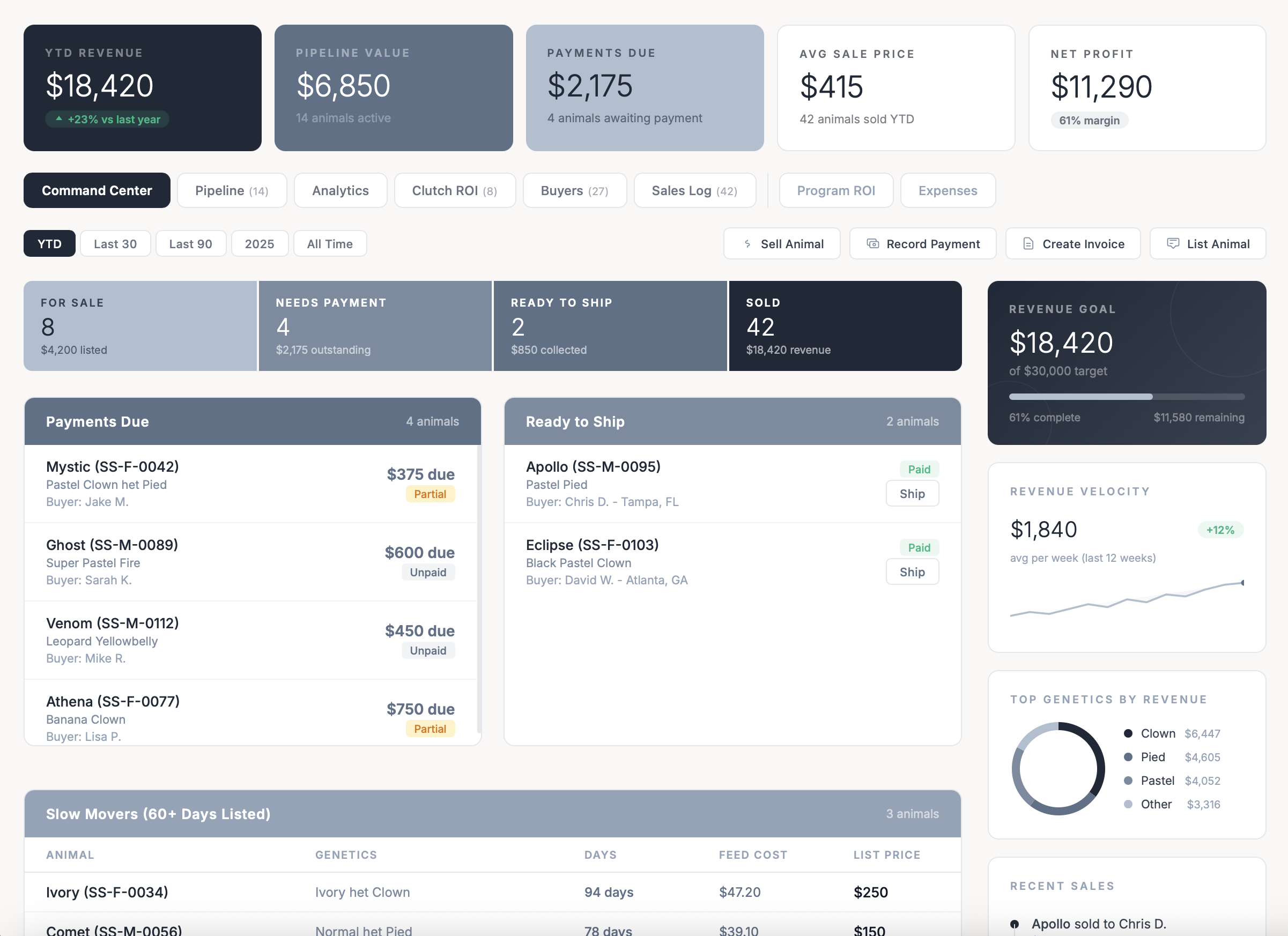
Want to know your real cost per animal and ROI per clutch?
Run Your Program Like a Business
THE RACK's Sales HQ shows you revenue, expenses, cost per animal, ROI per clutch, and holding costs. The numbers you need to make profitable decisions.
See Sales HQThe Uncomfortable Truth
Ball python breeding is not a get-rich path. The breeders who make a living at it have been at it for years, have significant collections, and treat every dollar in and out with discipline. They know their feeding costs down to the animal. They know their ROI per clutch. They know which morphs sell and which sit.
If you go in expecting passive income from a small collection, you will be disappointed. If you go in with a plan, a realistic timeline, and a commitment to running the numbers, you can build something paying for itself and eventually generates real income.
The difference between those two outcomes is not luck. It is data.
The Bottom Line
Ball python breeding is profitable for breeders who treat it like a business. Break even in year 2-3. Profitability from there depends on genetics strategy, expense management, and sales execution.
Content verified against THE RACK breeding database. Cost structures and profitability timelines sourced from active breeder financial data. Last reviewed April 2026.
Built by a Breeder
Your Numbers,
In One System
Sales tracking. Expense management. ROI per clutch. Cost per animal. Feeding cost projections. THE RACK gives you the business tools to run a profitable program.
See THE RACKFree for up to 5 animals. Keeper $10/mo. Breeder $20/mo. 7-day money-back guarantee.