
News / Your First Ball Python: A 30-Day Guide for New ...
Your First Ball Python: A 30-Day Guide for New Owners
- Days 1-3: Do not handle, do not feed. Let the snake acclimate in a fully set up enclosure.
- Days 5-7: Offer the first frozen-thawed meal at dusk. One refusal is normal.
- Days 7-14: Start short handling sessions (5-10 minutes). Weigh the snake and record your baseline.
- By day 30, the goal is a snake that eats on schedule, sheds cleanly, and tolerates handling.
The first 30 days with a new ball python set the tone for everything after. How you handle acclimation, first feedings, and early handling determines whether your snake settles in comfortably or spends weeks stressed and hiding. This is the day-by-day playbook.
In This Guide
Before the Snake Arrives: Enclosure Setup
Set up the enclosure and have it running for at least 24-48 hours before the snake arrives. This gives you time to dial in temperatures and humidity before a live animal is depending on them.
The Essentials
- Enclosure: Appropriately sized for the snake. A 20-gallon tank, 28-41 quart tub, or equivalent PVC enclosure works for most juveniles and sub-adults. For a deeper comparison, see our guide on tub vs. tank vs. PVC enclosures.
- Heat source on a thermostat: Hot side surface temperature 88-92F. Cool side 76-80F. A heat pad with a thermostat is the simplest setup for beginners.
- Two hides: One on the warm side, one on the cool side. The snake needs to feel secure on both ends of the thermal gradient. Snug hides where the snake's body touches the walls are better than oversized ones.
- Water bowl: Large enough for the snake to soak in. Clean, fresh water. Replace every 2-3 days or sooner if soiled.
- Substrate: Coconut fiber, cypress mulch, or paper towels. Paper towels are easiest for monitoring health during the first 30 days (you can see feces, urates, and mites clearly).
- Thermometer and hygrometer: Digital. Measure both the hot side and cool side. Humidity target: 55-65%.
Once the enclosure is set up and stable, you are ready. Logging feedings, sheds, weights, and health notes from day one gives you a record you can look back on. THE RACK's free tier covers up to 5 animals, which is more than enough for a new keeper getting started.
Starting with your first ball python?
Log Feedings, Weights, and Sheds From Day One
THE RACK's free tier covers up to 5 animals. Feeding logs, weight tracking, shed records, and health notes. Everything a keeper needs, at no cost.
Get Started FreeDays 1-3: Arrival and Acclimation
Day 1: Placement
When the snake arrives, place it in the enclosure and close the lid. Do not handle it. Do not peek at it every 30 minutes. Do not introduce it to the family. The snake has been through transport, a new environment, and new scents. It needs time to settle.
Confirm your temperatures and humidity are correct. Make sure the water bowl is full. Then walk away. The best thing you can do on day one is nothing.
Day 2-3: Observation Only
Do not handle the snake. Do not offer food. The snake is still acclimating. It may stay in one hide for the entire time, or it may explore at night. Both are normal. Check temperatures and water bowl once a day. Keep the room quiet and the enclosure undisturbed.
If you see the snake soaking excessively in the water bowl during these first days, check your hot side temperature (it might be too high) and humidity (it might be too low). Brief soaking is fine. Sitting in the water bowl all day is a sign something is off.
Day 1-3 Rule
Do not handle. Do not feed. Let the snake settle. The best thing you can do in the first 72 hours is leave it alone.
Days 4-7: First Feeding
Day 5-7: Offer the First Meal
After 5-7 days of acclimation with no handling, offer the first meal. Use a frozen-thawed prey item appropriate for the snake's size. Thaw and warm it thoroughly (see our prey sizing guide for the right size based on weight).
Offer at dusk with lights dimmed. Use long feeding tongs. Present the prey near the hide entrance. Gentle, slow movements. If the snake takes it, great. If it refuses, remove the prey after 15-20 minutes and try again in 5-7 days.
A first-feeding refusal is common. The snake is still adjusting. Do not panic. Do not try a different prey type the next day. Wait a full cycle and try again with the same approach.
If the Snake Eats
Leave it alone for 48 hours after feeding. No handling. The snake needs to digest in peace. Handling after a meal increases the risk of regurgitation, which is stressful for the snake and worrying for you.
If the Snake Refuses
Wait 5-7 days and try again. Check your husbandry: is the hot side at 88-92F? Is humidity at 55-65%? Are the hides snug enough? Nine times out of ten, a new ball python refusing food in the first week is still acclimating, and the second attempt goes smoothly.
The first 30 days are about building trust.
Days 7-14: First Handling and Settling In
Day 7-10: First Handling Session
After the snake has eaten at least once (or after 10 days if it has not eaten yet but is otherwise healthy), you can start handling. Keep the first sessions short: 5-10 minutes. Support the snake's body fully. Let it move through your hands at its own pace. No sudden movements.
Handle during the early evening when the snake is naturally more alert. Avoid handling during the day when it is likely in deep rest. Do not handle within 48 hours of feeding or during a shed cycle (cloudy eyes, dull skin).
Day 10-14: Establishing Routine
By the end of week two, you should have a feeding schedule established (every 5-7 days for juveniles, every 7-14 days for sub-adults and adults). Handle 2-3 times per week, 10-15 minutes per session. Consistency builds trust. The snake learns your scent, your movements, and the routine.
Weigh the snake. Record the weight. This is your baseline. From here, weigh every 1-2 weeks and log it. A consistent weight record helps you spot problems early and confirms your feeding program is working.
Days 1-3: Hands Off
Place the snake in its enclosure. No handling, no feeding. Check temps and water once a day.
Days 5-7: First Feeding Attempt
Offer a frozen-thawed prey item at dusk. If refused, wait 5-7 days and try again.
Days 7-10: First Handling
Short sessions of 5-10 minutes. Support the body fully. No handling within 48 hours of feeding.
Days 10-14: Establish Routine
Set a feeding schedule. Handle 2-3 times per week. Weigh and record your baseline.
Days 14-30: Monitor and Confirm
Watch for feeding consistency, healthy sheds, and normal behavior. Log everything.
Days 14-21: Watching for Problems
By week two and three, you know the snake's baseline behavior. Now you are watching for anything deviating from it.
What to Monitor
- Feeding response: Is the snake eating consistently? One refusal is fine. Three in a row means check your husbandry.
- Activity level: Ball pythons are not active snakes, but they should explore at night. If the snake has not moved from one spot in days and is not in shed, investigate.
- Breathing: Listen for wheezing, clicking, or open-mouth breathing. These are signs of respiratory infection and need veterinary attention.
- Feces and urates: Healthy feces are dark brown and firm. Urates are white and chalky. Runny feces, foul smell, or green-tinged urates are red flags.
- Skin condition: Look for retained shed (stuck eye caps, patches of old skin), mites (tiny black specks around the eyes or in the water bowl), and sores or discoloration.
Your First Shed
The snake will likely shed within the first 30 days. You will notice the belly turning pink, the eyes turning milky blue, and the skin looking dull. This phase lasts about 7-10 days. Do not handle during shed. Keep humidity at 60-70% (a bump above normal helps). The snake should shed in one complete piece. A partial shed (pieces coming off in patches) indicates humidity is too low.
Days 21-30: Routine Established
By the end of the first month, your snake should be eating on a schedule, tolerating handling, and behaving predictably. You have a baseline weight, at least two or three feeding records, and you know what "normal" looks like for this animal.
Your Ongoing Checklist
- Weigh every 1-2 weeks. Log it.
- Feed on schedule. Log every meal and every refusal.
- Spot clean the enclosure weekly. Full clean monthly.
- Check temperatures and humidity daily.
- Handle 2-3 times per week. Keep sessions 10-15 minutes.
- Watch for signs of illness: respiratory sounds, feeding refusal streaks, abnormal feces, mites, retained shed.
All of this data; feedings, weights, sheds, health notes; builds a record you can reference for the life of the animal. Starting it in the first 30 days means you never have to recreate it later.
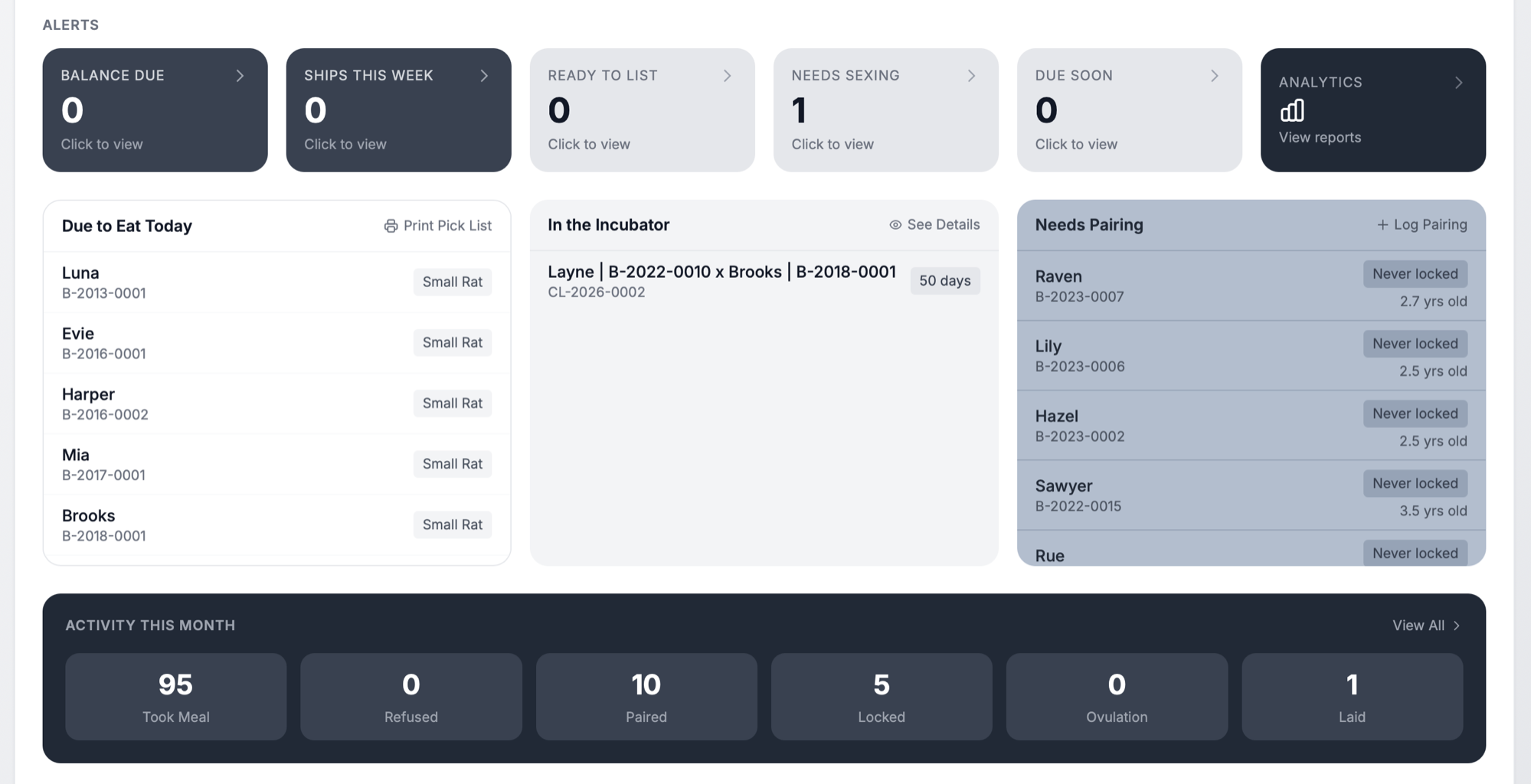
Want a system growing with you?
Start Free. Stay Organized Forever.
THE RACK's free tier covers up to 5 animals. Feeding logs, weight tracking, shed records, health notes, and alerts. Start on day one and build from there.
Get Started FreeCommon First-Month Mistakes
- Handling too soon. Let the snake acclimate for 5-7 days minimum. Handling a stressed, new snake leads to defensive behavior hard to unlearn.
- Offering food the first day. The snake will not eat while stressed from transport. Wait 5-7 days.
- Checking on it constantly. Every time you open the lid, you reset the acclimation clock. Check once a day for water and temps.
- Handling after feeding. Wait 48 hours. Regurgitation is stressful and avoidable.
- Panicking at a food refusal. One refusal in the first week is normal. Two refusals are normal. Check husbandry and try again.
- Not weighing the snake. Start weighing from the first week. Trends matter more than any single number.
Your 30-Day Goals
A snake that eats on schedule, sheds cleanly, and tolerates handling. If you hit all three by day 30, you are off to a strong start.
Content verified against THE RACK breeding database. Acclimation timelines and husbandry parameters sourced from active keeper and breeder programs. Last reviewed April 2026.
Built by a Breeder
Start Free.
Stay Organized.
Feeding logs. Weight tracking. Shed records. Health notes. THE RACK's free tier covers up to 5 animals at no cost. Everything a keeper needs from day one.
See THE RACKFree for up to 5 animals. Keeper $10/mo. Breeder $20/mo. 7-day money-back guarantee.