
News / Ball Python Morphs Explained: Beginner Genetics...
Ball Python Morphs Explained: Beginner Genetics Guide
- Dominant genes express with one copy. No hidden carriers. Some have a super form.
- Co-dominant genes express with one copy and produce a distinct super form with two copies.
- Recessive genes need two copies to show visually. One copy creates an invisible het carrier.
- Designer morphs stack multiple genes from different groups. Understanding inheritance is what separates collectors from breeders.
Ball pythons come in hundreds of visually distinct variations called morphs. Each morph is the result of a specific genetic mutation affecting color, pattern, or both. Understanding how these genes work is the difference between collecting animals you think look cool and building a collection with intentional breeding potential. This guide breaks down the three inheritance types, shows real morph examples for each, and explains how genes combine to produce the designer morphs the market is built around.
In This Guide
What is a morph?
A morph is a genetic mutation producing a visible change in a ball python's appearance. The wild-type (normal) ball python is brown and black with gold alien-head markings. Every morph is a departure from this baseline. Some mutations change color. Some change pattern. Some change both.
The word "morph" refers to the visible result of the gene. Two ball pythons can carry the same gene but look different depending on what other genes they also carry. This is why understanding inheritance matters. It tells you what an animal can produce, not what it looks like on the surface.
The three inheritance types
Dominant
A dominant gene expresses visually with only one copy. If a ball python inherits a dominant gene from one parent, the trait is visible. There is no "het" (heterozygous carrier) state for dominant genes; the animal either has it and shows it, or it does not have it at all. Some dominant genes do have a homozygous (super) form that can look different or, in rare cases, be lethal.
Examples of dominant morphs:
- Pinstripe: Dramatically reduced pattern with thin, elongated stripes running the length of the body. One of the most popular dominant genes for combo projects.
- Spider: Busy, web-like pattern with a lighter background. Known for its distinctive head stamp. The Spider gene is linked to a neurological wobble of varying severity.
When you breed a dominant morph to a normal, statistically 50% of the offspring will express the trait. There is no hidden carrier. The other 50% are normals with no copy of the gene.
Building a morph collection?
Know Every Gene in Your Collection
THE RACK's animal profiles store every morph, gene, and het for each animal. When planning pairings, you know what you have and what it can produce.
See THE RACKCo-Dominant (Incomplete Dominant)
Co-dominant genes also express with one copy, but they have a super form when an animal inherits two copies (one from each parent). The single-copy version and the double-copy version look different from each other. This gives co-dominant genes two distinct visual forms.
Examples of co-dominant morphs:
- Pastel (single copy): Brighter yellows, cleaner pattern, faded head. One of the foundational co-dominant genes. Pastel is in hundreds of designer combos.
- Super Pastel (double copy): Intensely bright yellow and white. Visually distinct from a single-copy Pastel. The super form takes the brightness further.
- Mojave (single copy): Muted browns with a distinctive flame pattern. Deep, rich tones.
- Blue-Eyed Leucistic (BEL, double copy of BEL complex genes): Completely white snake with blue eyes. Produced when two copies of genes within the BEL complex combine (Mojave x Mojave, Lesser x Mojave, Butter x Lesser, and other combinations).
When you breed two single-copy co-dominant animals of the same gene, the expected outcome is 25% super, 50% single-copy, 25% normal. The super form is where the excitement is for many breeders. The morph calculator shows the expected ratios for any pairing before you commit.
Inheritance at a Glance
Dominant: One copy = visible trait. No hets. Some have a super form. Co-dominant: One copy = one look. Two copies = super form. Recessive: Two copies needed to see the trait. One copy = invisible het carrier.
Recessive
Recessive genes require two copies to express visually. An animal with one copy is called het (heterozygous) for the trait. Het animals look normal. You cannot tell they carry the gene by looking at them. The trait is invisible until it is paired with another carrier.
Examples of recessive morphs:
- Piebald: Large patches of pure white alongside normally patterned sections. One of the most recognizable and sought-after recessive morphs. Het Piebalds look like normals.
- Clown: Reduced, aberrant pattern with a distinctive "clown face" head stamp and vibrant colors. The visual difference between a Clown and a normal is dramatic.
- Albino: Complete lack of dark pigment (melanin). Bright yellows and whites with red or pink eyes. The original ball python morph, first produced in captivity in the early 1990s.
Recessive genetics drive a large portion of the breeding market. A het Piebald x het Piebald pairing produces 25% visual Piebalds, 50% het Piebalds, 25% normals. The challenge is in the 50% het offspring. They look like normals, but half of them carry the gene. Without pairing data or genetic testing, there is no way to confirm het status visually. This is why breeders track lineage obsessively.
Morphs are what you see. Genetics is what an animal can produce.
Designer morphs: stacking genes
A designer morph is a ball python carrying two or more genes from different mutation groups. The visual result is a combination of both traits. Stacking genes is how breeders create the multi-gene animals the market values most.
A few well-known designer combinations:
- Banana Pastel: Combines the Banana gene (co-dominant, lavender and yellow) with Pastel (co-dominant, brighter yellows). The result is a vivid, high-contrast animal.
- Killer Bee: Pastel + Spider. Bright yellow pattern with thin, spidery markings. One of the original "designer" combos.
- Piebald Clown: Two recessive genes stacked. Requires both parents to carry both genes. The visual result combines the white patches of Piebald with the aberrant Clown pattern.
The more genes stacked, the harder the pairing becomes. A three-gene recessive animal requires years of calculated pairings and large clutch counts to produce. This is where detailed lineage tracking and a genetics engine become essential. Without accurate records of who carries what, multi-gene projects stall.
Hets: the invisible variable
Het animals are the backbone of recessive breeding projects. They look normal. They function normal. But they carry one copy of a recessive gene waiting to express in the next generation.
Het status can be:
- 100% het (proven): At least one parent is visual (homozygous) for the gene. Every offspring from a visual parent is guaranteed to inherit one copy. This is the gold standard.
- 66% possible het: The math from the pairing says two-thirds of the normal-looking offspring statistically carry the gene. It is not guaranteed for any individual animal.
- 50% possible het: One parent is visual or proven het, the other is normal. Half the offspring carry the gene statistically.
Possible het status is a probability, not a diagnosis. The only way to confirm a possible het is to breed it to a known het or visual and see what the clutch produces. One clutch of all normals does not prove the animal is not het; sample size matters. Multiple clutches of all normals makes it increasingly unlikely.
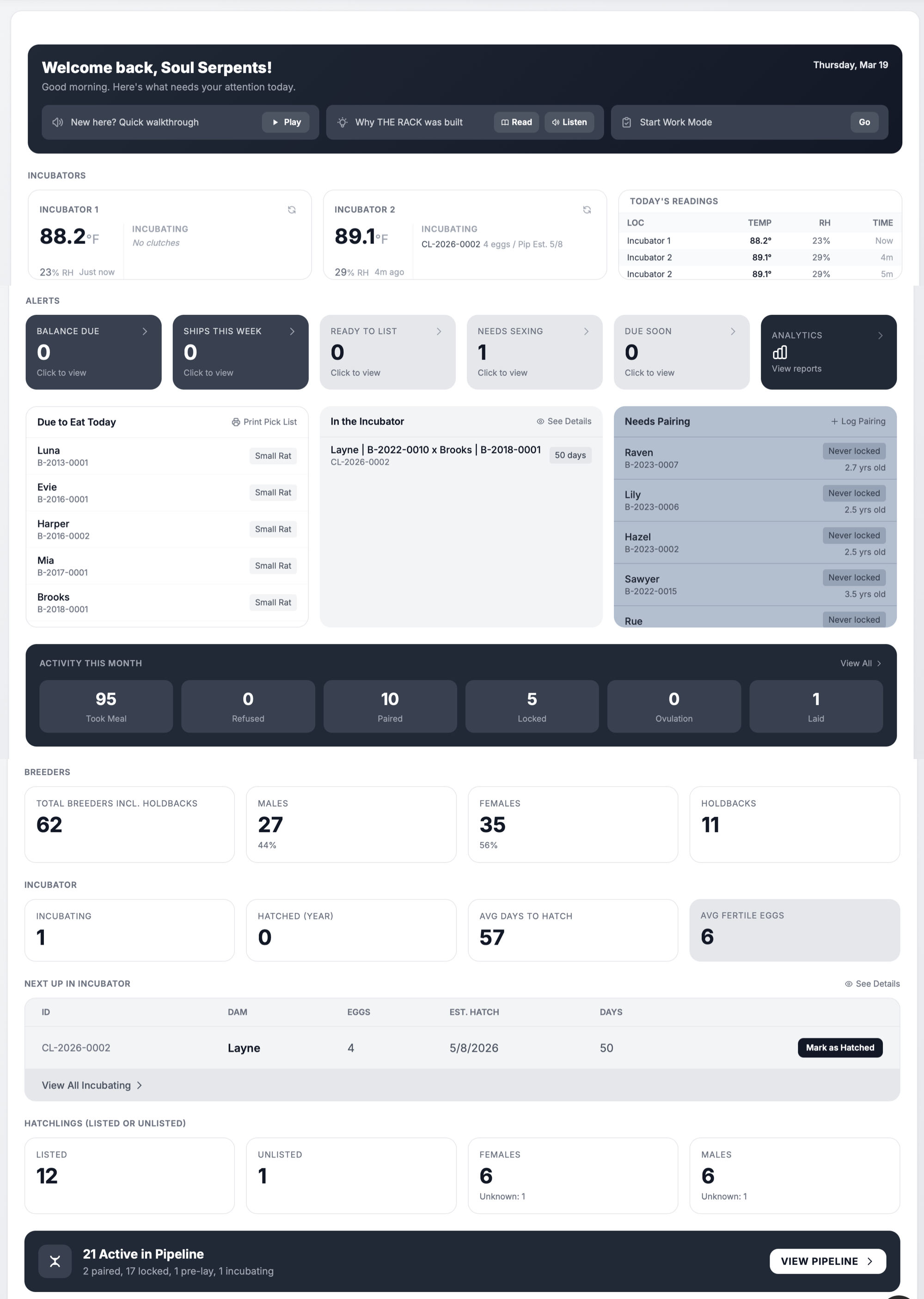
Want every gene and het tracked for your whole collection?
Your Genetics, Organized and Searchable
THE RACK stores morph data, het status, and lineage for every animal. When you plan a pairing, the data is already there.
See THE RACKWhere to start as a beginner
If you are new to morphs, start by learning five to ten common genes across all three inheritance types. Get familiar with how Pastel, Mojave, Banana, Piebald, and Clown look as singles. Then start looking at how they combine. The ball python morph calculator is a useful tool for running hypothetical pairings and seeing expected outcomes before committing to a purchase.
Do not buy animals for projects you do not understand. Learn the genetics first. Know what each animal in your collection can produce and what it needs to pair with to get there. The difference between a collector and a breeder is a plan.
Starting Point
Learn 5-10 common genes across all three inheritance types. Understand dominant, co-dominant, and recessive before buying for a project. Use a genetics calculator to run pairings before committing.
Content verified against THE RACK genetics engine. Inheritance ratios and morph outcomes confirmed through offspring calculator. Last reviewed April 2026.
Built by a Breeder
Know Your Genetics.
Plan Your Projects.
Animal profiles. Morph tracking. Het status. Lineage records. Genetics calculator. THE RACK gives you the tools to build a collection with intention.
See THE RACKFree for up to 5 animals. Keeper $10/mo. Breeder $20/mo. 7-day money-back guarantee.