
News / What to Do When a Hatchling Has a Hardened Abso...
What to Do When a Hatchling Has a Hardened Absorbed Yolk
- Hardened retained yolk is a firm mass inside the body cavity, not to be confused with external retained yolk
- Warm soaks at 82-84F twice daily are the single most important intervention; rehydration softens the mass
- Do not feed until the mass resolves. Hatchlings can safely go 2-4 weeks without a first meal
- Discoloration, increasing swelling, or no waste by day 10 means get to a reptile vet immediately
- Prevention starts in the incubator. Keep temps at 88-89F at the egg. Spikes above 91F are the most common cause
You pull a hatchling from the egg and something feels wrong. The belly is hard. Not the normal soft roundness of a freshly hatched neonate. There is a firm lump underneath the skin, and the animal is not moving the way it should. This is retained hardened yolk, and how you respond in the next 48 hours determines whether the hatchling lives or dies.
In This Guide
Every ball python hatchling absorbs a yolk sac in the final stage before or during hatching. The yolk is the last nutritional deposit from the egg: a dense package of lipids, proteins, and antibodies fueling the hatchling through its first days while its digestive system finishes developing.
In a normal hatch, the yolk is fully internalized and soft. The umbilical opening closes, the remaining tissue dries, and you are left with a healthy hatchling bearing a small belly button scar. When something goes wrong, the yolk (or a portion of it) hardens inside the body cavity. The severity ranges from "monitor closely" to "veterinary emergency" depending on what you are dealing with.
What You Are Looking At
A hatchling with a hardened internal yolk will show one or more of these signs:
- Firm, distended belly. Not the normal soft roundness of a recently hatched neonate. The belly feels hard to the touch, like a marble or lump under the skin.
- Visible lump or asymmetry. You can see a defined mass sitting mid-body or slightly caudal (toward the tail) of center.
- Reluctance to move normally. The mass is uncomfortable. The hatchling holds still, resists being uncurled, or moves stiffly.
- Failure to pass first urate or feces. The hardened mass can physically compress the GI tract.
- Refusal to feed. The body knows something is occupying space meant for food. First meal refusal in these hatchlings is the norm, not the exception.
Do not confuse this with a retained external yolk sac, where yolk still hangs outside the body attached by the umbilicus. External retained yolk is a different situation with a different protocol. This guide covers yolk already inside the body cavity but solidified.
Catching these signs early is everything. When you are logging hatchling health data from day one, you have a record of belly condition, weight, and behavior changes to reference instead of relying on memory across a full incubator of neonates.
Want health tracking from the moment they hatch?
Log Symptoms. Track Weight. Catch It Early.
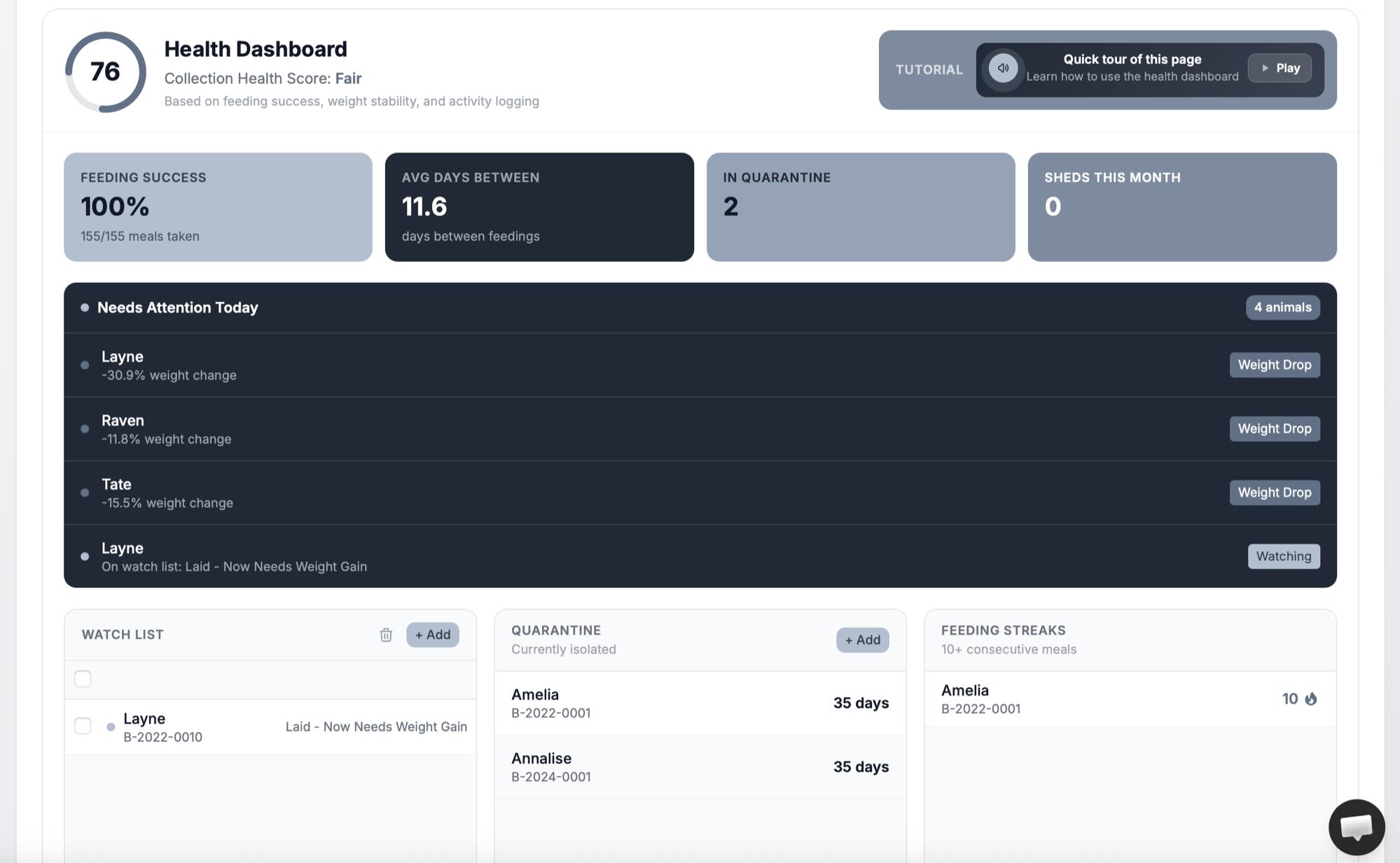
THE RACK logs hatchling health data, weight trends, and symptom notes per animal. When you are managing a full clutch of neonates, having every observation in one place is the difference between catching a problem on day 2 and finding it on day 10.
See Health ToolsWhy It Happens
Several factors contribute, sometimes in combination.
Incubation Temperature Errors
Too hot. This is the most common culprit. Elevated temperatures accelerate embryonic development faster than the yolk can be properly absorbed. The hatchling develops "ahead of schedule," but the yolk has not had time to fully liquefy and integrate. What remains solidifies.
Temperatures consistently above 91F (32.8C) increase the risk significantly. Spikes matter more than averages. A single day at 94F can cause partial yolk hardening even if the rest of incubation was perfect.
Humidity Issues
Low humidity during incubation causes dehydration of the egg contents. The yolk loses moisture and thickens. By the time the hatchling absorbs it, the consistency is paste-like or solid rather than the normal viscous liquid.
Premature Pip or Assisted Hatching
If you cut eggs early, before the hatchling has fully absorbed the yolk on its own timeline, you can catch the animal mid-absorption. The yolk gets pulled in but was not ready to be internalized. Once inside, it can harden as the body temperature and environment change.
This is one of the strongest arguments for patience when cutting eggs. The temptation to cut at day 55 when another clutch pipped at day 52 has cost more hatchlings than most breeders want to admit.
Bacterial Contamination
If the egg was compromised through a small shell defect, fungal exposure, or substrate contamination, bacteria can colonize the yolk before absorption. Infected yolk hardens differently. It becomes caseous (cheese-like) rather than firm. This is the most dangerous scenario because you are dealing with both a physical mass and an active infection.
Individual Variation
Some hatchlings absorb slower. In a clutch of six, five can absorb perfectly while one lags. Genetics, positioning in the egg, and the individual embryo's development rate all play a role. This is the least concerning cause. These cases often resolve on their own.
Critical Thresholds
Incubation temps above 91F increase hardened yolk risk. Spikes to 94F can cause it in a single day. Keep your incubator at 88-89F measured at the egg, not the air.
Hydrate aggressively.
Be patient.
Know when to call the vet.
The First 48 Hours
The Response Protocol
Assess severity
Pick up the hatchling gently and palpate the belly. Determine how hard the mass is, how large it is relative to the body cavity, and whether the hatchling is alert and responsive. Tongue flicking and good muscle tone means the animal is compensating. Limp or gaping means emergency.
Start hydration immediately
Warm soaks at 82-84F (27.8-28.9C), belly-deep, 15-20 minutes, once or twice daily. The hatchling will drink and absorb water through the skin and cloaca. Supervise the entire time. Bump tub humidity to 70-80% with damp paper towel substrate. Offer a water dish large enough for voluntary soaking.
Set correct temperatures
Warm side at 88F (31.1C), not higher. Cool side at 78-80F (25.6-26.7C). Let the animal thermoregulate. A hatchling processing a hardened yolk mass is already under physiological stress. Do not add thermal stress on top.
Do not feed
Do not offer food until the mass has softened or passed. Introducing prey into a GI tract already compressed by a yolk mass creates a blockage risk. Ball python hatchlings can safely go 2-4 weeks without a first meal.
Want every hatchling's health logged from day one?
Symptoms. Weight. Soaks. All in One Place.
THE RACK tracks health notes, weight changes, and daily observations per animal. When you are monitoring multiple hatchlings through a yolk complication, organized records keep you ahead of the problem instead of guessing from memory.
See Health TrackingDays 3-14: Monitoring and Escalation
Signs of Resolution
Here is what you want to see:
- The firm area softens gradually over the course of several days.
- The hatchling becomes more active and moves freely.
- A urate passes (white chalky waste). This confirms the GI tract is functional and not fully obstructed.
- Belly distension decreases visibly.
- The hatchling starts tongue-flicking at its environment, showing feeding interest.
If you are seeing these signs, keep doing what you are doing. Warm soaks, proper humidity, patience. Most mild to moderate cases resolve within 7-14 days with hydration support alone.
Red Flags: Get to a Vet Now
- Discoloration around the umbilical area. Pink, red, or greenish tinge on the ventral scales near the belly button signals possible infection. Infected retained yolk (yolk sac infection, also called omphalitis) can go septic. This kills hatchlings fast.
- Swelling increases rather than decreases. The mass is growing, not shrinking. This suggests active infection or inflammation.
- Lethargy worsens. Day 1 lethargy is expected. Day 5 lethargy worse than day 1 is a red flag.
- Foul smell from the umbilical site. If the navel area smells, the yolk is infected. Period.
- No waste passed by day 10. Complete GI obstruction needs veterinary intervention.
What the Vet Can Do
Find a reptile vet with significant herp experience. Not a dog-and-cat vet who "also sees reptiles." Board-certified herp vets are ideal. Here is what they bring to the table:
- Radiograph or ultrasound to confirm the mass is yolk and assess its size and density.
- Antibiotics if infection is suspected (typically enrofloxacin or ceftazidime for neonatal reptiles).
- Subcutaneous fluids for more aggressive rehydration than soaking alone provides.
- Surgical removal in severe cases. This is a last resort, but it is survivable. Yolk sac removal in neonatal snakes has a reasonable success rate when performed early, before sepsis sets in.
Response Protocol
Warm soaks at 82-84F, 15-20 min, twice daily. Humidity 70-80%. Warm side at 88F. No food until the mass resolves. Vet immediately if discoloration, swelling, or no waste by day 10.
After Resolution: First Feeding
Once the mass has softened or passed and the hatchling is active and alert:
- Wait for a shed. The first shed is the biological signal indicating the hatchling's body has shifted from "absorbing internal reserves" to "ready for external nutrition." This typically happens 7-14 days post-hatch.
- Offer a small meal. For a standard 50-70g ball python hatchling, a fuzzy or hopper mouse or small rat fuzzy is appropriate. The prey item should be roughly 10-15% of the hatchling's body weight.
- Do not panic if it refuses. Hatchlings recovering from yolk complications often take longer to accept their first meal. Assist-feeding or force-feeding should be an absolute last resort and only under veterinary guidance.
Prevention for Your Next Clutch
Most hardened yolk cases are preventable. The corrections are straightforward:
- Nail your incubation temps. 88-89F measured at the egg, not the air. Use a probe thermometer directly at egg level. Digital thermostat with a quality probe, not a dial thermometer across the room.
- Maintain humidity. 90%+ in the incubation container. Sealed containers with ventilation holes and a proper moisture medium (perlite, hatchrite, or vermiculite at the correct water ratio) maintain this passively. Weigh the container periodically. If it is losing weight, it is losing moisture.
- Do not cut early. Let the clutch pip naturally. If you must cut for assessment (visible mold, collapsed eggs, significantly overdue), make a small window. Do not extract the animal. Let it come out when it is ready. A hatchling sitting in a cut egg for another 24-48 hours is almost always safer than one pulled out prematurely.
- Keep your incubation substrate clean. Contaminated substrate introduces bacteria. Fresh, clean medium for each clutch.
- Monitor for temperature spikes. A quality incubator with an alarm function is worth the investment. One thermostat failure on a hot day can spike an entire clutch.
Logging incubation parameters per clutch in THE RACK gives you season-over-season data to reference. When you can see the exact temps and humidity readings from your last three successful hatches, you are not guessing anymore. You are building on your own track record.
The Bottom Line
A hardened retained yolk is not an automatic death sentence. Most cases, caught early and managed with proper hydration and temperature support, resolve without veterinary intervention. The hatchlings lost to this condition are the ones where the breeder either did not notice, waited too long, or tried to feed through it.
Know what a healthy hatchling belly feels like so you can recognize when something is off. Hydrate aggressively. Be patient. And know when to call the vet. The line between "this is resolving" and "this is infected" is the line between a healthy holdback and a dead hatchling.
Content verified against THE RACK breeding database. Incubation parameters and hatchling health protocols sourced from active breeder programs. Last reviewed April 2026.
Built by a Breeder
Every Hatchling,
From Pip to First Feed
Health logging. Weight tracking. Symptom notes. Incubation records. THE RACK manages your hatchlings and your entire breeding season in one system.
See THE RACKFree for up to 5 animals. Keeper $10/mo. Breeder $20/mo. 7-day money-back guarantee.