
News / How to Price Ball Python Hatchlings the Right Way
How to Price Ball Python Hatchlings the Right Way
- Listing prices are not sale prices. Filter by recently sold on MorphMarket. Active listings tell you what sellers hope for, not what buyers pay.
- Know your production cost per animal before setting a price. Parent acquisition, feed, substrate, shipping supplies. This is your pricing floor.
- Price by genetics and sex. Not every hatchling in a clutch is worth the same amount. Tier pricing to match market demand for each outcome.
- Every week an animal sits unsold, it eats into your margin. Track accumulated feed costs alongside listing prices.
You have hatchlings eating and growing. Now comes the question nobody teaches you in a care guide: what do you charge? Price too high and the animals sit in your rack eating into your margins for months. Price too low and you are giving away genetics you spent years building. Neither feels good. Here is how to price with data instead of guessing.
In This Guide
Stop Looking at Listing Prices
The first mistake new breeders make is opening MorphMarket, looking at what other sellers are listing their animals for, and setting their prices in the same range. Listing prices are not sale prices. An animal listed at a certain number for 90 days has not sold at that number. It has been sitting.
What you need is sold data. Look at completed sales for the same morph combination, not active listings. MorphMarket shows recently sold animals if you filter correctly. This tells you what buyers are paying, not what sellers are hoping for.
The gap between listing prices and sold prices can be significant. A morph with dozens of active listings and few recent sales signals an oversaturated market. Pricing at the top of the range means you are competing for a shrinking pool of buyers.
Building a price reference
Search the morph combo on MorphMarket
Filter by recently sold. Note the range. This is your demand baseline.
Check sex-based pricing
Females typically command higher prices for breeding-relevant morphs. This gap varies by morph and market demand.
Look at seasonal patterns
Prices tend to dip during peak hatching season (July through September) when supply is highest. Off-season listings face less competition.
Factor in het status
A visual morph sells at a different price than a 66% possible het. Know what the market pays for verified hets versus possible hets.
The Pricing Trap
Every week an animal sits unsold, it is eating into your margin. The real price of a hatchling is the sale price minus every dollar you spent producing and feeding it. An animal priced right sells. One priced wrong sits and costs you money.
Understanding Your Production Costs
You cannot price intelligently without knowing what it costs to produce an animal. Most breeders have a rough idea of their overall rodent bill. Very few know the per-animal cost.
What goes into production cost
- Parent acquisition. What did the sire and dam cost? Spread across the number of seasons you breed them and the offspring they produce per season.
- Feed costs. Every meal the parents ate during the season. Every meal the hatchling has eaten since it hatched. This number climbs every week the animal stays in your rack.
- Substrate, electricity, supplies. The overhead of keeping your facility running, divided across the number of animals you house.
- Shipping supplies. Insulated boxes, heat packs, cold packs, deli cups. These add up across a full shipping season.
The breeders who know their per-animal cost make better pricing decisions because they can see the floor. Below a certain price, you are losing money. Above it, you are making margin. Without the number, you are guessing.
Want to see the real cost of every animal in your rack?
Know Your Numbers. Price With Data.
THE RACK manages feeding costs per animal so you know your floor before you set a price. No more guessing what an animal has cost you to produce.
See THE RACKReading Demand Signals
What the market tells you
Pricing is not a math equation. Market demand is the other half of the picture, and it changes. A morph combo in high demand three years ago can be oversaturated today. A combo nobody cared about last year can be trending now.
Pay attention to these signals:
- How fast animals sell. If animals with similar genetics sell within days of listing, demand is strong. Price accordingly. If they sit for weeks or months, the market is telling you the price is too high or the supply exceeds demand.
- Inquiry volume. If you list an animal and get multiple messages in the first 48 hours, you priced it to move. If a week goes by with no inquiries, you are either priced too high or the listing needs better photos and description.
- Social media interest. The morphs getting the most engagement on Instagram and in Facebook groups give you a real-time read on what buyers are excited about.
- Expo sales data. What sells at shows versus what comes home. Expos give you direct buyer feedback in the form of who opens their wallet and who walks past.
The market does not care what you think an animal is worth. It pays what it pays.
Pricing Strategies That Work
Tiered pricing by genetics
Not every hatchling in a clutch is worth the same amount. A clutch from a Banana het Clown x Clown pairing will produce Banana Clowns, Banana het Clowns, Clowns, and Normals het Clown. Each of those animals has a different market value. Price them individually based on their genetics and market demand, not as a flat rate across the clutch.
Sex-based pricing
For breeding-relevant morphs, females are worth more. A female with desirable genetics represents future production for the buyer. A male of the same morph is a proven or potential breeder, but the economics are different because one male can be paired with multiple females. Price accordingly.
Volume-based pricing adjustments
If you produce a large number of the same morph combo, consider pricing the first ones slightly higher when they hit the market fresh. As hatching season progresses and supply increases across the market, adjust downward to move remaining inventory before feed costs erode your margin further.
Bundle and pair deals
Offering a breeding pair at a slight discount moves two animals at once and appeals to buyers building projects. A buyer getting a male and female of compatible genetics in one transaction saves on shipping and gets started on their project faster. You move inventory quicker.
Want to price based on real sales data?
See What Sold, What Sat, and What It Cost You.
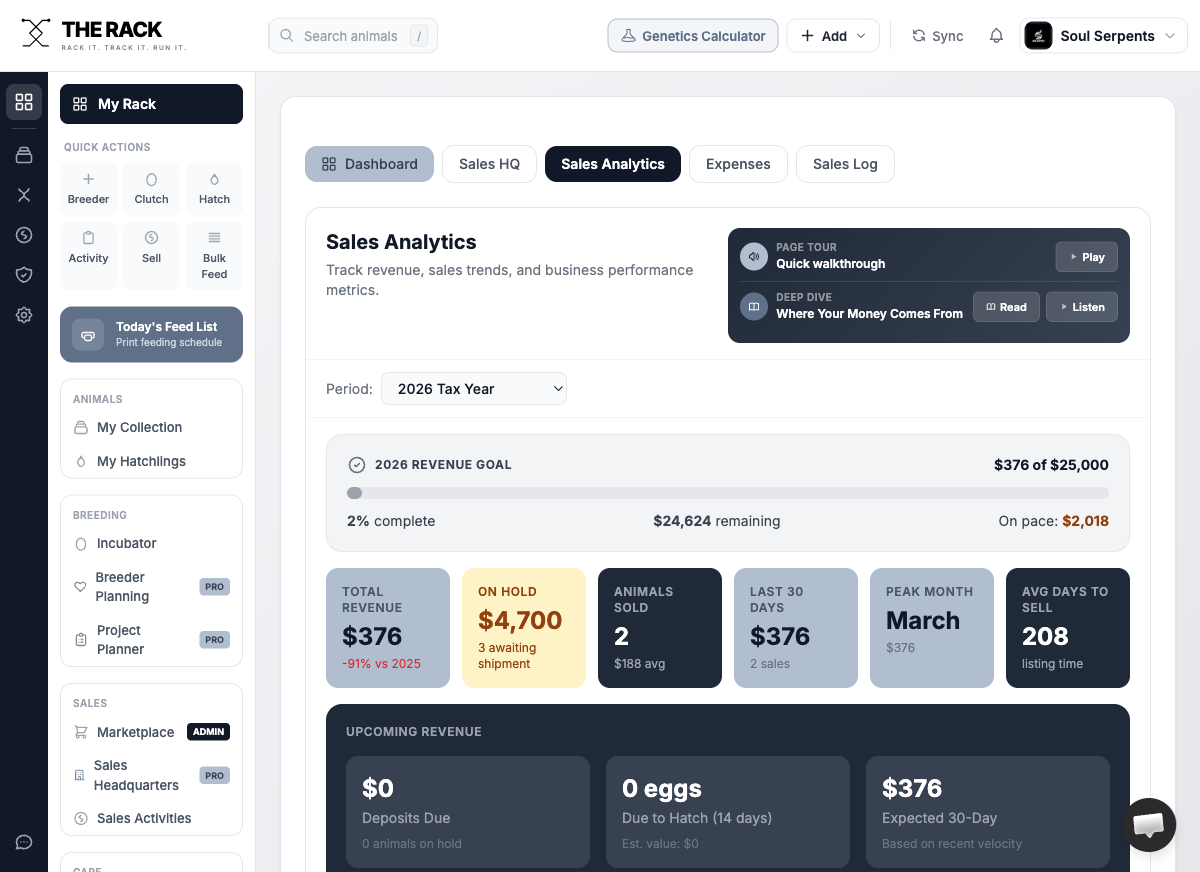
THE RACK's sales analytics show revenue by morph, days on market, and accumulated feed costs so you can price every hatchling with full visibility into your numbers.
See THE RACKWhen to Adjust Prices
A price is not a commitment. If an animal has been listed for 30 days with no serious inquiries, the market is giving you information. Ignoring it costs you money every week in feed.
Set a timeline for yourself. If an animal has not sold within your target window, drop the price by a defined amount. Revisit every two to four weeks. Track the accumulated feeding costs alongside the listing price. When the cost of keeping the animal approaches the sale price, you have waited too long.
The best breeders review pricing monthly. They know their average days on market across morphs. They know which genetics move fast and which sit. They use the data to adjust production the following season. Producing fewer of what sits and more of what sells is the definition of running a program instead of a hobby.
The Real Cost of Waiting
An animal eating $8 per week in rats for six months has accumulated over $200 in feed costs alone. If the sale price is less than your production cost plus feed cost, you lost money on the animal. Track the numbers or guess.
Using Sales Data to Plan Next Season
Every sale you make this season is data for next season. What genetics sold the fastest? What sat the longest? What price points moved? What did buyers ask for?
The breeders who grow revenue year after year are the ones who treat their sales history as a planning tool. They look at last season's data and adjust pairings accordingly. They increase production of high-demand combos and reduce or eliminate projects producing animals nobody wants to buy.
Sales analytics in THE RACK show you revenue by morph, average sale price, and days on market across your entire program. When it is time to plan next season's pairings, you have the data in front of you instead of working from memory.
Content verified against THE RACK breeding database. Pricing strategies and sales analytics features confirmed against active breeder programs. Last reviewed April 2026.
Built by a Breeder
Price With Data.
Not Gut Feeling.
Sales analytics. Feed cost management. Revenue by morph. Days on market. THE RACK gives you the numbers to price every animal in your program.
See THE RACKFree for up to 5 animals. Keeper $10/mo. Breeder $20/mo. 7-day money-back guarantee.