
News / Pre-Lay Shed to Eggs: Why the 30-Day Rule Isn't...
Pre-Lay Shed to Eggs: Why the 30-Day Rule Isn't Always 30 Days
- Research shows an average of 28.8 days from pre-lay shed to eggs, with a standard deviation of 4.4 days
- The real range from combined breeder data is 21-45 days, with most females falling in the 27-33 day window
- Temperature, individual variation, clutch size, and stress all influence timing
- Have your incubator ready by day 21. Beyond day 45, consider a vet consult
- The best predictor of when a specific female will lay is her own history from prior seasons
You have been tracking your female all season. She ovulated. She had her pre-lay shed. Now you are counting down to eggs. The standard advice is "30 days after pre-lay shed." But experienced breeders know the reality is more complicated.
In This Guide
What the Research Shows
The Bertocchi et al. (2018) study on 129 female ball pythons documented an average of 28.8 days from pre-lay shed to egg laying, with a standard deviation of +/- 4.4 days.
That means the typical range is 24-33 days based on that research.
Breeder experience extends this range further:
- World of Ball Pythons: "We usually anticipate getting eggs 30 days after the pre-lay shed but we have gotten eggs as early as day 21 and as late as day 45."
- American Made Exotics: "We see the good majority of females lay exactly 30 days after their pre lay shed."
- Markus Jayne Ball Pythons: "From this date my females usually lay 27 days later... give or take a few days."
Stop counting on sticky notes
Log Pre-Lay Shed.
Get Estimated Lay Dates.
THE RACK's Female Health page calculates estimated lay dates from pre-lay shed dates automatically. See where each gravid female stands in her timeline at a glance.
See Female HealthThe Real Range: 21-45 Days
Based on combined research and breeder data:
- Point estimate: 30 days
- Common range: 24-35 days
- Extended range: 21-45 days
Most females fall in that 27-33 day window. But outliers exist on both ends.
Why the Variation
Several factors influence timing:
Temperature: Higher basking temperatures may speed development. Some breeders report shorter shed-to-lay times with warmer gravid female setups.
Individual variation: Every female has her own timeline. First-time breeders may take longer. Experienced females often follow consistent patterns year to year.
Clutch size: Larger clutches may take longer to develop fully.
Body condition: Females in optimal condition may progress more efficiently.
Stress: Disturbance during this critical period can delay laying.
What to Do With This Information
Days 21-25: Do not panic if eggs appear early. Some females run fast. Have your incubator ready by day 21.
Days 26-33: The most likely window. Check daily. Watch for the "perfect coil" posture and restless behavior.
Days 34-40: Still normal. Do not stress. Continue monitoring.
Days 41-45: Unusual but documented. If the female is eating, behaving normally, and shows no signs of distress, continue waiting.
Beyond 45 days: Consider veterinary consultation. Egg binding is rare but possible.
Signs She's Getting Close
In the days before laying, watch for:
- Perfect coil posture: Tightly wound with tail tucked underneath
- Restlessness: Moving around the enclosure more than usual
- Seeking warmth: Spending extended time on the hot side
- Body shape change: The "v-shape" ridge along the spine becomes more pronounced
- Behavioral irritability: More defensive than usual
Track the date. Check daily. Trust the process.
Why Tracking Matters
The most common mistake breeders make is obsessing after day 30. As American Made Exotics puts it: "You may drive yourself crazy looking for a female to be sitting on a pile of eggs after that 30 day mark but it is not uncommon to see a girl take a little longer sometimes."
The best predictor of when a specific female will lay is her own history. If she went 34 days last year, expect similar timing this year.
Record:
- Pre-lay shed date
- Lay date
- Days between
After a few seasons, you will know your females' individual patterns better than any general guideline can tell you.
THE RACK makes this tracking automatic. When you log a pre-lay shed activity, it calculates estimated lay dates based on the verified 30-day average and shows you the expected range. The Female Health page displays where each gravid female stands in her timeline, so you can see at a glance who is due soon and who is still weeks out.
Over multiple seasons, THE RACK builds a history for each female. You stop relying on general averages and start working with data specific to your animals.
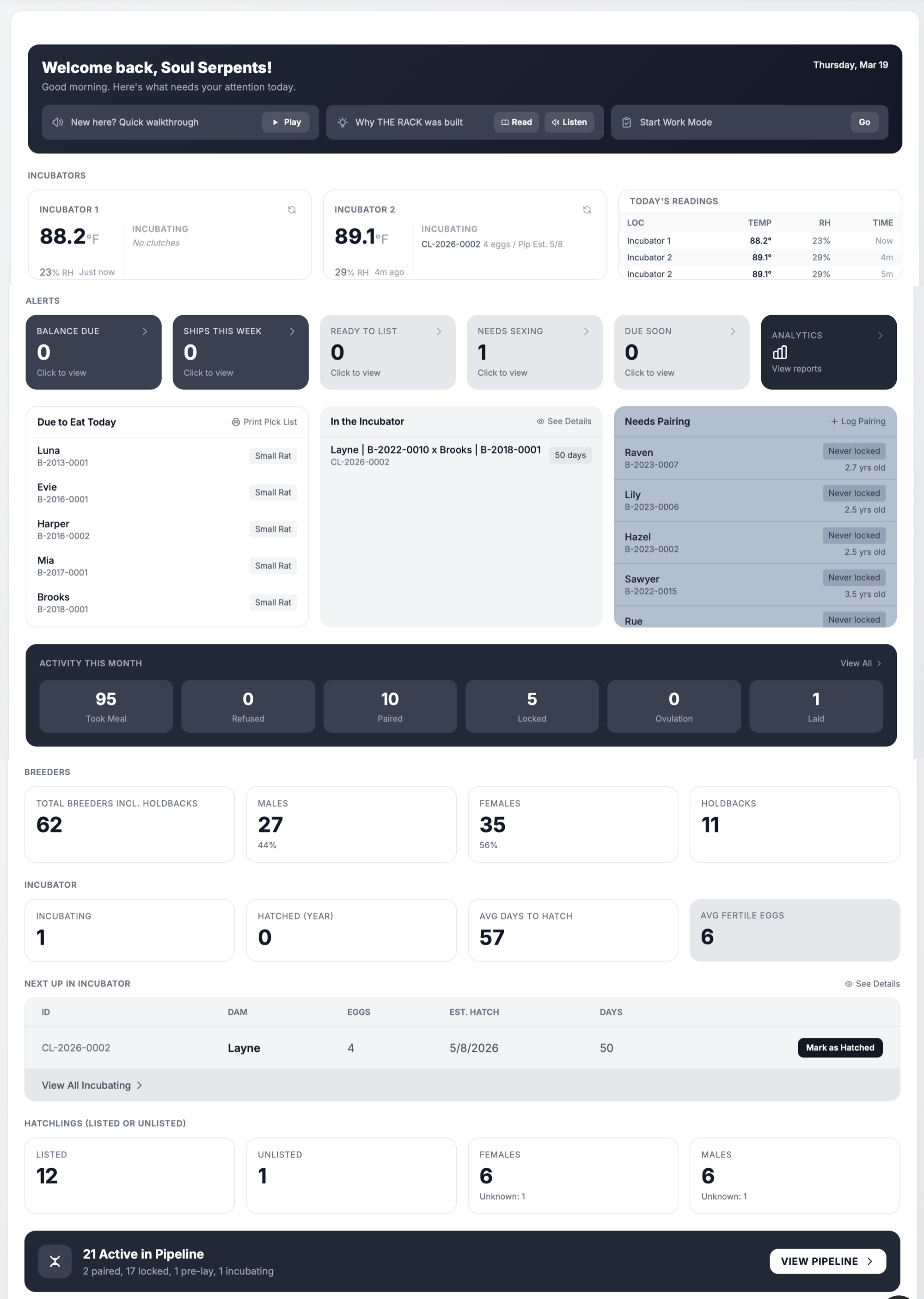
Build her history over multiple seasons
Know Her Pattern.
Stop Guessing.
THE RACK builds individual timelines for every female. Log shed dates, track lay dates, and over time your own data replaces generic averages.
See THE RACKContent verified against THE RACK breeding database and published research (Bertocchi et al. 2018). Breeder quotes sourced from public breeder documentation. Last reviewed April 2026.
Built by a Breeder
Every Female.
Her Own Timeline.
Pre-lay shed logging. Estimated lay dates. Individual female history over multiple seasons. THE RACK replaces guesswork with data.
See THE RACKFree for up to 5 animals. Keeper $10/mo. Breeder $20/mo. 7-day money-back guarantee.