
News / Ball Python Breeding Timeline: Follicle to Clutch
Ball Python Breeding Timeline: Follicle to Clutch
- Follicle growth is not linear. Months of slow building precede a rapid acceleration toward ovulation.
- Once follicles exceed 30mm, the timeline becomes significantly more predictable.
- After ovulation, the countdown is fixed: approximately 48 days to egg laying.
- Managing multiple females requires structured tracking. Memory fails. Data does not.
Breeding efficiency depends on predicting the ovulation event. Follicles do not grow linearly. They spend months in a slow building phase before entering a rapid acceleration that ends in ovulation and egg laying. Understanding this timeline lets you prepare lay boxes, manage pairing schedules, and calculate estimated hatch dates with confidence.
Understanding the Growth Cycle
Ball python follicles begin developing as small structures in the 10 to 15 millimeter range during the cooling period. Growth at this stage is slow and difficult to predict. Females in this phase are building the foundation, and the timeline can stretch weeks depending on temperature and body condition.
Between 15 and 25 millimeters, follicles enter a developing phase. Growth accelerates slightly, but this stage still carries significant variance. Some females stall at 20 to 25 millimeters during cooler ambient temperatures, adding weeks to the timeline.
The real acceleration begins above 25 millimeters. Follicles grow at roughly 1.5 to 2 millimeters per day during this active phase, and the timeline becomes increasingly predictable. Once follicles exceed 30 millimeters, you can begin calculating estimated ovulation and lay dates with reasonable accuracy.
TARGET SIZE
Ovulation occurs when follicles reach approximately 44 millimeters. This is the critical threshold where the countdown becomes fixed.
The Follicle Size Reference
Use these ranges to estimate where your females stand in the breeding timeline:
- 10 to 15 mm (Building Phase). Cooling period. More than 100 days to lay. Too early for accurate prediction.
- 15 to 25 mm (Developing Phase). Growth accelerating. Approximately 75 to 90 days to lay. Stalls common during cool temps.
- 25 to 35 mm (Maturing Phase). Active growth. Approximately 55 to 75 days to lay. Pairing should be underway.
- 35 to 45 mm (Pre-Ovulation). Rapid growth. Approximately 50 to 55 days to lay. Watch closely for ovulation signs.
- Ovulation (Peak Swelling). Massive mid-body swelling lasting 24 to 48 hours. Fixed countdown: 48 days to lay.
- Post-Ovulation Shed. Pre-lay shed completes around day 20 to 25. The definitive 30-day countdown begins after shed.
Tracking breeding logs with follicle measurements at each ultrasound creates a growth curve unique to each female. Over multiple seasons, these records reveal individual patterns that improve prediction accuracy.
The Fixed Countdown
Once ovulation occurs, the biological clock is remarkably precise. This is the sequence:
- Day 0: Ovulation. Massive mid-body swelling. Follicles are approximately 44 millimeters. Lasts 24 to 48 hours.
- Day 14 to 20: Pre-Lay Shed. Female goes into blue (opaque). This is the confirmation marker that ovulation was successful.
- Day 20 to 25: Post-Ovulation Shed. Shed is complete. The definitive 30-day countdown to egg laying begins.
- Day 48 to 55: Egg Laying. Female inverts and coils. The clutch is deposited.
The post-ovulation period carries much less variance than the pre-ovulation building phase. Once you confirm ovulation, the rest of the timeline follows established biology rather than individual variation.
Before ovulation, you estimate. After ovulation, you count.
Managing Multiple Females
The complexity multiplies with every breeding female in your program. Ten females in different phases of follicle development means ten separate timelines to monitor, ten sets of pairing records to maintain, and ten lay boxes to prepare at different times.
This is where structured record-keeping separates professional breeding from guesswork. Each female needs her own timeline with ultrasound dates, follicle measurements, pairing history, ovulation confirmation, and shed dates. Without a system, critical milestones slip through the cracks.
Breeding pipeline tools that display every female's current reproductive stage in one view make this manageable. You see at a glance who is building, who is paired, who has ovulated, and who is approaching lay date. No guessing. No forgotten females.
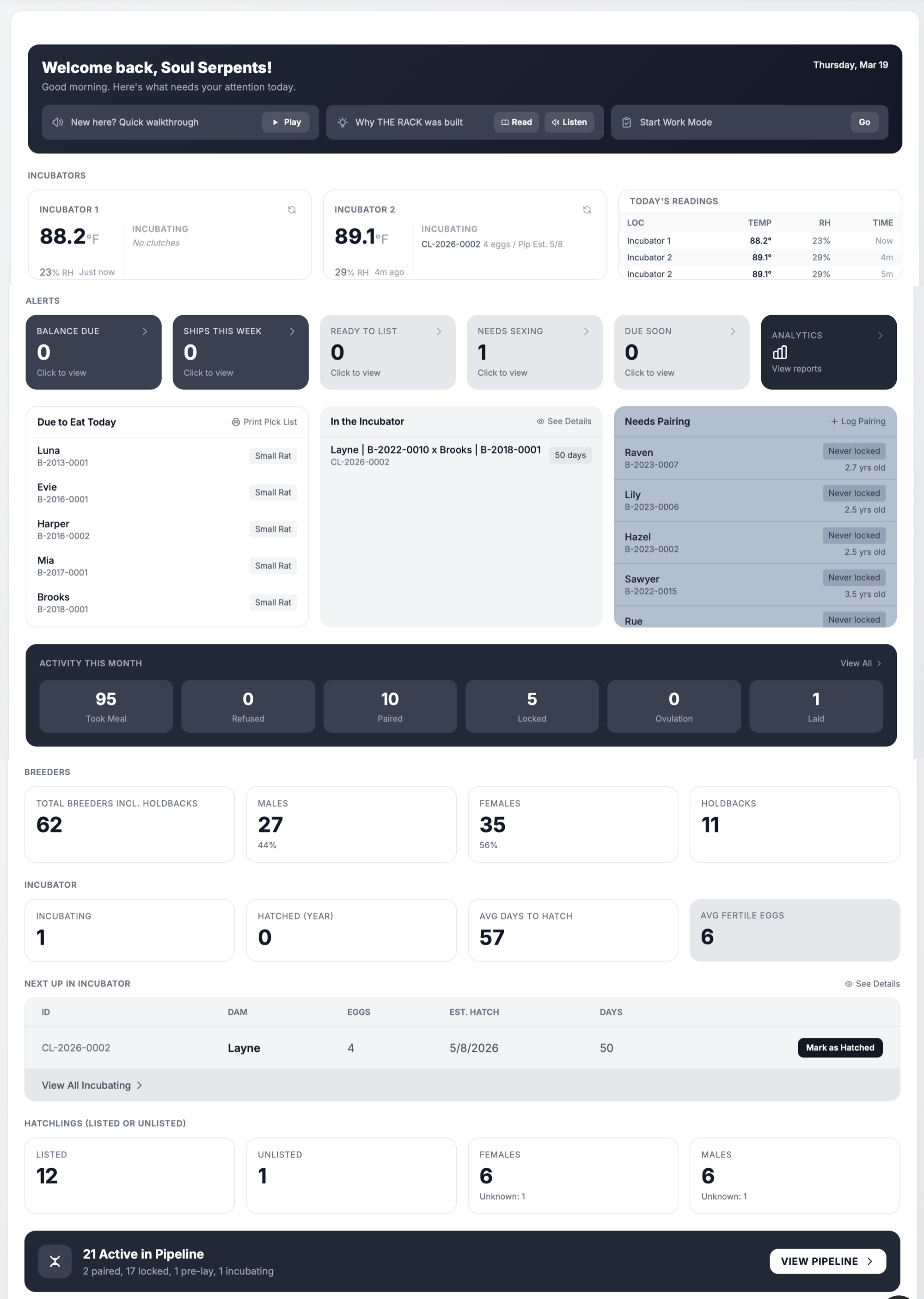
Want this exact system for your breeding pipeline?
See Every Female's Stage.
In One View.
THE RACK's breeding pipeline shows which females are paired, locked, ovulating, or approaching lay date. No spreadsheets. No guessing.
See THE RACKThe Stall Factor
Females often stall at 20 to 25 millimeters during cooler ambient temperatures. This is normal biology, not a problem to solve. The growth formula assumes active season temperatures. For animals in cooler environments, add a 15 to 20 percent buffer to your timeline estimates.
Consistent feeding, stable temps, and low stress help minimize stall duration. Females that enter the season in strong body condition with established feeding patterns tend to move through the building phase faster.
TIMELINE SUMMARY
Total timeline from first signs of development to egg deposition: 90 to 150+ days. Once follicles exceed 30mm, the timeline becomes significantly more predictable.
The follicle to clutch timeline is one of the most important cycles to understand and document in ball python breeding. Every season of data makes the next season's predictions more accurate. Track the measurements. Log the events. Let the data remove the uncertainty.
Built by a Breeder
Predict the Timeline.
Prepare for the Clutch.
Breeding pipeline. Female health tracking. Follicle logs. Estimated lay dates. Clutch management from pairing to hatch.
See THE RACKFree for up to 5 animals. Keeper $10/mo. Breeder $20/mo. 7-day money-back guarantee.