
News / Breeding Basics and Genetics for Ball Pythons
Breeding Basics and Genetics for Ball Pythons
- Breeding success starts with conditioning, timing, and genetics planned months in advance.
- Every morph follows rules: dominant, co-dominant, and recessive. Master the math before you pair.
- Documentation separates professional breeding from guesswork. Track every feeding, shed, and lock.
- Genetic clarity protects your reputation. Label hets only when confirmed.
Breeding ball pythons is not luck. It is the result of timing, conditioning, and genetics planned months in advance. Every lock, every shed, and every egg tells part of the story. The difference between a successful program and an inconsistent one comes down to preparation, documentation, and patience.
The Foundation of a Successful Program
It starts with clean stock. Every animal paired for breeding should be chosen for health, temperament, and clarity of expression. Never pair snakes that are not eating consistently, shedding clean, and showing proper weight.
A healthy female is the foundation of every clutch. A strong male carries the vision. Tracking feeding history, sheds, follicle growth, and locks determines when to introduce males. Biology drives the timeline, not a date on a calendar.
BREEDING RULE
Documentation separates professional breeding from guesswork. Track everything. Every feeding, every shed, every lock. Those details guide the next pairing season.
Understanding Genetics
Every morph follows rules. Master them and you build power. Break them and you lose direction.
- Dominant genes show their effect with one copy
- Co-dominant genes amplify when doubled, producing super versions
- Recessive genes require both parents to carry the trait to produce visuals
The best breeders learn to see the invisible: hets, probabilities, and the math that drives pairing results. A genetics calculator shows what is possible before you pair. When you know the odds before cutting an egg, you are working strategically.
Pairing Philosophy
Every pairing should start on paper long before it happens in a rack. Look for combinations that improve contrast, tighten pattern, or enhance visual clarity. The goal is refinement, not random experimentation.
When a female is nearing breeding weight and building follicles, she is ready. Pair males no more than once a week, then let them rest. Record each lock with date and temperature. When eggs drop, the odds, the genetics, and the purpose behind that clutch should already be documented.
Conditioning and Timing
Biology cannot be rushed. Females build follicles when they are ready, usually triggered by cooler seasonal temperatures and consistent feeding. Males cycle too. During breeding season, many stop eating as they focus on females.
Monitor weight closely on both sides. A breeding weight calculator helps determine when a female has reached the condition needed to support egg production safely.
Clean data builds clean decisions.
Incubation and Hatchling Care
Eggs incubate around 88.5 degrees Fahrenheit for roughly 55 days. Consistency is everything. No hot spots, no temperature swings. Clean incubation boxes, vermiculite at the right moisture ratio, and stable conditions produce reliable hatch rates.
Once pipped, babies move to hatchling tubs with identical parameters: warmth, humidity, and clean paper substrate. The first shed happens within a week. After that, the first meal is offered. No hatchling should leave a program until it is feeding regularly, shedding clean, and showing confidence.
Why Genetic Clarity Matters
Trust in the market requires truth in genetics. Every clutch should be tracked by sire and dam. Het status should be labeled only when confirmed through visual offspring or verified lineage. Precision in labeling protects both the breeder's reputation and the buyer's investment.
As the industry grows, so does the need for accuracy. RGI (Rare Genetics Inc.) testing can confirm complex recessives when lineage alone is not enough.
Documentation and Record Keeping
Systems that track every metric, feedings, pairings, weights, locks, and sheds, are not chores. They are data points that guide the next pairing season. Clean data builds clean decisions.
Every breeder, even beginners, should start documenting early. Patterns emerge faster when the data is there. Breeding logs that connect pairings to offspring outcomes make the invisible visible over time.
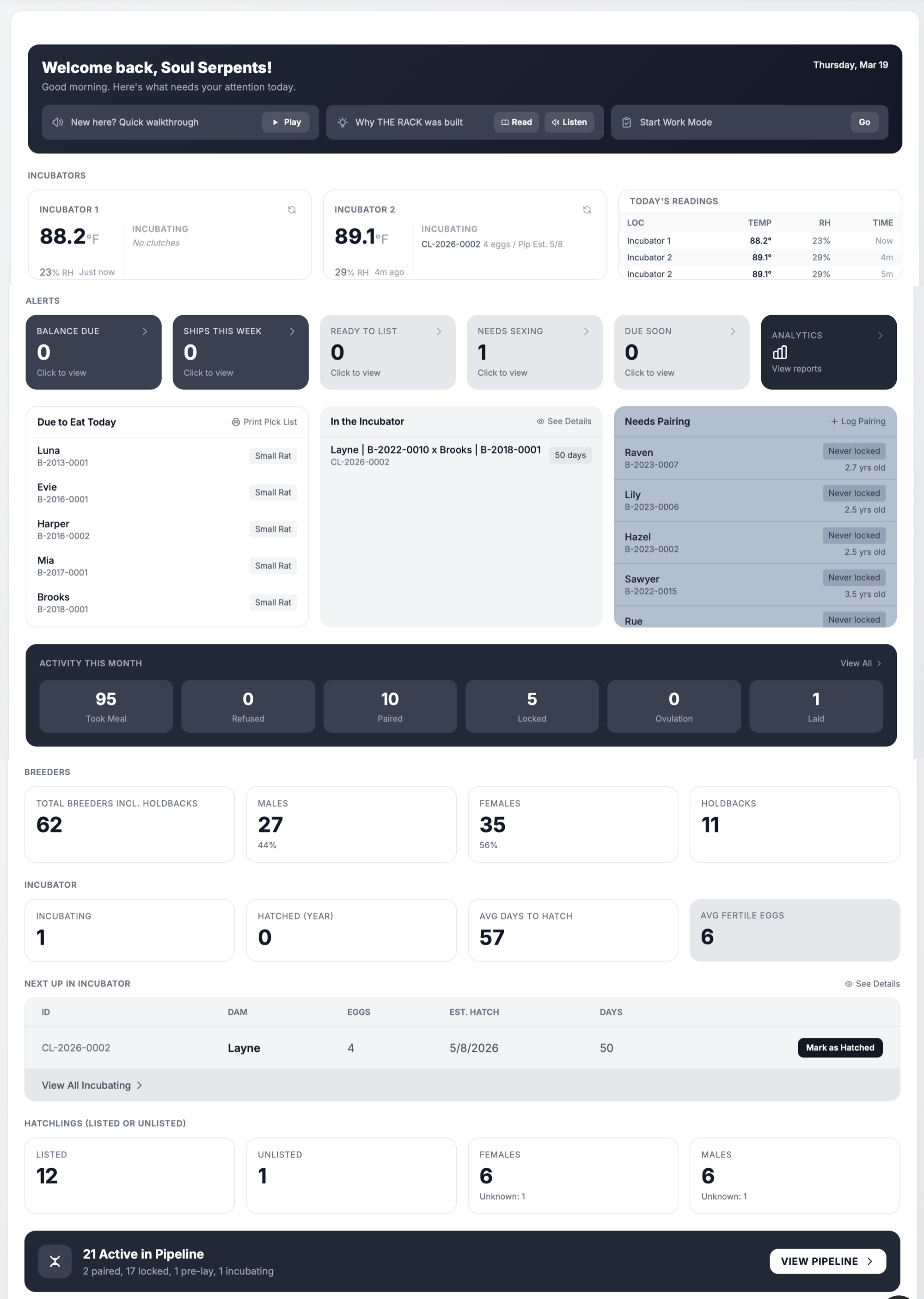
Want this exact system for managing your breeding program?
Every Pairing Tracked.
Every Outcome Documented.
THE RACK logs pairings, locks, follicle development, and offspring. The data that turns breeding from guesswork into a repeatable system.
See THE RACKRespecting the Process
Breeding is equal parts biology and patience. Proper feeding schedules, steady temperatures, and stress-free environments are the hidden work behind every clutch photo posted online. That effort is invisible, but it defines professionalism.
Good breeding looks easy from the outside. The truth is years of small choices, every one documented and refined. Healthy snakes, perfect sheds, consistent feeding, calculated pairings. These are the real milestones of success.
THE STANDARD
Structure produces results. When you focus on the system, the outcomes speak for themselves. Every clutch is proof of the work that came before it.
Built by a Breeder
Plan the Pairing.
Document the Results.
Genetics calculator. Breeding logs. Weight trends. Offspring tracking. The system that turns breeding into a data-driven program.
See THE RACKFree for up to 5 animals. Keeper $10/mo. Breeder $20/mo. 7-day money-back guarantee.