
News / Ball Python Respiratory Infection: Signs & Trea...
Ball Python Respiratory Infection: Signs & Treatment
- Silent breathing is healthy breathing. Any audible wheezing, clicking, or crackling is a warning sign.
- The #1 cause of RIs is temperatures too low. Immune function depends on proper heat.
- Mild early symptoms with bad husbandry? Correct the environment first. Open-mouth breathing or colored mucus? Vet immediately.
- Prevention comes down to consistent husbandry and systematic monitoring. Log everything.
Respiratory infections are one of the most common health issues ball python keepers encounter. The good news is they are preventable. The better news is they are treatable when caught early. Knowing the signs, understanding the root causes, and having a clear action plan can make the difference between a quick recovery and a serious veterinary situation.
Recognizing the Signs of a Respiratory Infection
Ball pythons are quiet animals. They do not cough or sneeze the way mammals do. When something is wrong with their respiratory system, the signs are subtle at first and become more obvious as the infection progresses.
Early Warning Signs
- Audible breathing: A healthy ball python breathes silently. If you can hear wheezing, clicking, or crackling sounds when the snake breathes, something is off.
- Excess mucus: Bubbles around the nostrils or visible mucus in the mouth are clear indicators. Check for a wet or bubbly appearance around the nares.
- Open-mouth breathing: Ball pythons do not breathe with their mouths open under normal conditions. If the mouth is gaping or the snake appears to be gasping, this is a red flag.
- Head tilting upward: A snake holding its head elevated, sometimes called stargazing, can be attempting to clear its airways. This often accompanies more advanced infections.
Advanced Symptoms
- Lethargy beyond normal: Ball pythons are not active animals, but a snake refusing food for extended periods and staying completely immobile with labored breathing is in distress.
- Thick or discolored mucus: Clear mucus in small amounts can be early stage. Yellow, green, or thick opaque discharge signals a bacterial infection progressing.
- Weight loss: Prolonged refusal to eat combined with respiratory symptoms leads to noticeable weight loss. Track body condition regularly using a health log so you catch changes early.
Key Takeaway
Silent breathing is healthy breathing. Any audible sound during respiration warrants immediate investigation.
What Causes Respiratory Infections in Ball Pythons
Respiratory infections do not appear randomly. They are almost always the result of environmental conditions falling outside the parameters these animals need. The bacteria responsible for most RIs, commonly Pseudomonas and Aeromonas species, are present in most environments. They become a problem when the snake's immune system is suppressed by poor husbandry.
The Usual Suspects
- Temperatures too low: This is the number one cause. Ball pythons are ectotherms. Their immune system depends on proper ambient and hot spot temperatures. When the warm side drops below 88F or the ambient falls below 78F consistently, the immune response weakens and bacteria gain a foothold.
- Humidity too high or too low: Sustained humidity above 80% without adequate ventilation creates a breeding ground for bacteria and mold. Conversely, extremely low humidity can irritate respiratory tissues. The target range for ball pythons is 55 to 70%, with bumps to 80% during shed cycles.
- Poor ventilation: Sealed enclosures with no airflow trap moisture and allow bacterial populations to build. This is especially common in tub setups where ventilation holes are insufficient.
- Dirty substrate and standing water: Wet, soiled substrate is a bacterial incubator. Spot clean regularly and replace substrate on a schedule. Water bowls tipped or overflowing create standing moisture the enclosure was not designed to handle.
- Stress: A snake stressed by frequent handling, improper hides, cohabitation, or recent relocation has a weakened immune response. Stress alone does not cause an RI, but it sets the stage.
Want to catch health changes before they become emergencies?
Log Every Observation. Spot Patterns Early.
THE RACK's Health Log lets you record symptoms, treatments, and vet visits for every animal in your collection. One timeline. Nothing missed.
See THE RACKHusbandry Correction vs. Veterinary Intervention
Not every respiratory issue requires a vet visit. But some absolutely do. The distinction matters because delaying veterinary care when it is needed can turn a treatable infection into a fatal one.
When to Correct Husbandry First
If you catch symptoms early, meaning faint wheezing or a small amount of clear mucus, and your husbandry parameters are off, the first step is correcting the environment:
- Raise the warm side to 90F and ensure the ambient stays at 80F minimum
- Check humidity levels and adjust ventilation if above 75% sustained
- Replace soiled substrate immediately
- Ensure the enclosure has a clean, dry hide on the warm side
- Minimize handling and reduce stress
In mild cases caught early, correcting the environment can resolve symptoms within a few days. The snake's immune system recovers when conditions are right, and it can clear a minor bacterial presence on its own.
When to See a Vet
Seek veterinary care immediately if you observe any of the following:
- Open-mouth breathing or gasping
- Thick, discolored mucus (yellow or green)
- Symptoms persisting beyond 48 to 72 hours after husbandry corrections
- Severe lethargy with complete food refusal exceeding two weeks
- Mucus accompanied by swelling around the head or jaw
A reptile veterinarian will perform a culture and sensitivity test to identify the specific bacteria and determine which antibiotic will be effective. Common treatments include injectable antibiotics like Baytril (enrofloxacin) or Fortaz (ceftazidime). Do not attempt to medicate without veterinary guidance. Incorrect antibiotics or dosing can cause more harm than the infection itself.
The enclosure is the immune system's first line of defense.
Prevention: Building a Protocol
The best treatment for respiratory infections is making sure they never happen. Prevention comes down to consistent husbandry and systematic monitoring.
- Temperature checks: Verify hot spot and ambient temps daily. Digital thermometers with probes are non-negotiable. Stick-on thermometers are unreliable.
- Humidity monitoring: Use a digital hygrometer placed at substrate level, not mounted on the wall above the snake's head. The reading at the animal's level is the one the animal experiences.
- Substrate schedule: Full substrate changes on a set schedule, not when it looks dirty. Spot clean between changes. How often depends on the substrate type and the animal's habits.
- Quarantine new arrivals: Every new animal entering your collection should be quarantined for a minimum of 30 days. Respiratory infections can be asymptomatic during transport stress and show up weeks later. Introducing an infected animal to your existing collection puts everyone at risk.
- Health logging: Recording feeding responses, shed quality, weight, and any behavioral changes creates a baseline for each animal. When something shifts, you see it in the data before it becomes an emergency. Health logs in THE RACK keep every observation timestamped and tied to the individual animal.
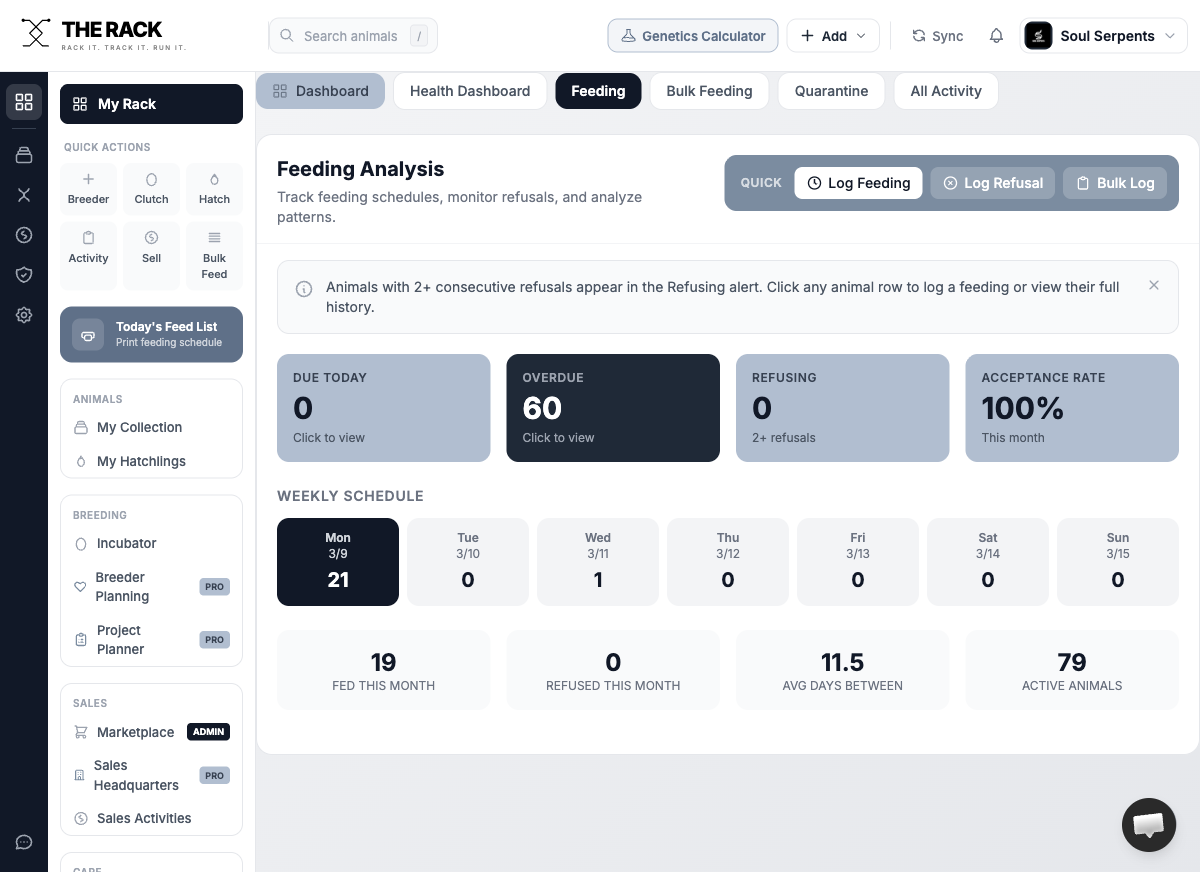
Want this exact health tracking system for your collection?
One Health Log. Every Animal. Every Detail.
THE RACK logs health observations, vet visits, treatments, and shed cycles for every animal in your collection. Spot problems before they spread.
See THE RACKRecovery and Monitoring
Once an RI is being treated, whether through husbandry correction or veterinary antibiotics, monitoring the recovery is critical. Symptoms should begin improving within the first week of treatment. If they do not, follow up with your vet.
During recovery:
- Maintain elevated warm-side temps (90F) to support the immune response
- Keep the enclosure cleaner than usual. Change substrate more frequently.
- Do not handle the animal unless necessary for treatment
- Offer food once the snake shows interest, but do not force it
- Log every observation, every treatment dose, and every behavioral change in your health log
A full recovery from a respiratory infection can take two to six weeks depending on severity. The animal is recovered when breathing is silent, mucus is absent, feeding has resumed, and the snake is behaving normally for at least two consecutive weeks.
Prevention Protocol
Daily temp checks. Consistent humidity. Clean substrate. Quarantine new arrivals. Log everything.
Built by a Breeder
Know Your Animals.
Protect Your Collection.
Health logs. Weight trends. Feeding records. Shed tracking. All in one place.
See THE RACKFree to start. Keeper $10/mo, Breeder $20/mo — 7-day money-back guarantee. Your data is yours, exportable anytime.