
News / Ball Python Cooling Schedule for Breeders | THE...
Ball Python Cooling Schedule for Breeders | THE RACK
Not every breeder uses a cooling cycle, and there is nothing wrong with skipping it. Some programs produce consistent clutches without ever dropping temperatures. This article is for breeders who want to test the theory and see if a structured cooling period works for their program. If it does, great. If it does not, your animals are fine. This is one approach, not the only approach.
For breeders who do cool, getting it right matters. Females build follicles on schedule. Ovulations happen when you expect them. Clutches land in predictable windows. Get it wrong, and you spend the season guessing why she is not responding to the male, why follicles stalled, or why she went off feed for four months with nothing to show for it.
This is the step-by-step cooling schedule many breeders follow. Timelines, temperatures, feeding adjustments, and the signs to watch for at each stage.
When to start cooling
Most breeders begin cooling between mid-September and early November. The exact start date depends on your geographic location, your room setup, and whether your females are at breeding weight.
Cooling is a seasonal trigger. In the wild, ball pythons experience a natural temperature and humidity drop during the dry season in West Africa. In captivity, you replicate this shift by lowering your hotspot temperatures and adjusting the photoperiod. The goal is to signal the female's reproductive system to begin follicle development.
Prerequisites before you start
- Females at breeding weight. For most ball pythons, this means 1,500 grams minimum. Underweight females should not be cooled. They need to gain weight first, not burn through reserves.
- Consistent feeding history. A female who has been eating well for 3-4 months leading into cooling season is in a strong position. A female who has been sporadic is not.
- Males in good condition. Males lose weight during breeding season. They need to start healthy and well-fed. A male at 700 grams is not ready to work.
- Health check. No respiratory infections, no mites, no active health issues. Cooling an unhealthy animal puts it at risk.
Cooling is not a calendar date. It is a readiness check. Your females need to be at weight, healthy, and eating consistently before you begin dropping temperatures.
The temperature drop: a two-week step-down
Do not drop temperatures all at once. A sudden shift from 90 degrees to 78 degrees stresses the animal and increases the risk of respiratory infection. Instead, reduce the hotspot temperature gradually over a two-week period.
Step-down schedule
- Week 1. Drop the hotspot from 88-90 degrees Fahrenheit to 84-86 degrees. The cool side stays at ambient room temperature.
- Week 2. Drop the hotspot to 80-82 degrees. You are now approaching your target cooling range.
- Week 3 onward. Hold the hotspot at 78-80 degrees. This is your cooling baseline. Maintain this range for the full cooling period.
The nighttime temperature can drop a few degrees lower. Many breeders let the room fall to 72-74 degrees overnight. This natural fluctuation between day and night mimics the temperature swings ball pythons experience in the wild during the dry season.
Use a proportional thermostat to manage the step-down. Adjust the set point every few days rather than making one large change. Your thermostat should hold steady at each new target before you drop again.
Feeding adjustments during cooling
Feeding changes when temperatures drop. Digestion slows in cooler conditions, and offering the same prey size on the same schedule risks regurgitation. Regurgitation during cooling season can take a female out of the breeding rotation entirely.
How to adjust
- Reduce frequency. Move from weekly feeds to every 10-14 days during the step-down. Once at full cooling temps, feed every 2-3 weeks or not at all, depending on the female's response.
- Smaller prey. Drop one prey size from your normal offering. If she eats medium rats during the season, offer small rats during cooling.
- Watch for refusals. Many females go off feed entirely during cooling. This is normal and expected. Do not force it. Offer food every 2-3 weeks and remove it if she does not take it within 12 hours.
- Log everything. Record every feeding attempt, every refusal, and every successful meal. This data matters when you evaluate her condition later in the season. Feeding logs give you the full picture without relying on memory.
Some breeders stop feeding entirely during cooling. Others offer small meals every few weeks. Both approaches produce results. The key is watching body condition. A female who entered cooling at 1,800 grams and drops to 1,400 needs food, even if she is being cooled. A female who holds steady at 1,700 is fine.
Cooling is a conversation
with her biology.
You set the conditions. She decides when she is ready.
How long to cool
The standard cooling period runs 8 to 12 weeks. Most breeders land somewhere in the 10-week range. Shorter cooling periods can still produce results, but females tend to respond more consistently with a full 10-12 week cycle.
Mark the start date on your calendar or in your breeding logs. When you are managing multiple females at different stages, the dates blur fast. Knowing exactly when each female started cooling tells you when to start warming them back up and when to expect follicle development.
What happens during cooling
- Follicle development begins. The temperature drop signals the pituitary gland to release reproductive hormones. Follicles start growing on the ovaries. You will not see this externally yet, but it is happening.
- Appetite decreases. Most females reduce or refuse food. This is normal. Their metabolism is slowing, and their body is redirecting energy toward reproduction.
- Activity changes. Some females become more restless. Others become more sedentary. Both responses are within the normal range.
Signs she is ready
After 8-12 weeks of cooling, you begin looking for signs the female is entering her reproductive cycle. These signs indicate follicle development has progressed to the point where pairing can begin.
What to watch for
- Restlessness. She moves around the tub more than usual, especially at night. She is not looking for food. She is looking for a mate.
- Inverted posture. She positions herself belly-up or with her lower body twisted, exposing her vent area. This is a receptivity signal.
- Mid-body swelling. Developing follicles create a visible thickening in the lower third of her body. Experienced breeders can palpate this gently, but ultrasound gives a clearer picture.
- Seeking the cool side. Females with developing follicles often position themselves on the cooler end of the enclosure. Follicle development generates internal heat, and she thermoregulates by moving to cooler areas.
Female health monitoring in THE RACK lets you log follicle checks, behavioral changes, and ovulation dates as they happen. When you are running multiple females through different stages of the breeding cycle, having every milestone in one place keeps the timeline clear.
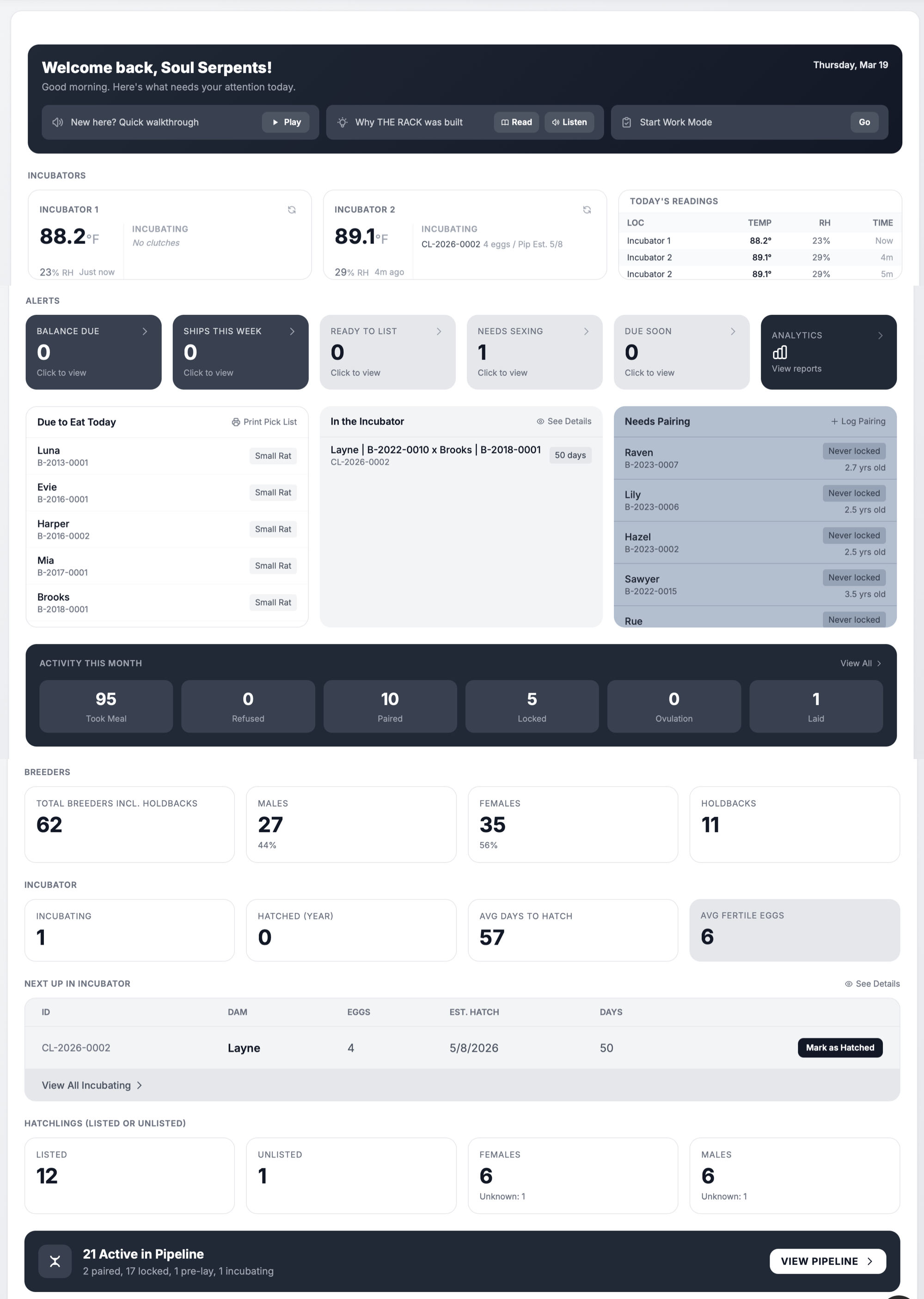
Want this breeding timeline for your program?
See every female's cooling and breeding status in one view
THE RACK logs cooling start dates, follicle checks, ovulations, and lay dates. Your entire breeding season, organized and visible.
See THE RACKCommon cooling mistakes
Cooling is straightforward, but small errors compound. These are the mistakes experienced breeders see most often in programs having a rough breeding season.
Dropping temperatures too fast
Going from 90 degrees to 78 degrees in a single day shocks the system. Respiratory infections spike when temperature changes happen abruptly. The two-week step-down exists for a reason. Use it.
Not cooling long enough
Six weeks is not enough for most females. Some breeders get impatient and warm up early, then wonder why follicles stall or the female never ovulates. Commit to a minimum of 8 weeks. Ten to twelve is better.
Cooling an underweight female
A female at 1,200 grams does not have the reserves to sustain 10 weeks of reduced feeding and lowered metabolism. She burns through her fat stores and comes out of cooling weaker than when she went in. She needs to gain weight before she breeds. Skip her this season and build her up for the next one.
Ignoring male condition
Males lose significant weight during breeding season. If a male enters the season underweight, he runs out of energy before the job is done. Weigh your males before cooling starts. A weight trend chart shows you whether he is gaining, holding, or dropping heading into the season.
No records
Cooling without documenting start dates, temperature changes, feeding attempts, and behavioral observations means you have no reference for next year. Breeding programs improve season to season because breeders learn what works for their animals. Without records, every season starts from zero.
Every cooling season builds on the last. Detailed records turn guesswork into a repeatable process with predictable outcomes.
Warming back up and introducing males
After 8-12 weeks of cooling, begin raising temperatures back to normal. Follow the same gradual approach in reverse.
Warm-up schedule
- Week 1. Raise the hotspot from 78-80 degrees back to 84-86 degrees.
- Week 2. Raise to 88-90 degrees. Full normal temps restored.
- Resume feeding. Offer a small meal once temps are stable at the higher range. Most females take food within a week of warming up. Some take two.
Many breeders introduce males during the warm-up phase or immediately after. The combination of rising temperatures and a meal signals the female's body to accelerate follicle development. This is when pairing activity begins.
Pairing protocol
- Introduce the male to the female's tub. Not the other way around. Her scent in the environment makes him more active.
- Leave him in for 24-48 hours. Check for locks (copulation). If no lock occurs, remove him and try again in 3-5 days.
- Rotate males if needed. Some females respond better to different males. If she shows no interest after multiple introductions, try a different male.
- Log every pairing. Date, duration, whether a lock was observed, which male. This data shapes your decisions for the rest of the season. A pairing log keeps every introduction documented.
Putting it all together: the full timeline
Here is what a typical cooling and breeding timeline looks like from start to finish.
- August-September. Assess breeding weight. Verify all females and males are healthy, eating, and on target. Log baseline weights.
- October (weeks 1-2). Begin the two-week temperature step-down. Drop hotspot to 84-86 degrees in week one, 78-80 degrees by end of week two.
- October-December. Hold cooling temps at 78-80 degrees. Reduce feeding frequency. Offer smaller prey every 2-3 weeks. Log refusals and successful meals.
- Late December-January. Begin warming back up over two weeks. Resume normal feeding with small meals first.
- January-February. Introduce males. Begin pairing rotations. Watch for follicle development, behavioral changes, and receptivity signals.
- February-April. Monitor for ovulation. Log ovulation dates. Continue pairing until confirmed. Begin pre-lay preparations.
This timeline shifts depending on when you start and your specific program goals. Some breeders run an earlier schedule. Others push later. The structure stays the same; the dates move.
Breeding pipeline tools in THE RACK let you see where every female sits in this timeline. Who is cooling. Who is being paired. Who is building follicles. Who is gravid. One view for your entire program.
Built by a Breeder
Cooling season starts here.
Manage the whole timeline.
Cooling dates. Feeding logs. Follicle checks. Pairing rotations. Ovulation tracking. All in one place.
See THE RACKFree for up to 5 animals. Keeper $10/mo. Breeder $20/mo. 7-day money-back guarantee.