
News / Ball Python Weight Tracking: What the Numbers T...
Ball Python Weight Tracking: What the Numbers Tell You
- A single weight reading tells you nothing. A weight trend tells you everything: growth trajectory, breeding readiness, and early warning signs.
- Weigh hatchlings weekly, juveniles biweekly, adults monthly. Breeding season: weekly for males, biweekly for females.
- Male breeders losing more than 10-15% from pre-season baseline need rotation reduced or pulled entirely.
- A hatchling with documented growth data sells with confidence. Weight records are a sales tool, not paperwork.
A single weight reading tells you almost nothing. An animal weighs 1,800 grams. Is that good? Is she gaining? Is she losing? Without context, a number on a scale is data without meaning. A weight trend; a series of readings over weeks and months; tells you everything. It tells you whether a hatchling is growing on schedule. Whether a breeding female is in condition. Whether a male is being overworked. The number only matters when you can see where it came from and where it is going.
Weight tracking is one of the simplest records a breeder can keep and one of the most revealing. It requires a scale, a date, and a system to store the data. The value comes not from individual readings but from the pattern they create over time.
Why a Trend Matters More Than a Number
A ball python that weighs 2,000 grams might be in perfect health or in serious trouble. The number alone does not tell you. But if you look at the trend and see she weighed 2,400 grams three months ago and has been dropping steadily, the picture changes. Something is wrong. The trend surfaced the problem before the animal looked visibly thin.
This is the core value of weight tracking. It catches problems before they become visible. The breeder who tracks weight trends catches the decline early and intervenes.
How Often to Weigh
- Hatchlings. Weekly. Growth rate during the first several months is the clearest indicator of whether the animal is thriving.
- Growing juveniles. Biweekly to monthly. Growth slows after the first year, but the trend should still move upward.
- Adult breeders (off season). Monthly. Stable weight with minor seasonal fluctuation is normal.
- Adult breeders (breeding season). Weekly for males. Biweekly for females. Males lose weight fast during breeding because they stop eating.
The Weight Tracking Rule
A single weight is a data point. A trend is a diagnostic tool. Track consistently and the numbers tell you what your eyes miss.
Weight Tracking for Breeding Decisions
Weight data is not separate from breeding records. It is a core input for breeding decisions.
Female Breeding Readiness
Female ball pythons need to reach a minimum weight before breeding. Most breeders target 1,500 grams as the floor for a first-time breeder. The trend matters. A female at 1,500 grams on an upward trend is different from one who has been stalling for two months. Use your breeding weight calculator to determine target weights.
Male Workload Management
Males stop eating during breeding season. Record each male's pre-season weight as a baseline. Set a threshold; most breeders use 10-15% loss from baseline as the warning line. A male that crashes during breeding season often takes months to recover.
Post-Lay Recovery
A female loses significant weight after laying. What matters is the recovery trajectory. Compare recovery data across seasons. If a female's recovery time is increasing year over year, she is getting bred too frequently.
The scale shows you what's happening. The trend shows you what's coming.
Weight Tracking for Hatchling Sales
Buyers want to know a hatchling is thriving before they purchase. A hatchling with a documented growth trend showing consistent gains is a stronger sale than one with no weight history.
Growth Documentation
Every hatchling weighed at hatch gives you a baseline. Weekly weigh-ins create the growth curve. When a buyer asks "is this animal eating well?", you show them the data: hatch weight, current weight, weekly gains, and number of consecutive meals taken.
Feeding Correlation
Weight trends paired with feeding data create a complete picture. An animal gaining weight on a consistent feeding schedule tells you the husbandry is dialed in. You only see these correlations when weight and feeding data live in the same system.
The Sales Advantage
A hatchling with a documented growth trend and feeding record sells with confidence. Weight data is not paperwork. It is a sales tool.
Common Patterns and What They Mean
Steady Upward Trend
Consistent gains week to week in growing animals. Good husbandry, appropriate prey size, healthy animal. Continue the current protocol.
Plateau
Weight holds steady despite regular feeding. In adults, this can be normal. In juveniles, a plateau lasting more than a month is worth investigating.
Gradual Decline
Small, consistent drops over several weeks. The pattern most breeders miss because individual readings look close to normal. The trend reveals the decline.
Sharp Drop
Significant weight loss between two readings. In females after laying, this is normal. In any other context, a sharp drop is an emergency flag.
Making Weight Data Accessible
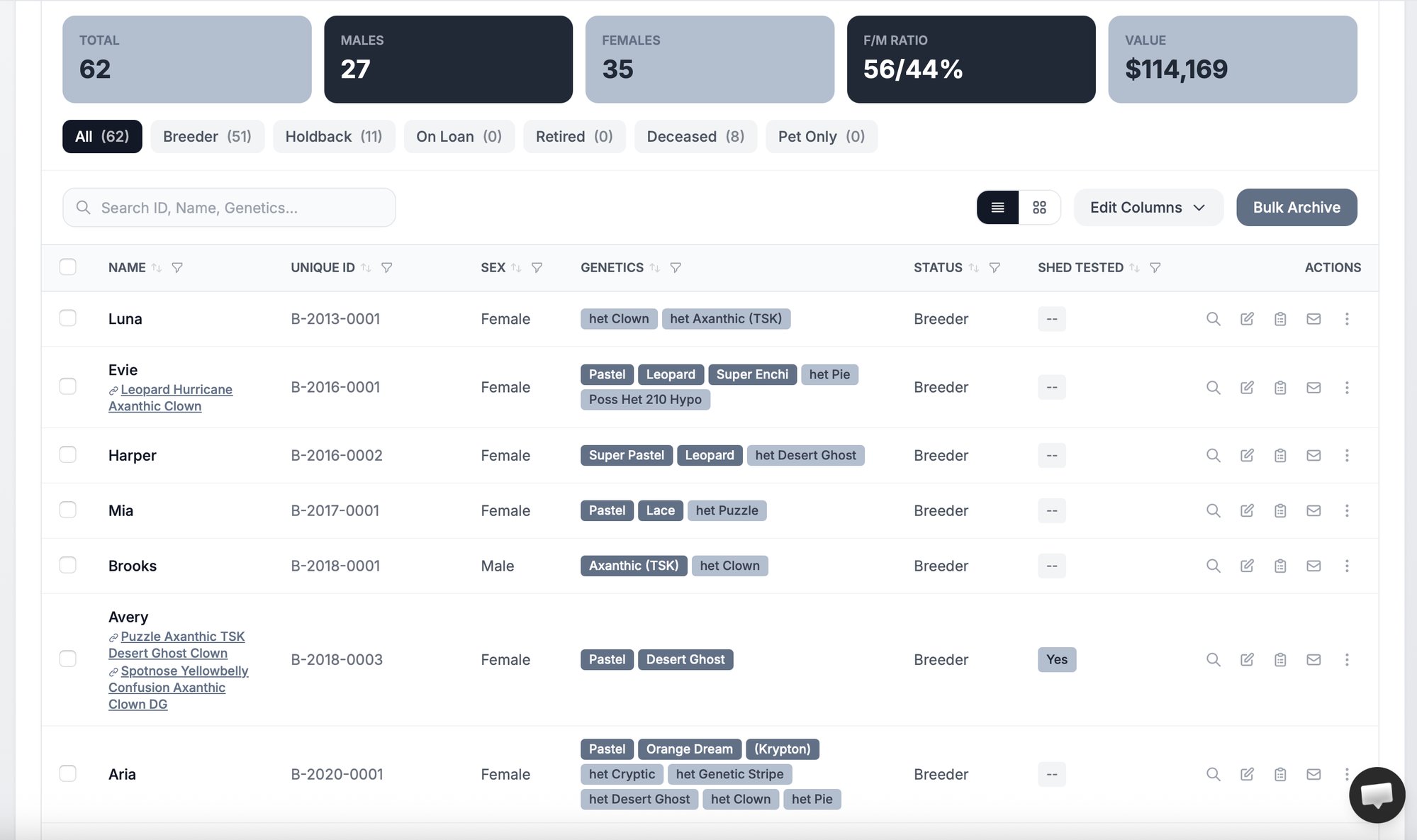
Facility management software that includes weight tracking stores every reading tied to the animal, dated, and plotted on a trend line. Open the animal's record. See the trend. Know instantly whether things are on track.
Want this exact weight tracking for your program?
Every weight. Every trend. One system.
THE RACK logs every weigh-in tied to the animal. Visual trend lines show growth, decline, and recovery at a glance.
See THE RACKWeight Tracking Is a Habit
The breeders who get the most out of weight tracking are the ones who make it routine. Weigh day is feeding day. The scale is next to the snake room door. The data goes into the system before the animal goes back in the tub. One number on a scale is nothing. A year of numbers is a diagnostic system that tells you more about your animals than anything else in your facility.
Built by a Breeder
See the trend.
Make the call.
Weight trends per animal. Feeding logs tied to growth data. Breeding weight calculator. Male health monitoring with workload alerts. THE RACK turns your scale into a diagnostic system.
See THE RACKFree for up to 5 animals. Keeper $10/mo. Breeder $20/mo. 7-day money-back guarantee.