
News / Female Health Cycles: What You Are Probably Mis...
Female Health Cycles: What You Are Probably Missing
- Follicles develop months before ovulation. Waiting for obvious signs means you have already missed the optimal breeding window
- Track follicle size, body condition, feeding response, and behavior every time you check a female during breeding season
- Individual females have unique rhythms. Some never refuse food. Some cycle faster. Data across seasons reveals patterns you cannot see in real time
- Female health tracking connects to everything: incubator capacity, supply ordering, hatch date forecasting, and sales planning
- The breeders who scale successfully are not smarter. They have better data.
I learned more about my females in three months of proper tracking than I did in my first two years of breeding. That sounds dramatic, but it is true. Before I started tracking follicle cycles systematically, I was guessing. Hoping. Waiting for obvious signs that a female was ready to breed. By the time those obvious signs appeared, I had already missed the optimal window.
In This Guide
The Follicle Development Timeline
Here is what happens inside a female ball python before she ever shows external signs of being ready to breed:
Follicles start developing months before ovulation. They grow slowly, reaching different stages that experienced breeders can identify through gentle palpation or ultrasound. The progression looks something like this:
- Tiny follicles (under 10mm): Not breeding ready
- Small follicles (10-20mm): Development starting
- Medium follicles (20-30mm): Getting closer
- Large follicles (30mm+): Breeding window approaching
- Pre-ovulatory: Ready now
The problem is that most breeders only pay attention when the female starts refusing food or showing obvious body changes. By then, she might be past the optimal breeding window, or you might have missed it entirely.
Track every female through her cycle
Follicles. Ovulation. Pre-Lay Shed. Lay Date.
THE RACK's Breeding Pipeline tracks every female through each stage of her cycle. Log follicle checks, pairings, locks, ovulation, and pre-lay sheds. The pipeline advances her automatically so you always know where she stands.
See the Breeding PipelineWhy Timing Matters
A female bred at the wrong time in her cycle might:
- Refuse the male entirely
- Lock but not produce fertile eggs
- Produce a smaller clutch than she could have
- Skip the season entirely
Compare that to a female bred at the right time:
- Receptive to the male
- Higher fertilization rates
- Larger clutch sizes
- Predictable lay dates
The difference between guessing and tracking can be several eggs per clutch. Across a season with multiple females, that adds up to thousands of dollars in potential offspring.
The Data You Should Be Capturing
Every time you check a female during breeding season, you should record:
- Date of check
- Follicle size estimate (if palpating or using ultrasound)
- Body condition (weight, girth changes)
- Feeding response (ate, refused, regurgitated)
- Behavioral notes (cruising, hiding, defensive)
This sounds like a lot of work. It is not, once you have a system that makes entry fast.
The value comes from patterns. After tracking a female for one or two seasons, you start seeing her individual rhythm. Some females cycle quickly. Others take longer. Some show obvious behavioral changes. Others stay subtle until the last moment.
Without data, you cannot see these patterns. You are reacting to whatever is happening right now.
What Tracking Reveals
Let me give you a real example from my own operation.
I have a female who never refuses food. Most breeders use food refusal as their primary indicator that a female is approaching ovulation. This female? She eats right up until she lays.
If I relied on food refusal, I would miss her breeding window every single time.
But because I track her follicle development, I know when she is ready regardless of her feeding behavior. I have two seasons of data showing her pattern. I do not need her to tell me she is ready. I already know.
That is the power of systematic tracking. It removes guesswork.
The breeders who scale
are not smarter.
They have better data.
The Cascade Effect
Female health tracking does not exist in isolation. It connects to everything else in your operation.
When you know a female is approaching her lay date, you can:
- Verify incubator capacity before you need it
- Order supplies in advance
- Plan your schedule around expected hatch dates
- Forecast how many babies you will have available and when
This is operational planning. It is what CEOs do in every other industry. They do not wait for production to happen and then react. They forecast production and prepare.
Without female health tracking, you cannot forecast. You are reacting.
The Minimum Viable System
If you are not tracking anything right now, start with this:
Every female in your collection gets a note every time you interact with her during breeding season. Date, weight, feeding response, and any observations.
That is it. Capture the data.
After one season, you will have a baseline for each female. After two seasons, you will see patterns. After three, you can predict her cycle with reasonable accuracy.
The Pattern
One season of data gives you a baseline. Two seasons reveal patterns. Three seasons let you predict cycles with confidence.
The Question Most Breeders Cannot Answer
Here is a test:
Right now, without looking anything up, can you tell me which of your females are within 30 days of laying?
If you have more than 10 breeding females and you cannot answer that question confidently, you are operating blind. You are reacting instead of planning.
Every egg that does not get incubated because you ran out of space is lost revenue.
Every female that skips a season because you missed her window is a year of production gone.
These are not small mistakes. They compound across your entire operation.
Building the Infrastructure
I track every female in my operation through a system that calculates estimated lay dates automatically based on the data I enter. When I log a follicle check, the system updates her timeline. When she approaches her window, I get an alert.
I do not have to remember anything. The system remembers for me.
That is not magic. It is infrastructure. The same kind of infrastructure that every successful business uses to manage production.
Your females are your production line. Treat them that way.
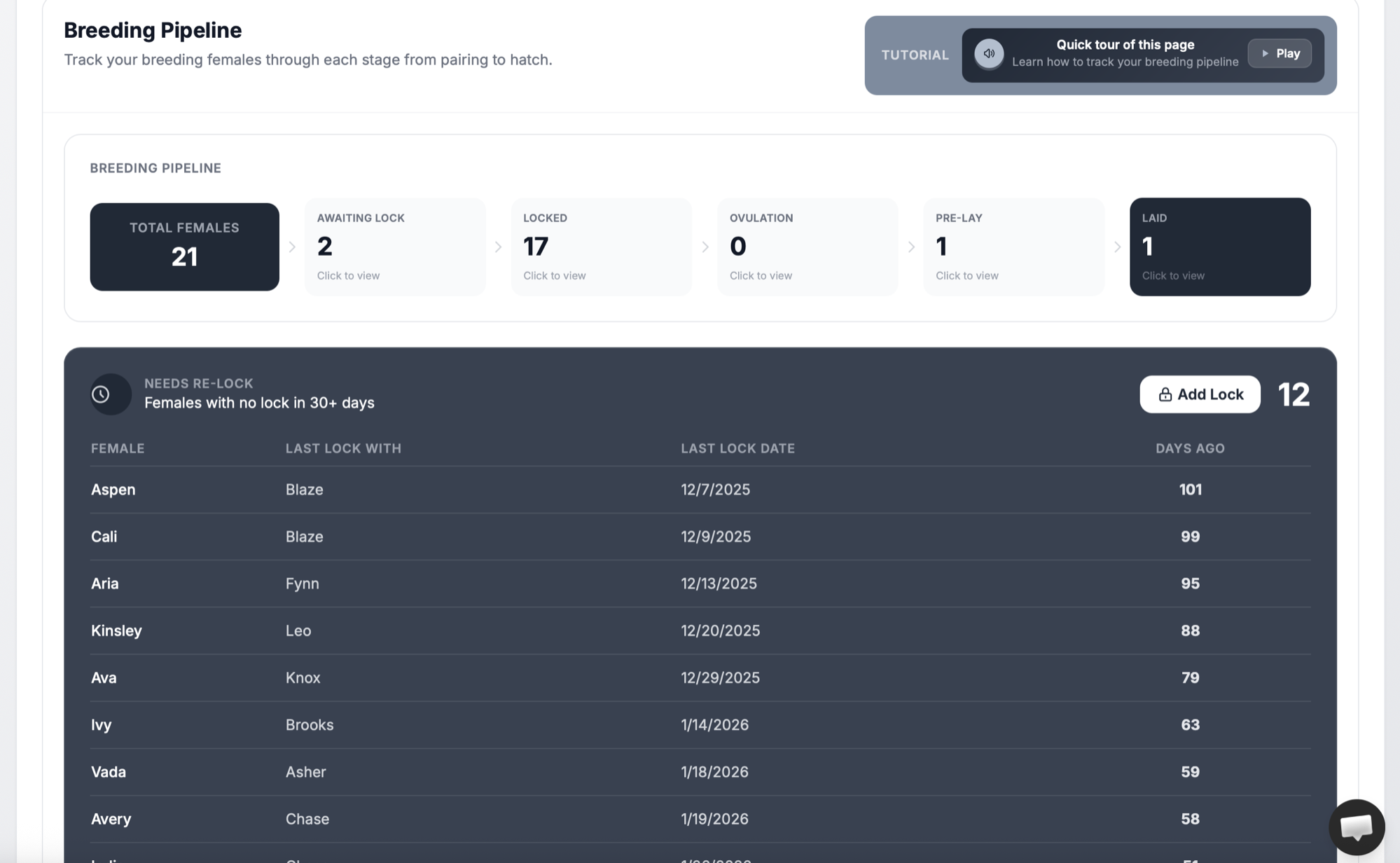
See every female's stage at a glance
Paired. Locked. Ovulating. Gravid. Laid.
THE RACK's Breeding Pipeline moves females through each stage automatically as you log activities. Estimated lay dates update in real time. You always know who is approaching her window and who needs attention.
See the PipelineContent verified against THE RACK breeding database. Follicle development timelines and breeding pipeline stages sourced from active breeder programs. Last reviewed April 2026.
Built by a Breeder
Every Female,
Every Stage, Every Season
Follicle tracking. Breeding pipeline. Estimated lay dates. Incubation management. THE RACK manages your entire breeding season in one system.
See THE RACKFree for up to 5 animals. Keeper $10/mo. Breeder $20/mo. 7-day money-back guarantee.