
News / Male Health: The Breeding Limits Nobody Talks A...
Male Health: The Breeding Limits Nobody Talks About
- Male ball pythons have physical breeding limits that most breeders ignore until it is too late
- Signs of exhaustion: shorter lock durations, weight loss, eventual breeding refusal
- Strategic pairing to 8 females produces equal or better results than aggressive pairing to 12
- Build male rotations; we do not breed a male to more than 4 females in our facility
- Track breeding events, lock success rates, and weight trends per male every season
A scenario we hear often: "I burned out one of my best males in my second breeding season." He was a gorgeous visual with genetics that could not be easily replaced. Paired aggressively because demand was high. By mid-season, his fertility dropped. By end of season, he was refusing to breed entirely.
In This Guide
This is a mistake breeders make constantly. And it is completely preventable with basic tracking.
The Biology of Male Breeding Limits
Male ball pythons are not unlimited breeding machines. They have physical limits that most breeders ignore because the males do not show obvious signs of exhaustion until it is too late.
A healthy male in good condition can breed multiple times per season. But there are variables:
- Recovery time between breedings: Males need time to replenish
- Total breeding events per season: There is a ceiling
- Age and condition: Younger males and males in peak condition can handle more
- Individual variation: Some males are marathon breeders, others tire quickly
The problem is that most breeders push their best males hardest. That stud male with the perfect genetics? He gets paired to every compatible female. And then he crashes.
Protect your best genetics
Track Every Pairing.
Know When to Rest.
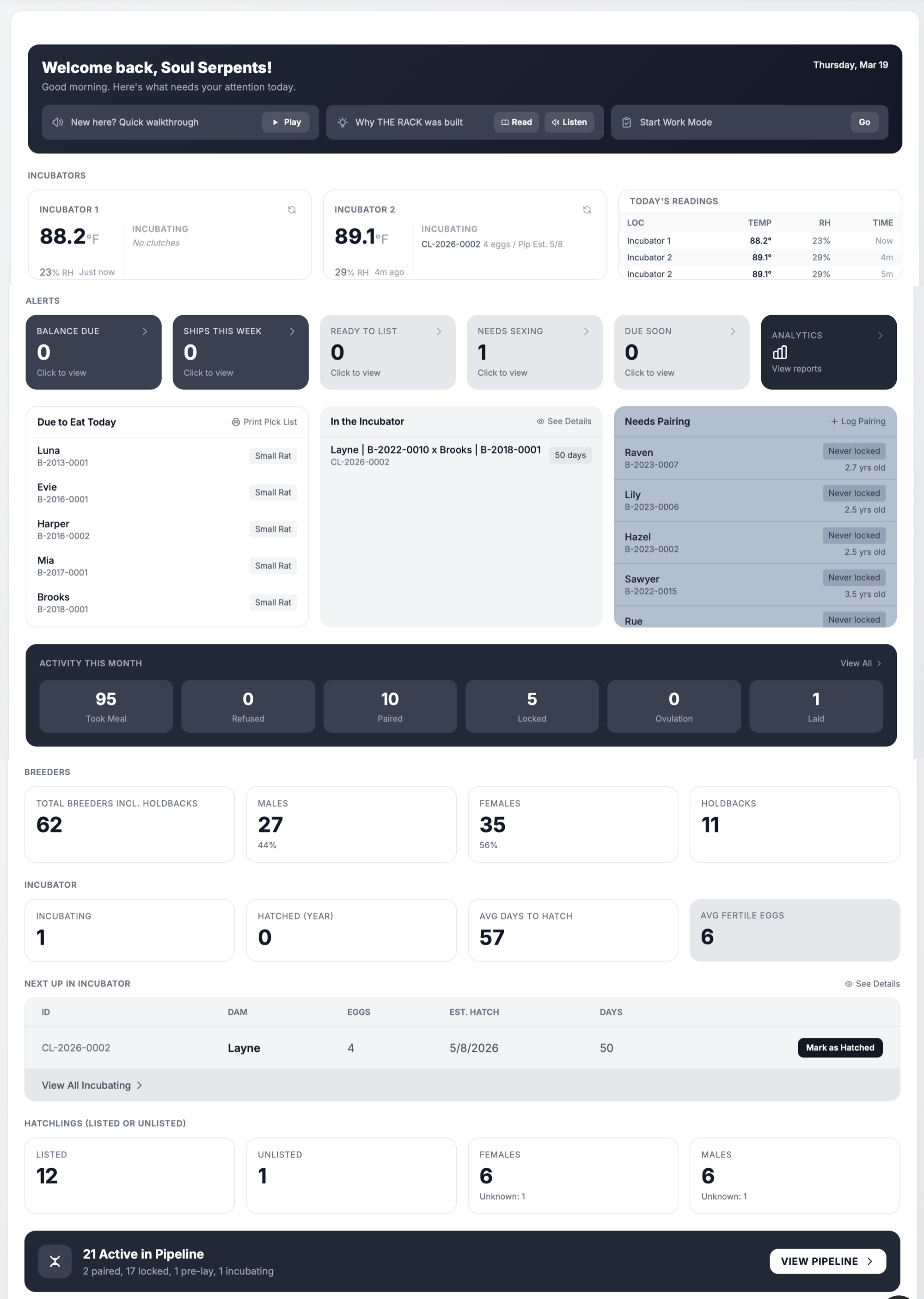
THE RACK's breeding pipeline logs every pairing event, lock duration, and rest interval per male. You see the pattern before the burnout happens.
See Breeding ToolsWhat Happens When You Overbreed a Male
The signs of male exhaustion are subtle at first:
- Slower to lock
- Shorter lock durations
- Less interest in females
- Weight loss despite eating
- Eventual breeding refusal
By the time you notice these signs, the damage is already done. The male needs extended rest. Depending on how hard you pushed him, that rest period might be months.
Meanwhile, you have females ready to breed and no male available. Or you have to use a backup male with inferior genetics. Either way, your production suffers.
The Math That Changes Everything
Say you have a male that can comfortably handle 8 breeding events per season with proper rest intervals. You have 12 compatible females.
Option A: Pair him to all 12 females, hoping for the best. Result: He burns out after female 9. The last 3 females either do not get bred or produce infertile clutches. Total successful clutches: 7-8.
Option B: Pair him to 8 females strategically, with proper rest between each. Result: All 8 females produce fertile clutches. Total successful clutches: 8.
Option A looks more aggressive. Option B produces equal or better results with a healthy male ready for next season.
This is not about being conservative. It is about being strategic. Note: we do not breed a male to more than 4 females in our facility. Limiting the stress of the male, regardless.
Your males are not disposable. Treat them like assets.
What You Should Track
For every male in your collection, you need to know:
- Total breedings this season (count of pairing events)
- Dates of each breeding (to calculate rest intervals)
- Lock success rate (did he lock, or show interest only)
- Duration of locks (longer is generally better for fertility)
- Fertility outcomes (did the pairing produce fertile eggs)
- Weight trends (is he maintaining condition)
This data tells you when a male is approaching his limit before he shows behavioral signs. If his lock durations are getting shorter, he needs rest. If his weight is dropping, he needs recovery time. If his fertility rate is declining, stop pairing him.
The Rotation Strategy
Smart breeders do not rely on a single male. They build male rotations.
If you have 12 females that need a certain gene, you want 2-3 males that carry it. Each male handles 4-5 females with proper rest intervals. All of them stay healthy. All of them are ready for next season.
Yes, this means buying more males. But the math works out. One burned-out male costs you more in lost production than two healthy males cost to acquire.
Think of males as production equipment. You do not run a machine at 100% capacity until it breaks. You run it at sustainable capacity so it lasts.
The Pattern Recognition Problem
Here is what makes male management tricky: every male is different.
I have a male who can breed every 5 days and stay strong all season. I have another male who needs 10 days between pairings or he loses interest.
Without tracking, I would treat them the same. With tracking, I know exactly how to manage each one.
This is the value of data. It reveals individual patterns that generalized advice cannot capture.
The Question You Should Ask
Right now, can you answer this: How many times has each of your breeding males locked this season, and when was their last pairing? If you cannot, you are flying blind.
Building Sustainable Production
Breeding is a long game. The breeders who succeed over 5, 10, 15 years are not the ones who maximize every single season. They are the ones who build sustainable systems.
Sustainable means:
- Males that stay fertile year after year
- Females that recover properly between clutches
- Production levels that match capacity
- Infrastructure that prevents burnout (yours and your animals)
Tracking male health is not extra work. It is the foundation of sustainable production.
Your males are not disposable. Treat them like the valuable production assets they are.
Ready to protect your genetics?
Track Pairings. Monitor Weight.
Prevent Burnout.
THE RACK logs every pairing event, tracks weight trends, and builds breeding history for every male. When the data shows a pattern, you adjust before the damage is done.
See THE RACKContent verified against THE RACK breeding database. Male management data sourced from active breeder programs. Last reviewed April 2026.
Built by a Breeder
Protect Your Males.
Protect Your Season.
Pairing history. Weight trends. Lock tracking. Fertility outcomes. THE RACK gives you the data to manage every male sustainably.
See THE RACKFree for up to 5 animals. Keeper $10/mo. Breeder $20/mo. 7-day money-back guarantee.