
News / Incubation Capacity: The Math That Saves Your S...
Incubation Capacity: The Math That Saves Your Season
- Breeding females x average clutch size = expected eggs. Run this equation before the season starts
- Peak capacity is the point where the most eggs overlap in your incubator at once
- If projected peak exceeds 80% of your incubator capacity, you need more space
- Stagger your pairings to smooth out production flow and reduce peak demand
- Emergency equipment purchases cost three times what planned purchases cost
I had one too many clutches and nowhere to put them. This was not a hypothetical scenario. This was my third breeding season, and I had failed to do basic math. My incubator was full, I had a clutch on the ground, and I was scrambling.
In This Guide
I ended up buying a second incubator at retail price in the middle of the season. Emergency shipping. No time to shop around. That "solution" cost me three times what it would have cost if I had planned ahead.
This is what happens when you do not plan capacity.
The Capacity Equation
Incubation capacity planning is straightforward math that most breeders skip:
Number of breeding females x Average clutch size = Expected eggs
If you have 15 females and they average 6 eggs per clutch, you are looking at 90 potential eggs.
Now look at your incubator. How many eggs can it hold? If the answer is less than your expected egg count, you have a problem.
But here is where it gets complicated: not all females lay at the same time. Eggs hatch and clear out. There is a flow.
The real question is not "how many eggs total" but "what is my peak capacity need?"
Plan your season with real data
Track Every Female's Timeline.
Know When Eggs Hit.
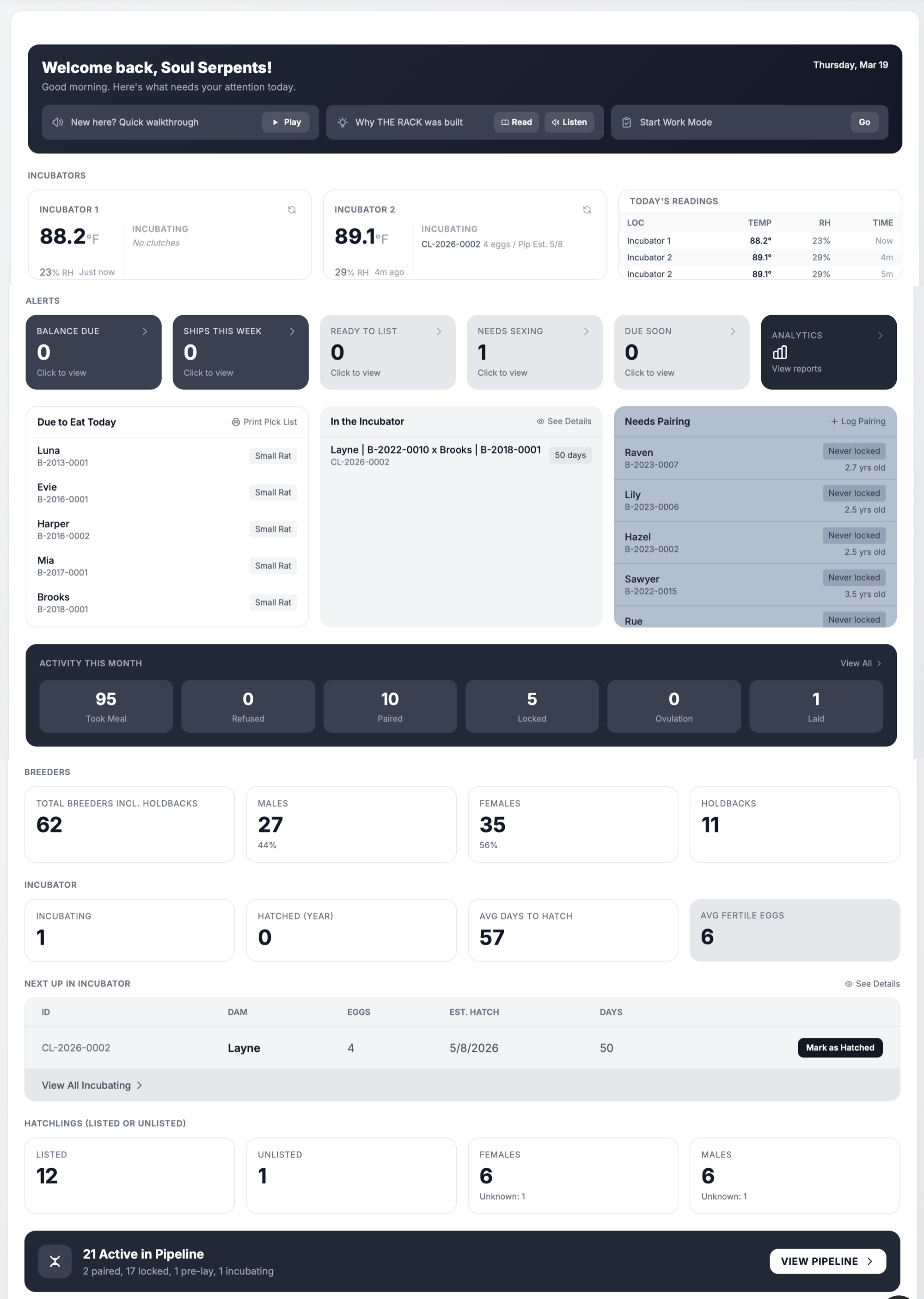
THE RACK's breeding pipeline tracks follicle development, pairing dates, and estimated lay dates. See your full season timeline before the first egg drops.
See Breeding PipelineCalculating Peak Capacity
Eggs incubate for roughly 55-60 days. Females do not all lay on the same day. So your incubator capacity need fluctuates throughout the season.
To calculate peak capacity:
- Estimate lay dates for each female based on her cycle
- Estimate clutch sizes based on her history or averages
- Plot when eggs go IN (lay date)
- Plot when eggs come OUT (lay date + incubation period)
- Find the point where the most eggs overlap
That overlap point is your peak capacity need.
If your peak exceeds your incubator space, you have three options:
- Reduce pairings (fewer eggs)
- Stagger pairings (spread out lay dates)
- Add incubator capacity (buy more equipment)
All three options are fine. But you need to decide BEFORE the season, not when eggs are on the ground.
The Hidden Cost of Poor Planning
When you run out of incubator space mid-season, your options are bad:
Option 1: Maternal incubation. Let the female incubate her own eggs. Success rates drop. The female loses significant body condition. She may not recover in time for next season.
Option 2: Emergency equipment purchase. Buy an incubator at full price with rush shipping. You pay premium. You stress about setup. You hope it works.
Option 3: Find someone to take the eggs. Give eggs to another breeder to incubate. You lose control of the process. You may lose some of the clutch. You owe favors.
Option 4: Lose the eggs. This happens more than people admit. Eggs that do not get proper incubation conditions die.
Every one of these options costs you money, time, stress, or all three. And all of them are avoidable with basic planning.
Hope is not an operations strategy. Math is.
The Staging Strategy
Smart breeders think about incubation in stages:
Stage 1: Early season. First females start laying. Incubator has plenty of room. No stress.
Stage 2: Peak season. Multiple females laying within weeks of each other. Incubator approaches capacity. This is where planning matters.
Stage 3: Hatching begins. Early clutches start pipping. Eggs come out. Space opens up.
Stage 4: Late season. Final females lay. Incubator has room again from early hatches.
If you stagger your pairings strategically, you can smooth out the peaks. Female A gets paired in week 1. Female B in week 3. Female C in week 5. Their lay dates spread out. Your peak capacity need drops.
This is operations management. It is exactly what manufacturing companies do to manage production flow.
The Data You Need
To plan capacity properly, you need to know:
- Number of breeding females this season
- Expected clutch size for each (based on history or estimates)
- Estimated lay date for each (based on follicle tracking)
- Incubation period (typically 55-60 days)
- Total incubator capacity (how many eggs fit)
With this data, you can build a simple timeline. Plot egg-in dates and egg-out dates. Find your peak. Make decisions before you have a crisis.
When to Invest in More Capacity
Here is my rule: if your projected peak is above 80% of your incubator capacity, you need more space.
Why 80%? Because estimates are wrong. Clutch sizes vary. Lay dates shift. You need buffer room for reality.
Running at 100% capacity with zero margin is how emergencies happen.
If you are planning to scale next season, buy the incubator this season. Set it up. Test it. Make sure it holds temperature properly. Do not wait until you need it desperately.
The Planning Test
Can you answer this right now: What is your projected peak incubator need this season, and when will it occur? If you cannot, you are not planning. You are hoping.
The Breeder Who Plans vs The Breeder Who Reacts
Two breeders with identical collections will have completely different experiences based on whether they plan capacity.
The planner knows exactly when peak hits. They have equipment ready. They stagger pairings to smooth production flow. The season runs smoothly.
The reactor scrambles every time something unexpected happens. They buy emergency equipment. They stress about space. They lose eggs they should have saved.
Same genetics. Same potential. Completely different outcomes.
Which one do you want to be?
Stop hoping. Start planning.
See Your Full Season.
Before Eggs Hit the Incubator.
THE RACK tracks every female's cycle, estimates lay dates, and gives you a full-season breeding pipeline view. Plan capacity with real data instead of guesswork.
See THE RACKContent verified against THE RACK breeding database. Capacity planning data sourced from active breeder programs. Last reviewed April 2026.
Built by a Breeder
Plan the Season.
Run the Numbers.
Breeding pipeline. Follicle tracking. Estimated lay dates. Capacity planning with real data from your own facility.
See THE RACKFree for up to 5 animals. Keeper $10/mo. Breeder $20/mo. 7-day money-back guarantee.