
News / Heat Pad vs CHE vs Radiant Heat Panel for Ball ...
Heat Pad vs CHE vs Radiant Heat Panel for Ball Pythons
- Every heat source requires a thermostat. No exceptions. Unregulated heat kills ball pythons.
- Heat pads: Belly heat for digestion. Best for tubs and racks in warm rooms.
- Ceramic heat emitters (CHEs): Raise ambient temps without light. Best for glass tanks and cold rooms.
- Radiant heat panels (RHPs): Even, gentle heat. The professional standard for PVC enclosures and large facilities.
Ball pythons need belly heat for digestion and ambient warmth for overall health. Heat pads, ceramic heat emitters, and radiant heat panels each deliver heat differently, and the right choice depends on your enclosure type, your climate, and your goals. This guide covers all three, plus the one non-negotiable piece of equipment no matter which you choose.
In This Guide
The Non-Negotiable: Use a Thermostat
Every heat source in this guide requires a thermostat. This is not optional. Without a thermostat, a heat pad can exceed 120F. A ceramic heat emitter can turn a tub into an oven. A radiant heat panel can cook the air in a PVC enclosure. Burns, overheating, and death are real outcomes of unregulated heat sources.
A thermostat with a probe placed at the hot spot maintains your target temperature and cycles the heat source on and off automatically. Proportional thermostats (which dim the output rather than cutting it on and off) provide the most stable temperatures, but on/off thermostats work fine for heat pads and CHEs.
Logging your husbandry parameters, including hot side temps, cool side temps, and ambient room conditions, makes it easier to catch drift before it becomes a problem. THE RACK lets you record these parameters per enclosure, so when something looks off with an animal you can go back and check the environment first.
Want to log husbandry parameters for every enclosure?
Temperatures, Humidity, All Logged Per Animal
THE RACK records husbandry parameters per enclosure. When a snake goes off feed or shows stress signs, you check the data before you check the snake.
See Husbandry ToolsHeat Pads (Under-Tank Heaters)
Heat pads sit under the enclosure and warm the floor from below. The snake absorbs heat through direct belly contact, which aids digestion. This is the most common heating method for tubs and rack systems.
How They Work
An adhesive or non-adhesive heat mat attaches to the outside bottom of the enclosure. It creates a warm zone on one end of the floor. The thermostat probe sits on the floor surface inside the enclosure, directly above the heat pad, under the substrate. The thermostat reads the surface temperature and regulates the pad to maintain your target.
Pros
- Belly heat. Direct contact heat for digestion. Ball pythons seek out warm surfaces after eating.
- Low profile. No fixtures, no bulbs, no visible hardware. Ideal for tubs and rack systems.
- Affordable. Heat pads are inexpensive individually and in bulk.
- Long lifespan. No bulbs to burn out. A quality heat pad lasts years.
- Easy to thermostat. A basic on/off or proportional thermostat regulates a heat pad effectively.
Cons
- Does not raise ambient temperature. Heat pads warm the floor, not the air. In cold rooms, the snake has a warm spot to sit on but the ambient air can still be too cold.
- Substrate depth matters. Thick substrate insulates the floor and reduces the effective surface temperature. You need the probe at the surface level, not buried in the substrate.
- Burn risk without a thermostat. Unregulated heat pads can exceed 120F. Thermostat is mandatory.
Best For
Tub and rack setups where room temperature stays above 72-74F. The heat pad handles the hot spot; the room temperature handles the ambient.
Safety Rule
Every heat source requires a thermostat. No exceptions. An unregulated heat source is the fastest way to injure or kill a ball python.
Ceramic Heat Emitters (CHEs)
Ceramic heat emitters screw into a standard light fixture and emit infrared heat without producing visible light. They warm the air and surfaces below them, creating both a hot spot and an ambient temperature increase.
How They Work
The CHE sits in a ceramic-rated dome fixture mounted above or on top of the enclosure. It radiates heat downward. The thermostat probe hangs at snake level (3-4 inches off the floor for terrestrial setups) to regulate the air temperature the snake experiences.
Pros
- Raises ambient temperature. Unlike heat pads, CHEs warm the air in addition to surfaces. This makes them useful in cold rooms or during winter.
- No light. Ball pythons are crepuscular. A heat source not disrupting the light cycle is ideal for 24/7 heating.
- Works with glass tanks. CHEs sit in dome fixtures on screen tops. This is the most common supplemental heat for glass tanks.
- Durable. CHE elements last thousands of hours. No filaments to burn out like heat bulbs.
Cons
- Dries the air. CHEs reduce humidity in the enclosure. In glass tanks with screen tops, this can create a persistent humidity problem. Misting, water bowl placement, and screen modification help offset this.
- Hot to the touch. The ceramic element itself reaches extreme temperatures. It must be in a fixture the snake cannot contact. In tub setups, this means external mounting only.
- Needs a ceramic-rated fixture. Standard plastic light domes will melt. Use a fixture rated for ceramic heat emitters.
- Wattage matching. Oversizing the CHE for the enclosure creates temperature spikes and forces the thermostat to cycle aggressively. Match wattage to enclosure volume.
Best For
Glass tanks and PVC enclosures, especially in rooms where ambient temperature drops below 72F. Good as supplemental heating alongside heat pads in cold climates.
Heat is a tool. A thermostat makes it safe.
Radiant Heat Panels (RHPs)
Radiant heat panels mount to the ceiling of an enclosure and emit even, gentle infrared heat downward. They are the premium heating option and the standard in professional-grade PVC enclosures and larger rack systems.
How They Work
An RHP is a flat panel, usually made of fiberglass or composite material with a heating element inside. It mounts flush against the enclosure ceiling with screws or brackets. The surface temperature of the panel stays low enough for a snake to touch it without burning, but it radiates consistent warmth across a wide area.
Pros
- Even heat distribution. RHPs heat a broader area than heat pads or CHEs. The entire warm end of the enclosure gets consistent warmth, not a concentrated hot spot.
- Gentle on humidity. RHPs dry the air less than CHEs because they operate at lower surface temperatures.
- Safe surface temperature. The panel itself stays warm but not hot enough to burn. Snakes can make contact without injury.
- Long lifespan. High-quality RHPs last for many years with zero maintenance. No bulbs, no elements to replace.
- Professional standard. Most high-end PVC enclosures and commercial rack systems use RHPs.
Cons
- Cost. RHPs are the most expensive option per unit. Outfitting a large rack system adds up.
- Requires mounting. You need to install the panel on the enclosure ceiling. This is straightforward in PVC but more involved in glass tanks (where RHPs are rarely used).
- Slower response time. RHPs take longer to reach operating temperature than heat pads or CHEs. The tradeoff is more stable, consistent heat once they are running.
- Overkill for simple setups. A single pet ball python in a tub with a heat pad does not need an RHP. The cost is not justified for basic setups.
Best For
PVC enclosures, large rack systems, and professional breeding facilities. If you want the best temperature stability and the lowest humidity impact, RHPs are the answer.
Which Heating Method Should You Use?
- Tub in a rack (warm room): Heat pad with a thermostat. Simple, effective, affordable.
- Tub in a rack (cold room): Heat pad for belly heat plus room heating (space heater on a thermostat) or upgrade to RHPs in the rack.
- Glass tank: Heat pad underneath for belly heat. CHE on the screen top for ambient. Both on thermostats.
- PVC enclosure: RHP mounted to the ceiling or heat pad underneath. Many PVC enclosures come with RHP mounting hardware built in.
Combining heat sources is common and often necessary. A heat pad for belly heat plus a CHE or RHP for ambient gives you the best temperature gradient. The key is thermostats on every heat source.
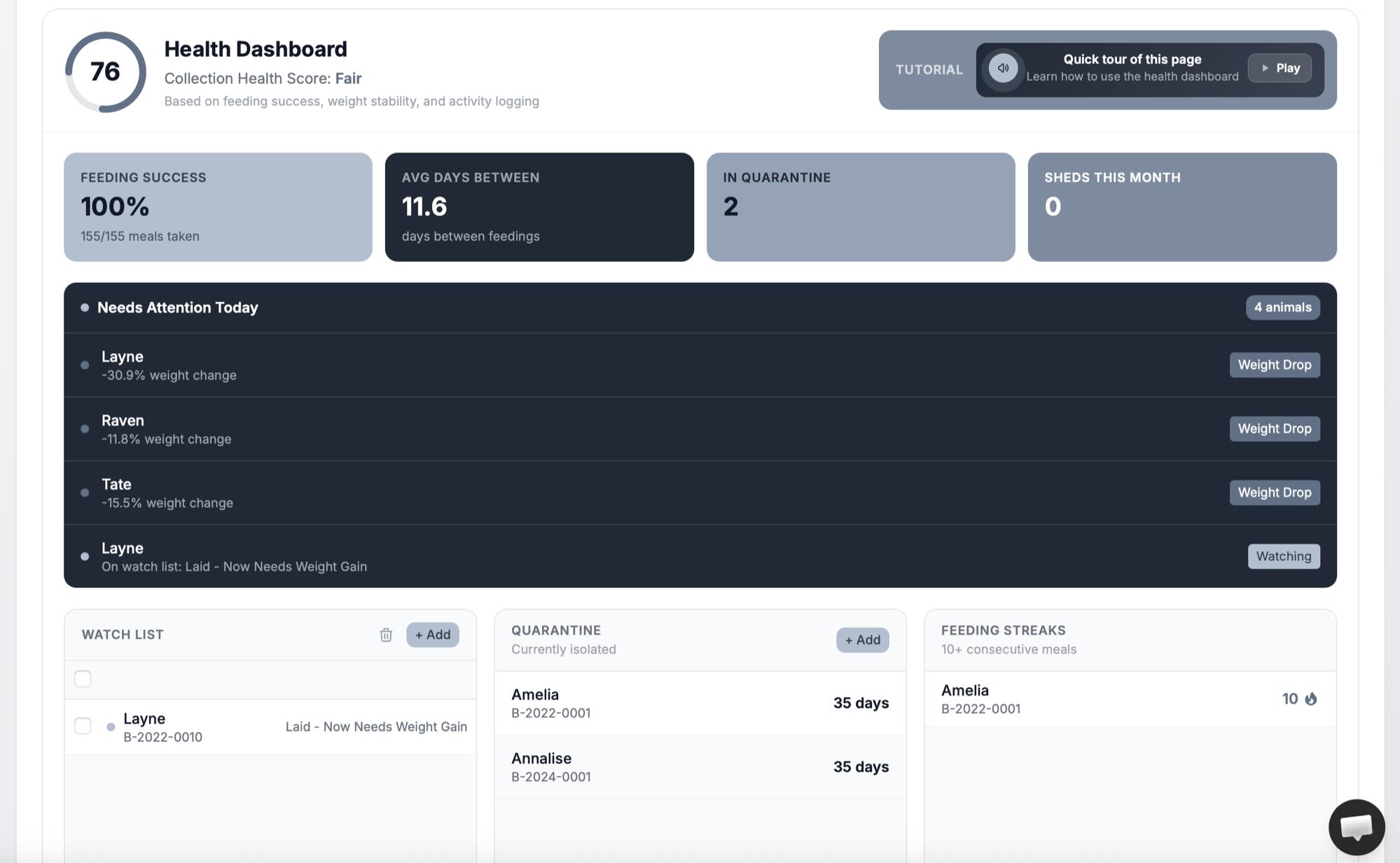
Want husbandry data for every enclosure in one place?
Log Temps. Log Humidity. Spot Problems Early.
THE RACK records husbandry parameters per enclosure. When something changes, the data shows you where to look first.
See Husbandry ToolsTarget Temperatures
Regardless of which heat source you use, the target ranges for ball pythons are:
- Hot side (surface): 88-92F
- Cool side: 76-80F
- Ambient (air at snake level): 78-82F
- Night drop: A 2-4F drop at night is fine. Below 74F is too cold.
Use an infrared temperature gun for surface readings and a digital thermometer with a probe for ambient readings. The thermostat probe and your measuring tool should agree. If they do not, recalibrate or reposition the probe.
Thermostat Recommendation
A proportional thermostat provides the most stable temperatures by dimming the heat source gradually instead of cycling it on and off. Worth the investment for any setup.
Content verified against THE RACK breeding database. Temperature ranges and husbandry parameters sourced from active breeder programs. Last reviewed April 2026.
Built by a Breeder
Husbandry Data,
Per Enclosure, Always
Temperature logs. Humidity records. Equipment notes. Maintenance schedules. THE RACK ties husbandry data to every enclosure so you can catch problems before they cost you.
See THE RACKFree for up to 5 animals. Keeper $10/mo. Breeder $20/mo. 7-day money-back guarantee.