
News / Building a Multi-Year Ball Python Breeding Roadmap
Building a Multi-Year Ball Python Breeding Roadmap
- Quad-recessive visuals can take four to five years of deliberate pairing to produce. A roadmap prevents wasted seasons.
- Phase one builds the het pool. Foundation pairings create double-het offspring that feed every future step.
- Hold back females aggressively because they control the program's direction. Males must justify their place.
- Document every clutch and holdback decision. The data from early phases shapes every decision in later phases.
- The breeders who produce the best animals planned the outcome before the first egg was ever laid.
A multi-year breeding roadmap turns scattered pairings into a focused program. Instead of reacting to what hatches each season, a roadmap defines the destination and works backward. Every holdback, every pairing, and every sale connects to a defined genetic goal years in the future.
In This Guide
Why a Roadmap Matters
Recessive projects cannot be rushed. A quad-recessive visual can take four to five years of deliberate pairing to produce. Without a roadmap, breeders make decisions season by season and lose sight of the long-term goal. With one, every animal in the program has a defined role.
A roadmap answers the core questions before each season begins: which animals pair, which offspring stay, which move on, and what the next generation needs to produce.
THE APPROACH
Define the end goal first. Build backward from the target combination. Every season's pairings should feed the next step in the roadmap.
Phase One: Early Foundations
The first year establishes the genetic base. Foundation pairings create the double-het offspring that feed every future step. This is the phase where patience matters most because the results are invisible. Double hets look like normal ball pythons, but they carry the recessives that make everything possible later.
Focus on pairing proven animals with complementary genetics. Each clutch should produce offspring carrying at least two of the target recessives as hets. The goal is building a deep pool of genetically loaded animals, not hitting visuals yet.
Phase Two: Foundation Year
The second phase expands the het pool and starts producing visual carriers. Pairing double hets together gives the first chance at single-recessive visuals while also producing triple hets that become the backbone of future work.
This is where documentation becomes critical. A genetics calculator shows the probabilities for each pairing. Breeding logs track which combinations produce the strongest visuals. The data from this phase shapes every decision in phase three.
Phase Three: Triple Recessive Expansion
By the third phase, the focus shifts from stacking hets into real triple-recessive work. Visual combinations of three target genes begin appearing in clutches. Holdback females from this phase become the foundation for the final push.
The target is four to six strong triple-recessive females held back for the next season. These animals carry three of the four target genes visually and often carry the fourth as a het. They are the most valuable animals in the program at this stage.
Think in generations, not seasons.
Phase Four: Quad Project Development
The best holdbacks from earlier phases combine all four recessives in planned pairings. Triple visuals become standard output in flagship clutches. Quad-het depth grows to support multiple attempts at the target combination.
This is when the math gets serious. Quad-het pairings produce the target quad-recessive visual at roughly 1 in 256 odds per egg. Large clutch numbers and multiple pairings increase the probability of hitting the goal in any given season.
Phase Five: Full Expression
The final phase centers on full expression of the quad-recessive project. The target combination appears consistently across multiple pairings, backed by years of selective holdbacks and documented testing.
At this stage, the program has a signature line. Every animal that carries the full combination represents the culmination of a multi-year plan executed with discipline.
Plan your breeding roadmap with data
Plan Every Pairing.
Track Every Generation.
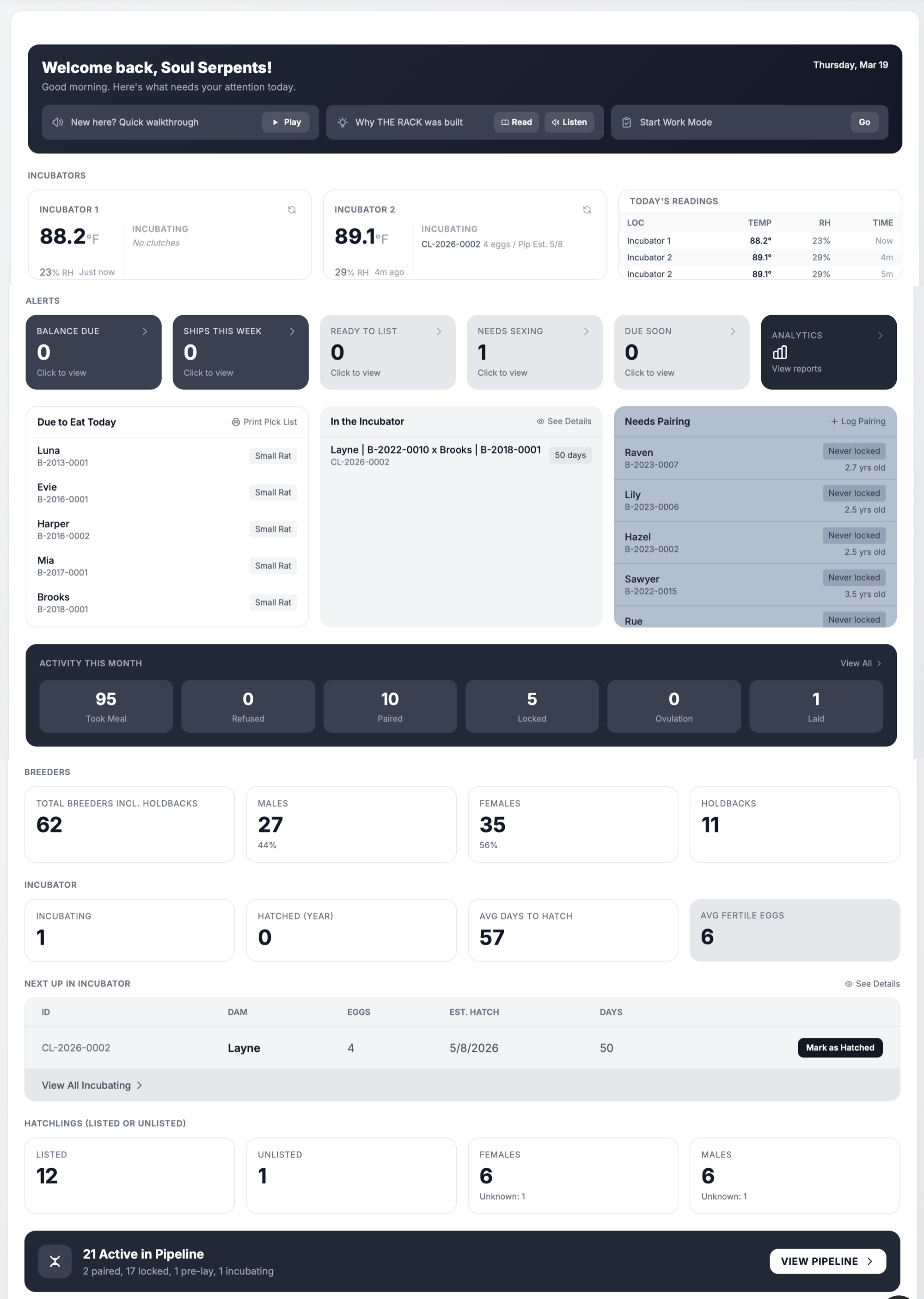
THE RACK connects pairings to offspring, tracks lineage across seasons, and documents every step of a multi-year breeding program. Facility management software built by a breeder.
See THE RACKHow to Build Your Own Roadmap
- Define the target combination before buying the first animal
- Map backward from the goal to identify which foundation animals are needed
- Plan each season's pairings to produce the next phase's building blocks
- Hold back females aggressively because they control the program's direction
- Document every clutch, every holdback decision, and every sale
- Review and adjust the roadmap annually based on results
The breeders who produce the best animals in the industry all share one trait: they planned the outcome before the first egg was ever laid.
THE LONG GAME
A roadmap turns hope into strategy. Every season feeds the next. Every holdback moves the project forward. That is how signature lines are built.
Content verified against THE RACK breeding database. Multi-year project planning and genetics data sourced from active breeder programs. Last reviewed April 2026.
Built by a Breeder
Plan the Program.
Build the Legacy.
Breeding logs. Lineage tracking. Genetics calculator. Offspring records. The facility management software that turns a multi-year roadmap into documented results.
See THE RACKFree for up to 5 animals. Keeper $10/mo. Breeder $20/mo. 7-day money-back guarantee.