
News / Essential Items for Your Ball Python
Essential Items for Your Ball Python
- A thermostat is the most important piece of equipment you will buy. Never run a heat source without one.
- Proper thermal gradient: 80F cool side, 88-90F warm side. Ball pythons thermoregulate by moving between zones.
- Two hides minimum. One warm, one cool. Security at every temperature is non-negotiable.
- Start documenting feeding, sheds, and weight from day one. Patterns emerge faster when the data is there.
Every ball python deserves a setup that covers its basic needs from day one. The right equipment creates stability, and stability is what keeps a ball python healthy, feeding, and shedding clean. This guide covers every essential item, why it matters, and how to choose the right option.
Enclosure
Choose an enclosure that matches the size of the snake. Hatchlings do well in smaller tubs or 20-gallon tanks. Adults need enclosures approximately 4 feet by 2 feet. Glass terrariums, PVC enclosures, and plastic tubs all work when the parameters are correct.
Security is critical. Ball pythons are strong and curious. Use secure locking mechanisms on any enclosure. Sliding doors are preferred over screen tops, which can cause humidity loss and create escape opportunities.
Heating Equipment
Ball pythons require a warm environment to digest food and maintain their metabolism. Ceramic heat emitters provide warmth without light, making them ideal for maintaining temperature around the clock. Under-tank heat tape works well in rack systems.
The goal is a thermal gradient: ambient temperature near 80 degrees Fahrenheit on the cool side and 88 to 90 degrees on the warm side. Ball pythons thermoregulate by moving between zones. Without a proper gradient, digestion and immune function suffer.
CRITICAL RULE
Never use a heat source without a thermostat. Burns are preventable. A thermostat is the most important piece of equipment you will buy.
Thermostat
A thermostat regulates the heating element to maintain a set temperature. It prevents overheating, which can cause burns and death. Digital thermostats with alarm features provide the most reliable control and peace of mind.
Place the probe directly on the heat source surface. Verify readings with a separate temperature gun. Trust the probe, verify with the gun.
Hides and Enrichment
Provide at least two hides: one on the warm side and one on the cool side. Ball pythons need to feel secure at any temperature zone. Sturdy hides made of ceramic, wood, or plastic work well.
Enrichment matters for overall well-being. Fake plants, live plants, branches, and climbing structures create a stimulating environment. The key is providing enough options that the snake can interact with its space naturally.
Substrate
Coconut fiber and forest floor blends retain humidity well for display enclosures. Paper or reptile liners work best for rack systems because they show waste and shedding immediately.
Avoid cedar, pine, and any scented or dusty substrate. These irritate respiratory systems and create unnecessary health risk.
Good equipment is cheap insurance.
Water Bowl
A heavy, tip-proof bowl large enough for the snake to soak in is essential. Replace water daily with fresh, clean water. Sanitize the bowl weekly. Proper hydration supports clean sheds and overall health.
Thermometer and Hygrometer
Accurate temperature and humidity monitoring is non-negotiable. Digital thermometers and hygrometers provide reliable readings. Avoid stick-on analog gauges. Ball pythons can pull them off walls and get stuck to the adhesive.
WiFi-connected devices allow remote monitoring and send notifications when temperature or humidity drifts outside the safe range. That visibility prevents problems before they become emergencies.
Lighting
Ball pythons do not require UVB lighting, but a consistent day and night cycle supports natural behavior. Low-wattage LEDs on a 12-hour timer create a gentle rhythm. Avoid bright overhead lights. Red lights should not be used.
Feeding Tools and Cleaning Supplies
Long feeding tongs prevent accidental bites during feeding. A reptile-safe disinfectant like chlorhexidine keeps enclosures clean. Keep separate cleaning gloves, paper towels, and a small dustpan for routine maintenance.
Logging every feeding, shed, and weight measurement from day one creates a complete health record that reveals patterns over time. When something changes, the data shows why.
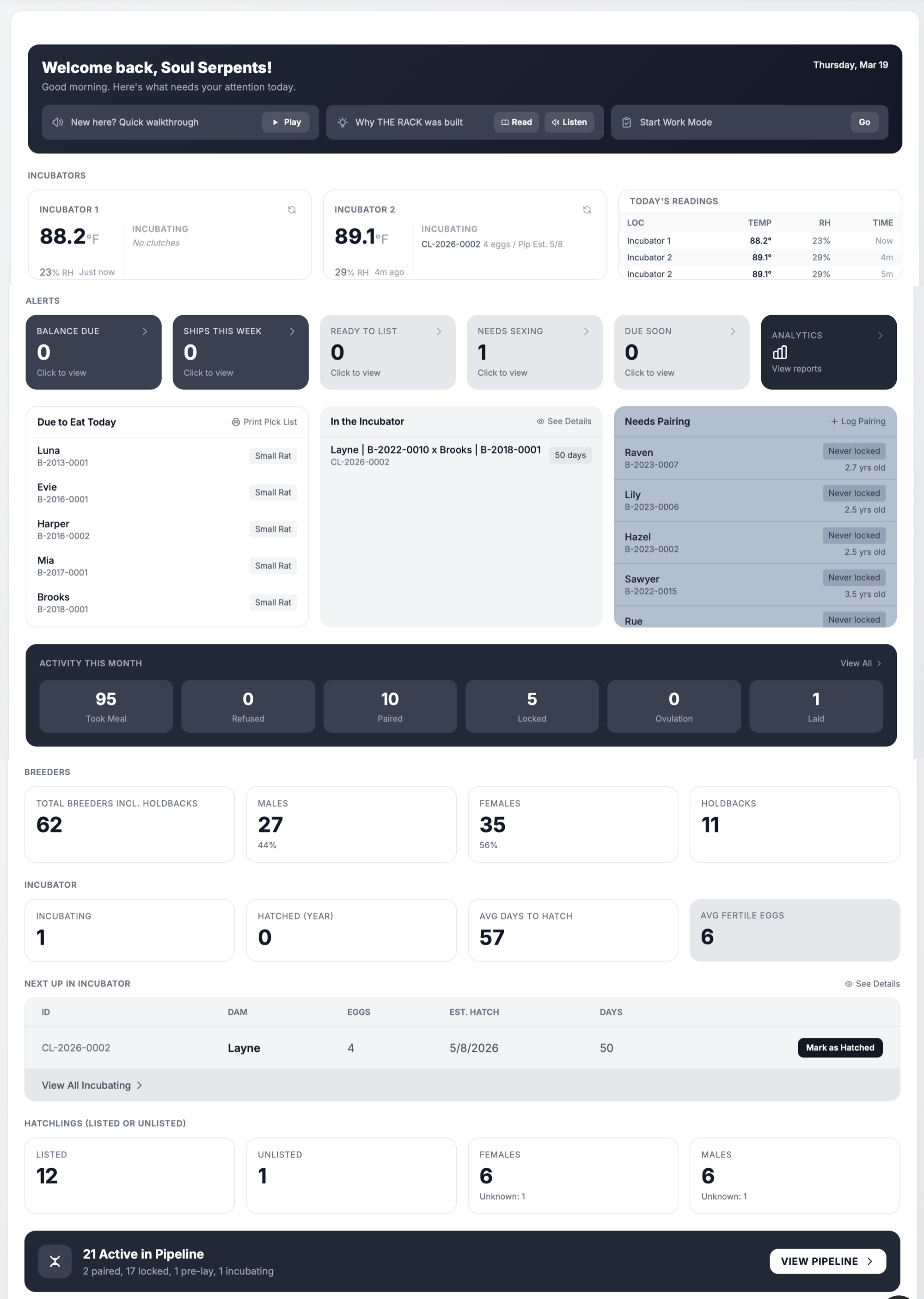
Want this exact system for managing your collection?
Every Feeding Logged.
Every Shed Tracked.
THE RACK manages feeding schedules, weight trends, shed cycles, and health records for every animal. One system. Complete visibility.
See THE RACKThe Complete Checklist
- Enclosure sized to the snake with secure locks
- Ceramic heat emitter or heat tape
- Digital thermostat with probe
- Digital thermometer and hygrometer
- Two hides, one warm side and one cool side
- Heavy water bowl
- Appropriate substrate
- LED light strip on a 12-hour timer
- Feeding tongs
- Reptile-safe disinfectant
- Spray bottle for humidity control
GETTING STARTED
Buy the right equipment once. Cheap shortcuts cost more in vet bills and lost animals. Invest in the setup and the snake takes care of the rest.
Built by a Breeder
Start Right.
Stay Organized.
Feeding logs. Shed tracking. Weight trends. Health records. The system that grows with your collection from day one.
See THE RACKFree for up to 5 animals. Keeper $10/mo. Breeder $20/mo. 7-day money-back guarantee.