
News / Ball Python Breeding Season Preparation Guide
Ball Python Breeding Season Preparation Guide
Breeding season does not start when you introduce the first male to a female. It starts months earlier, when you begin assessing which animals are ready, which need more weight, which pairings align with your project goals, and whether your facility is set up to handle the workload. The breeders who prepare well produce more clutches, lose fewer eggs, and enter the season with a plan instead of reacting to what happens.
Preparation is the difference between a season that runs smoothly and one that stalls because a female was not heavy enough, a male was not rested, or the pairing plan existed in your head instead of on paper where it could be referenced, adjusted, and tracked.
Assessing Your Breeders
Not every animal in your collection is ready to breed. Readiness depends on age, weight, health history, and recovery from the previous season. Assess every potential breeder before the season begins.
Female Readiness
Female ball pythons reach breeding maturity at approximately 36 months (3 years). Age alone is not the benchmark. Weight is the deciding factor. A female who is 36 months old but underweight is not ready. A female who hit breeding weight at 30 months could be closer than her age suggests, but most breeders wait until she has hit target weight and maintained it through a full feeding cycle to confirm she is in condition.
Review her feeding history. Has she been eating consistently? Any prolonged refusals? Check her weight trend over the past several months. A steady upward trend indicates she is gaining well. A flat line or a drop means she needs more time before pairing.
If she bred last season, assess her post-season recovery. Did she regain her pre-breeding weight? How long did it take? Females who did not fully recover are at higher risk for smaller clutches, higher slug rates, or failed reproduction entirely.
Male Readiness
Male ball pythons reach breeding maturity at approximately 8 months. Most breeders wait until males are closer to 12 to 18 months and at a healthy weight before using them in pairings. A male who is too young or too light will not lock consistently, and overworking a young male in his first season can set him back for the following year.
Check each male's weight and condition. Males lose weight during breeding season because they stop eating when focused on breeding. A male entering the season underweight has no margin. Record his pre-season weight so you have a baseline to compare against during the breeding period. If he drops below a safe threshold, pull him from rotation before he crashes.
Pre-Season Assessment
Every breeder weighed. Every weight trend reviewed. Every recovery from last season confirmed. The season starts with data, not assumptions.
Cooling: an option, not a requirement
Some breeders use a cooling period to trigger reproductive behavior in their ball pythons, typically dropping nighttime temperatures starting in November or December and running through January or February. Other breeders produce consistent clutches without ever cooling. This is a tool in the toolbox, not a mandatory step.
If you choose to cool
The common approach is to drop nighttime ambient temperatures to 72 to 75 degrees Fahrenheit while maintaining daytime hot spots at their normal range. Some breeders drop to 70 degrees at night. The specific temperature matters less than consistency. Pick a target, hold it for the duration, and document the conditions.
Cooling usually runs 6 to 8 weeks. Some breeders go longer; some go shorter. Track start date, end date, and nighttime temperatures. This is the kind of data that becomes useful when you compare clutch production across seasons and can correlate results with cooling protocols.
Feeding during and after cooling
Males often stop eating during cooling. This is normal breeding behavior. Do not force feed. Do not panic. Document the date feeding stopped and continue offering at regular intervals. When he starts eating again, log it.
Females should continue eating through cooling if offered. Some will refuse as breeding behavior kicks in. Track all refusals during this period. A female refusing during cooling is likely entering breeding mode. A female refusing outside of cooling is a different signal that needs attention.
Getting animals back on feed after breeding duties is as important as preparing them for the season. When warming back up, start with a prey item one size smaller than normal. Offer every 5 to 7 days. If a female refuses, leave the food overnight and remove it the next morning. Most females accept a meal within two weeks of warming up. Males who fasted through the breeding season need the same gradual reintroduction. Track every offer and every refusal so you can see the recovery curve forming in your feeding logs.
Breeding season is won or lost in the months before the first pairing.
Building Your Pairing Plan
A pairing plan is the blueprint for the season. It answers: which males go with which females, in what order, and toward what genetic goals. Building this plan before the season starts prevents scrambling, reduces wasted pairings, and keeps your breeding projects on track.
Genetics-Driven Pairings
Every pairing should have a purpose. "Let's see what happens" is not a breeding strategy. Review your project goals. What morphs are you working toward? Which animals in your collection move you closer to those targets?
A genetics calculator shows the probability outcomes for any pairing before you commit. If you are working a het Clown project, running the numbers tells you the statistical odds of producing visuals. If the odds are low, you might decide to use the female in a different pairing that moves a different project forward more efficiently.
Male Allocation
A single male can service multiple females, but there are limits. Overworking a male leads to weight loss, reduced lock rates, and higher slug rates in the clutches he produces. Before the season starts, assign each male to his females and schedule the rotation. Spreading males across too many females means none of them get the attention they need.
Track how many females each male is assigned to. If a male is paired with five females, he needs adequate rest between pairings. A pairing tracker that shows male workload prevents overuse before it becomes a problem.
The Pairing Schedule
- Priority pairings first. Your most important genetic projects get paired earliest in the season when males are fresh and females have the longest window.
- Backup males identified. If a male will not lock with a specific female after multiple attempts, who is the backup? Have this planned before you need it.
- Timeline documented. When are you introducing each pair? How many introductions per week? When do you move to the next female in the rotation?
The Pairing Plan
Every male assigned. Every female paired to a project goal. Backup males identified. The plan should exist before the first introduction.
Facility Preparation
Your facility needs to be ready before the season creates demand. Waiting until a female is gravid to set up lay boxes is too late.
Incubator Setup
If you are using an incubator, it should be running and calibrated before the first clutch is possible. Set your target temperature, verify it holds, and let it run empty for at least a week to confirm stability. Thermostats fail. Heat tape shifts. Discovering this when you have eggs in the incubator is the wrong time to find out.
Lay boxes (if you use them)
Some breeders provide a lay box filled with damp sphagnum moss or perlite. Others let the female lay directly in her enclosure. If you use lay boxes, have them prepared and on standby. Pre-lay shed to egg laying is typically 14 to 21 days. When you see the pre-lay shed, the box goes in. Having boxes ready to deploy means you do not scramble when a female sheds unexpectedly early.
Supply Inventory
- Rodents. Breeding season means higher demand. Make sure your feeder source can handle increased volume. Running low during peak season means underfeeding animals when they need it most.
- Substrate. Incubation substrate needs to be on hand before the first clutch drops.
- Egg containers. Clean, prepped, and ready to receive clutches.
- Bin tags and labels. When hatchlings start arriving, you need to label them immediately. Having bin tags printed and ready prevents identification errors during the chaos of hatch day.
Records That Drive the Season
Everything above depends on accurate, accessible records. Pre-season assessment requires weight history. The pairing plan requires genetics data and last season's clutch results. Tracking the season requires a system that connects pairings to clutches to hatchlings.
Facility management software built for breeding consolidates all of this into one system. Your breeding pipeline shows where every female sits in the cycle. Your dashboard surfaces what needs attention today. Your breeding records link pairings to clutches to hatchlings automatically.
Walking into the season with scattered records across notebooks, spreadsheets, and phone apps means spending time searching for information instead of acting on it. Walking in with everything connected in one system means you manage the program instead of chasing data.
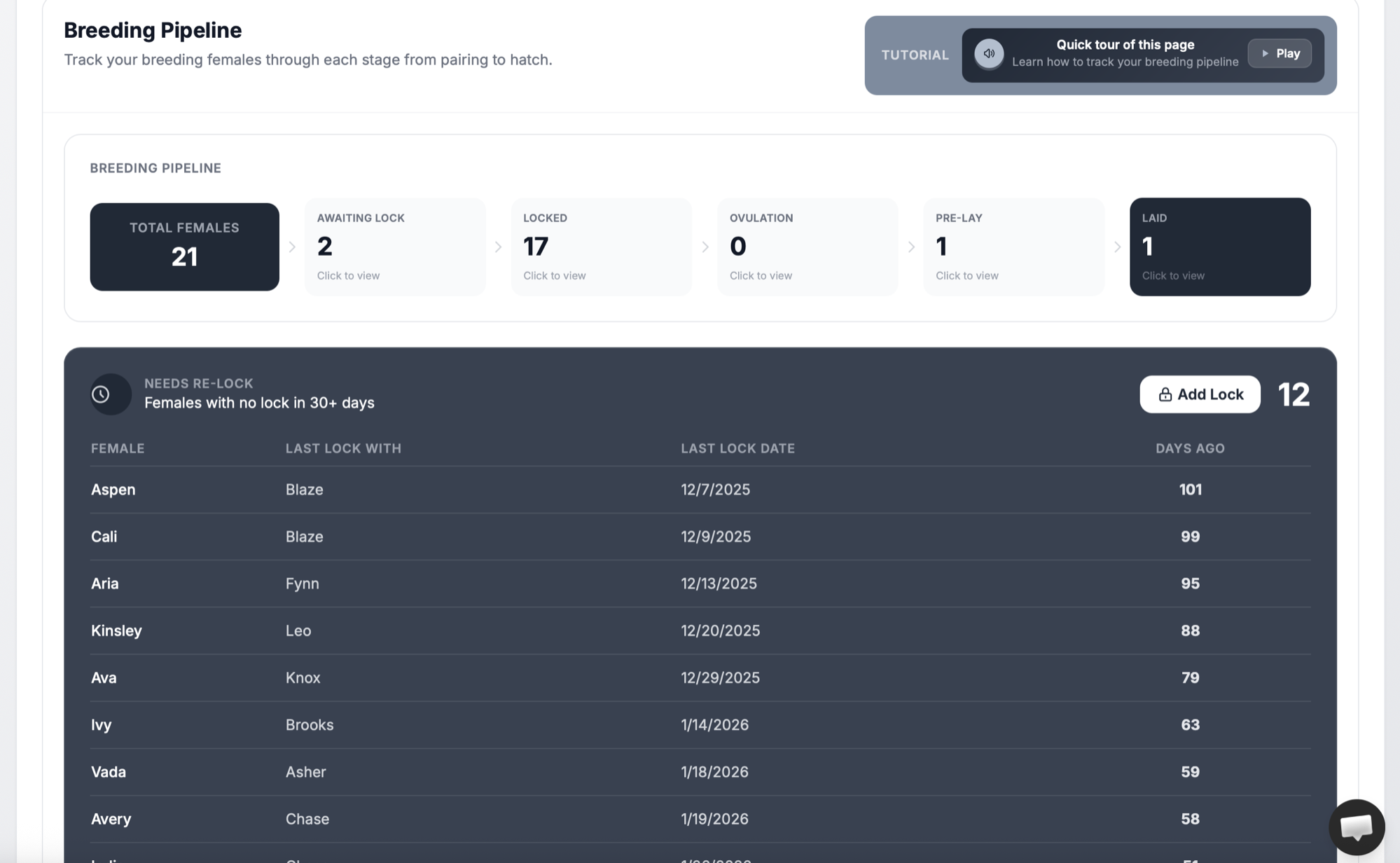
Want this exact pipeline for your breeding season?
Every female. Every stage. One view.
THE RACK's breeding pipeline tracks every female from pairing through laying. See who needs a lock, who is ovulating, and who is about to lay. All in one view built for breeding season.
See THE RACKThe Pre-Season Checklist
Start this process at least 8 weeks before your first planned pairing.
- Weigh every breeder. Record baseline weights for all males and females entering the season.
- Review weight trends. Confirm females are at or above target weight with an upward trend. Confirm males are in good condition with margin to lose weight safely.
- Assess recovery. Any animal that bred last season should have fully regained pre-breeding weight.
- Build the pairing plan. Males assigned. Females paired to genetic goals. Rotation scheduled. Backup males identified.
- Run the genetics. Use a calculator to confirm offspring probabilities for every planned pairing.
- Calibrate the incubator. Running and verified stable at least one week before it is needed.
- Prepare lay boxes (if you use them). Ready to deploy the moment a pre-lay shed is observed. If you do not use lay boxes, confirm your enclosure humidity setup is dialed in.
- Check supply inventory. Rodents, substrate, egg containers, bin tags.
- Get your records in order. One system. Every animal. Every log. Every plan. Accessible from anywhere.
Breeding season rewards preparation. The breeders who do this work before the first introduction are the ones who finish the season with more clutches, healthier animals, and data that makes next season even better.
Built by a Breeder
Ready for
breeding season.
Breeding pipeline. Weight trends. Genetics calculator. Pairing tracker. Clutch management. THE RACK was built for the entire season; from prep to pip.
See THE RACKFree for up to 5 animals. Keeper $10/mo. Breeder $20/mo. 7-day money-back guarantee.